A suburban office park in Chester County is getting converted to apartments. Is it a sign of things to come?
The suburbs have been lagging Philadelphia in replacing vacant offices with housing.
When COVID-19 pushed many professionals to work from home, empty buildings across the country showed that the United States had too much office space.
At the same time, the nation also had too few homes. Some real estate experts saw an opportunity to take advantage of the crisis in commercial real estate to produce more housing. Vacant office buildings could be transformed into apartments or, in some cases, razed to make way for new development — especially in high-demand suburban areas.
But six years later, some sprawling campuses in suburbs like Horsham, Plymouth Meeting, and Wayne have soaring vacancies — and there are only a couple suburban conversions underway.
Developers agree that the primary challenge is the buildings themselves, which have more difficult floor plans for residential development than their urban counterparts, making demolition easier than conversion in many cases.
“Transforming an office building tucked inside a suburban office park is a completely different equation than converting a building on Walnut Street steps from Rittenhouse Square,” said Sarah Maginnis, executive director of the Philadelphia chapter of the Commercial Real Estate Development Association. “Location, context, and building design all matter a lot.”
The lack of suburban office redevelopment is partly due to the fact that many of the highest-vacancy buildings are in remote, less desirable corners of the region. The patchwork quilt of hyperlocal zoning regulations across dozens of municipalities is a challenge, too, as builders have to negotiate with officials on almost every project.
“A lot of townships are fighting residential development because it comes with burdens on the school systems. Office buildings don’t do that,” said Glenn Blumenfeld, principal with Tactix Real Estate Advisors. “Zoning is more liberal in the cities [which is why residential conversion] has not come to the suburbs.”
Architectural challenges of conversion
Most suburban office buildings date to an era when office and residential structures began to look very different from each other.
When office work began to move into undeveloped land surrounding cities in the mid-20th century, developers generally built out instead of up, taking advantage of the abundant space. Almost everyone commuted by car, so vast parking lots were required.
Suburban office buildings often have a lot of dark interior space. The windows that do exist mostly cannot be opened because of ubiquitous air-conditioning. The parking lots that wreath the buildings make for unsightly and dull vistas.
In large rectangular glass buildings, residential conversion would entail what longtime suburban developer Eli Kahn calls “bowling-alley-shaped apartments … that just don’t work.”
“In the city, a 30-story office tower doesn’t look a whole lot different from an apartment building,” said Kahn, president of E. Kahn Development Corp.
An exceptional suburban conversion
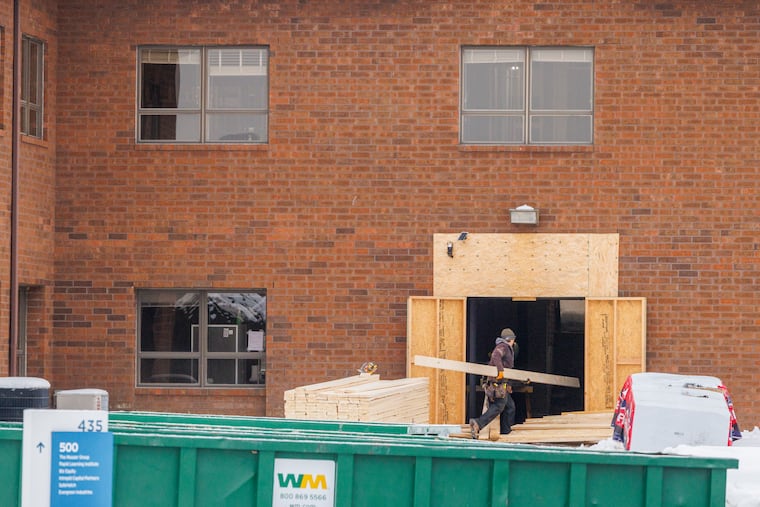
The redevelopment of an eight-building office complex at 435 Devon Park Dr. in Chester County’s Tredyffrin Township is one of the only suburban office-to-residential conversions underway right now.
Notably, none of its former office structures are big glass rectangles.
“This just happened to be perfect for conversion,” said Mark Thomson, founder of Love Communities, which is developing the project in partnership with E. Kahn Development Corp. and Triple Crown Corp.
“It’s going to be the largest garden-style suburban conversion in the whole Northeast, maybe even a bigger area than that,” Thomson said.
Kahn also is part of the team behind the conversion of 435 Devon Dr., and he developed the complex when it was built in the 1980s.
This office park broke from the standard big glass box model of suburban offices and instead offered two-story, L-shaped buildings with brick facades and windows that open.
That makes conversion cheaper, too. To make those big box buildings livable, the glass facade would need to be torn off and windows installed that actually open.
“The most expensive part of construction is the windows,” Thomson said. “If we had to do that, it would probably make this not economically feasible.”
The project is also able to move forward because it accords with the goals of local political leadership, who are wary of family-size apartments.
The 162-unit office-to-residential project will be largely composed of studio and one-bedroom apartments in an attempt to appease concerns about strains on the school district and to produce unsubsidized affordable housing in this wealthy township.
Zoning rules everything
In many suburbs, building apartments, townhouses, and other more modestly scaled housing is often not allowed by zoning laws. Office parks are usually zoned to exclude residential development.
That’s a sharp contrast with Philadelphia, which has few barriers to office-to-residential conversion in Center City, and a citywide 10-year property tax abatement is available for building renovations. Wilmington also offers a variety of incentives.
In Tredyffrin, officials were opposed to the idea of either very high density apartments — at almost 10 acres, the site could support hundreds of units — or new single-family homes.
So to make 435 Devon Park Dr. work, the developers knew they couldn’t demolish the buildings and construct new homes.
Instead, the developers pitched the conversion not as luxury apartments, but as affordable homes for nurses, teachers, and other middle-income workers in Tredyffrin. They also plan to convert some parking lots into green space for residents.
The units can be priced more affordably because of the relatively small scope of the conversion and because the developers essentially purchased the campus for its land value.
Working in partnership with Triple Crown Corp. also helps because the company has in-house contractors and architects.
The paucity of multi-bedroom units lowers rental costs, too, and assuages fears about overburdening schools.
“None of these communities have made it easy like Philadelphia, because they’re all their own fiefdoms,” Kahn said. “But if you make the right argument and you show them how it’ll benefit them financially, they generally come around.”
The future of (some) suburban offices
There are few other conversion projects underway in Philadelphia’s suburbs.
Keystone Property Group has a more traditional office-to-apartment tower in the works at the Plymouth Meeting Mall. The Parkview Tower next to the Valley Forge casino was considered for conversion last year. The Buccini Pollin Group is weighing a conversion project at BNY Mellon’s old headquarters in Bellevue State Park, north of Wilmington, and is looking at opportunities in the Pennsylvania suburbs.
But it is more common for developers to consider demolishing old office buildings to make way for something new.
In Chester County’s East Whiteland Township, which contains the Great Valley Corporate Center, office-to-residential conversion proposals have met a chilly reception.
“The proposals to rezone large vacant office buildings for direct conversion to apartments were really viewed negatively,” said Scott Lambert, chairman of the East Whiteland Township Board of Supervisors. The plans were seen as “short-term fixes that created long-term challenges.”
East Whiteland’s government looked more kindly on Tripoint Properties’ proposal to demolish a standalone office building at 52 Swedesford Rd. — outside the corporate center — and replace it with 250 apartments.
The vacant office building is surrounded by four-lane roadways, which eased congestion concern. Developers also proposed mostly small apartments, with 30 rented for below market rate, which helped earn support from the township.
“On the school side, they were OK with limiting the units to either one- or two-bedroom apartments,” Lambert said. “We would like to be in a position to limit the number of three-bedroom apartments in the township because of the impact it has on schools.”
But some real estate experts say eventually, municipalities will need to replace the tax revenue lost from dead office buildings.
“The centerpiece of tax bases in commercial areas has been office space,” Kahn said. “If the tax base goes down, and they can’t pay for the schools, who gets the burden? A couple years of 30% property tax increases on your constituents, you’re going to get voted out of office real quick.”
