Julius Erving remembers Philly fans forever reminding him of the debt he owed them — until it was ‘paid in full’
Dr. J first rose to prominence as part of the ABA, but the former Sixer went on to deliver an NBA title to Philly in 1983.
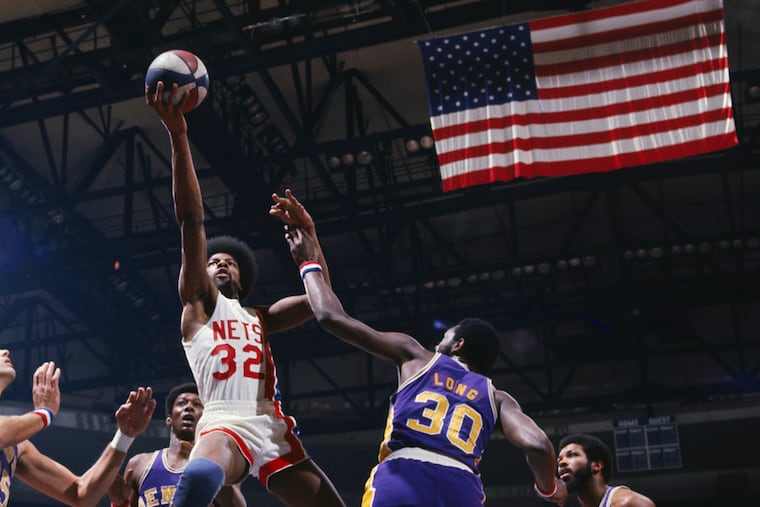
Throughout basketball history, few players have been as transformative a talent and cultural figure as NBA Hall of Famer Julius Erving.
Footage of the former Philadelphia 76er’s thunderous dunks, stylish finger rolls, and suave demeanor off the court still draw applause from basketball fans, decades after his 1987 retirement. The iconic forward is still championed by Sixers fans for bringing the city an NBA title in 1983.
It was in Philly where Erving embraced one of the world’s most impassioned fan bases and learned of the phrase, “You owe us one,” after falling short in the NBA finals three times between 1977 and 1982.
“I was like, ‘What the hell does that mean?’” he said to The Inquirer. “I was getting pissed. I was not happy with the situation.”
The fans were reminding Erving that he owed the city a championship. It was only after he and fellow Hall of Famer Moses Malone swept the Los Angeles Lakers in the 1983 finals that he paid his debt to the City of Brotherly Love. Fans shouted out the words that have stuck with him all these years on: “Paid in full.”
Erving, affectionately and fittingly known as “Dr. J,” surgically dissected opposing defenses. He and fellow NBA star David Thompson went on to inspire talents like Michael Jordan and Kobe Bryant.
But veteran sports fans know Erving’s legacy was cemented years before he took his first steps on the floors of South Philly’s Spectrum. One of his early visits to Philadelphia was in April 1971, when he signed to the American Basketball Association to play for the Virginia Squires.
Erving went on to win two ABA championships and three MVP awards in five seasons. He joined ABA greats Rick Barry, Artis Gilmore, Connie Hawkins, and Spencer Haywood as the faces of a league that would soon merge with the NBA in 1976.
The merger brought a new brand of fast-paced, high-flying action to the NBA, and elements like the three-point line, dunk contest, underclassmen signees, and other additions that continue today.
The legacy of those ABA greats and visionaries are the subject of the new sports docuseries, Soul Power: The Legend of the American Basketball Association.
“It just sets the stage for the memories that I have, the friendships that were developed, and the history that was established with the ABA,” Erving said.
The four-part series, streaming on Amazon Prime Video to commemorate 50 years of the ABA-NBA merger, chronicles the ABA’s formation, triumphs, and challenges during the late 1960s and ’70s.
Emmy-winning director Kenan K. Holley said he wanted the series to be a “player-driven” story that addressed the league’s on-court innovations and debunked the idea that the ABA was an inferior semipro league.
“Amazon executives saw the vision. They saw the ABA story was worth telling, and told us to lean into the characters,” he said. “That gave my team the North Star creatively. We knew we had the goods because of all the guys in the league, from Rick Barry to George ‘the Iceman’ Gervin, Dr. J, and others. That was the key.”
The series highlights the hotly-contested rivalry between ABA and NBA players, the personal, financial, and legal battles ABA stars faced, and the early advancements in women’s team ownership.
There are even brief flashes of downtown Philadelphia and City Hall, depicting the moments leading up to Erving’s ABA signing.
Soul Power shows how players like Erving were trying to save a league that made such an imprint on sports, but it was faltering due to disinvestment.
“It wasn’t a fun position to be put in, especially if you know you’re trying to fight for rights of players who gave a commitment to the league and made the sacrifices to keep it afloat for the years that it was around,” Erving said.
Holley also wanted Soul Power to right the wrongs of past depictions of the ABA. To do that, he needed to earn the trust of figures like George Karl, Barry, Ralph Simpson, and Erving.
“They have a chip on their shoulder because the way the league’s been handled in the past with certain documentaries,” Holley said. “There was a serious trust-building period where we had to let them know look, ‘If I tell your story, it will be a player-driven story.’”
Erving was approached about the project five years ago. The first year was largely information gathering, Erving said, but Holley soon stepped in to tie all the narrative threads together.
To be among the leading voices in the series, which earned him an executive production credit, Erving said, was a “gift.” And at the core of the project, he’s proud to see the series reflective of the brotherhood shared between him and the other pioneers who contributed to the series and ABA history.
“It was a one for all, all for one approach we shared,” he said. “There was no hating. It was a genuine feeling of relief like, ‘Wow, they’re recognizing my guy or us,’ and it was shared.”
Holley said he’s excited for younger sports fans to see how influential the ABA was, not just in basketball, but the sports world at large.
“It does my heart good, and I feel grateful to have played any part in helping bring these guys the validation that they deserve,” Holley said.
“Soul Power” is available to stream on Amazon Prime Video.