A hypothetical trade that illustrates Sixers' biggest trade-deadline question: What is Markelle Fultz’s value? | David Murphy
Fultz will be paid $9.75 million on his third-year option next season. That’s a significant sum for a backup point guard with availability concerns.
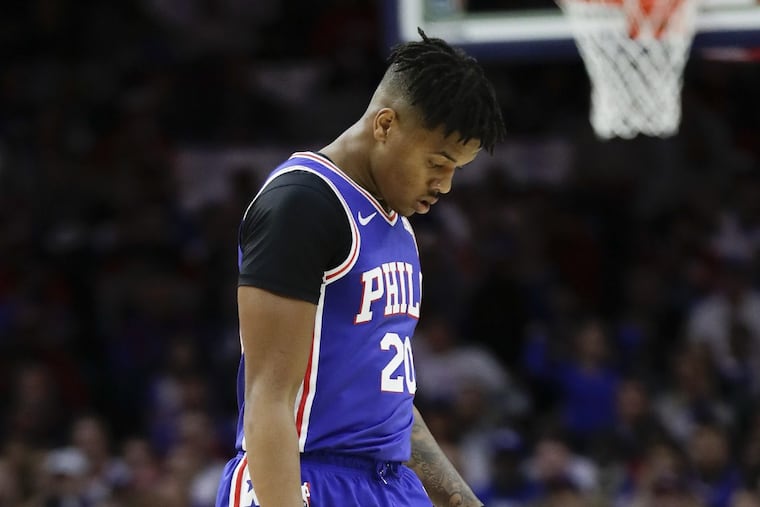
There is a question that will play a huge role in determining the course that Elton Brand charts for the future of his roster over the next week. It is a familiar question, one that everyone here in Sixersville has been contemplating in one iteration or another since October of last season.
And there is some reason to believe that now is as logical time as any for us to achieve resolution.
So, who is Markelle Fultz?
At this point, the actionable information we need involves perception rather than reality. Part of that involves the Sixers. What do they think of Fultz right now compared to what they thought of him in June 2017?
I mean that in an empirical, probabilistic sense. We know that they like him as a human being, and we know that they think he has a package of skills that includes some elite-level tools. At the same time, from being around the team this season, my educated intuition suggests that the key decision-makers are far from convinced that this latest hiatus will yield results any different from the first one.
Keep in mind, there was confusion about Fultz all the way back in October ’17, when then-GM Bryan Colangelo made a concerted yet ultimately futile attempt to put into coherent words an explanation of what the team thought was wrong with its prized rookie. Even then, it wasn’t hard to pick up on the remarkable signal lurking underneath the noise. The Sixers did not know. And, to a large degree, they know even less now.
But what does that mean in concrete terms? How have their projections changed? That’s one slice of the unknown. The other, more significant piece, concerns the projections of the other 29 teams in the NBA.
Consider the Hawks, an organization that the Sixers would be wise to pay particular attention to between now and the Feb. 7 trade deadline. Forget about the obvious history between the teams, from the signings of Ersan Ilyasova and Marco Belinelli last season to the Hawks' hiring of Lloyd Pierce off the Sixers staff to serve as their current head coach.
On a pragmatic level, these two teams simply match. This is particularly true from the Sixers' perspective.
More than any other team in the NBA, the Hawks boast a roster that features a variety of pertinent players in fungible contract situations. If a magic genie gave you three free transactions to upgrade this Sixers roster in advance of the playoffs, you’d pick a three-and-D wing, a backup point guard, and a backup rim protector.
Within that third category of player, Atlanta might have the most logical fit for the Sixers in Dewayne Dedmon, a former cup-of-coffee Processor who just two seasons ago played a big rotational role for a Spurs team that won 61 games and advanced to the Western Conference finals before getting swept by the Warriors.
Dedmon might not be a tipping point in a championship run, but he would be a huge upgrade over Amir Johnson or Mike Muscala on the defensive end of the court while playing 10-15 minutes a night behind Joel Embiid. (In 2016-17, the Spurs were nearly five points better on defense with Dedmon on the court.)
Yet Dedmon alone isn’t the sort of prize that is worth a price any steeper than a lottery ticket. The Hawks stand to gain close to $3 million in salary relief by moving him, and there is little reason for them to consider re-signing him this summer, when he is set to become a free agent.
At the same time, a player such as Dedmon could help plenty of would-be contenders, and his salary isn’t steep enough to necessitate a move. So the Hawks do have leverage.
Which is where Fultz, and the questions about perception, enter into the equation.
If you shudder at the thought of parting with two-plus years of Fultz for a half-season of a 29-year-old backup center, you aren’t alone. But it is better than cutting bait and getting nothing in return, and there is a realistic scenario in which the Sixers end up reaching for the needle-nosed pliers this summer.
Remember, Fultz will be paid $9.75 million on his third-year option next season. That’s a significant sum for a backup point guard with availability concerns. It’s also a big enough chunk of change that shedding it could be the difference between fitting another high-dollar free agent under the salary cap.
In other words, the Sixers' approximation of fair value for Fultz changes drastically if they view this summer as the potential end of his road.
Now, there’s an argument to be made that whatever sliver of reachable ceiling might still exist between then and now gives them better value than a rent-a-backup. Which is why any trade of Fultz might require a trading partner that has a greater appraisal of that value, and, thus, would be incentivized to part with a player or package that might actually move the Sixers' needle.
Most likely, that would mean a rebuilding team that is in a position to give Fultz the rest of his rookie deal to become the player he was projected to be, as well as to give him the regular minutes that might help him find his way.
Back to the Hawks, who are as likely as any team to see some value in taking a chance on Fultz, and who have at least one other piece that is expendable to them and of significant utility to the Sixers.
Taurean Prince checks off a lot of boxes on the Sixers' wish list: an efficient, switchable wing with good size (6-foot-8, 220) and a decent three-point stroke (.377 over the last two years) who would instantly upgrade most second-unit defenses.
Prince is young (24) and under contract for less than $3 million next season, but the Hawks are facing a looming numbers crunch, with two first-round picks likely coming to them this season, one of them a top 3-5 and the other top 10-15. With Trae Young, John Collins, Omari Spellman, and a handful of other young players on the roster, Prince seems likely to command an extension that does not make sense for that sort of team to pay.
I would be mildly surprised if Fultz alone got that deal done. I’m not even sure that including a first-round pick in the 22-30 range would get it done. But these are the sorts of conversations the Sixers should be having. Unless they know something now that they haven’t known all along.