Sixers-Magic observations: Jimmy Butler’s late-game heroics; Mike Scott finding his way
When the game called for it, Jimmy Butler showed up and did exactly what he’s known to do best.
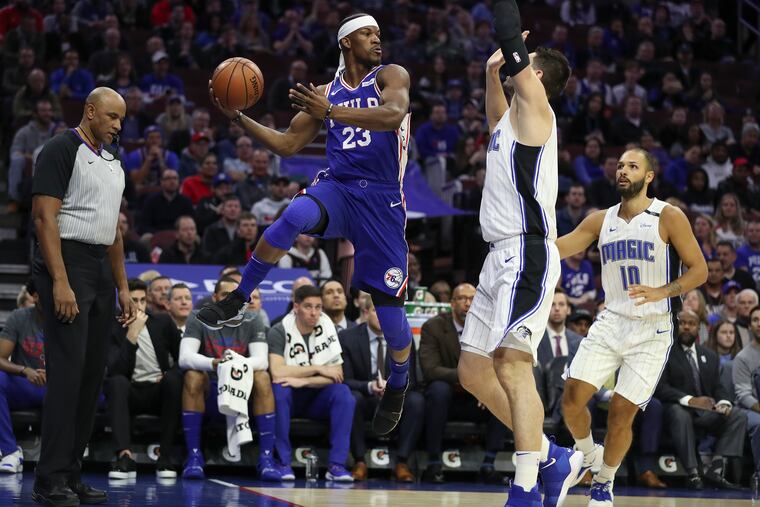
The 76ers beat the Orlando Magic, 114-106, Tuesday night at the Wells Fargo Center.
Here are some observations and best and worst awards:
Three observations
— Jimmy Butler has taken a bit of a backseat since the Sixers acquired him in November, but Brett Brown made a good point Tuesday night about Butler’s playing within the flow of the offense and stepping into a larger role when the situation called for it. While JJ Redick broke out of his slump and had a 19-point first half, the Sixers didn’t need Butler to go bananas on the offensive end. But when the game called for it, Butler showed up and did exactly what he’s been known to do best. He created shots for himself, helped in defensive rotations that were key, and made clutch buckets that kept the game from going away.
— Mike Scott is incrementally finding a rhythm with the Sixers. In the last five games, he is shooting a staggering 57.6 percent from three-point range, including hitting three threes against the Magic. Scott is likely to see heavy minutes when the playoffs roll around, especially when Brown elects to work with a small-ball unit.
— Tobias Harris has fit in with the Sixers just about as seamlessly as you could have hoped. Whether it’s joining a completely new team, or suddenly playing without Joel Embiid on the floor, little seems to affect him. Harris’ ability to adapt is a welcomed addition to the Sixers roster. He has become an incredible tandem with Ben Simmons, working well away from the ball, as a distributor, and knocking down shots with ease.
Best and worst
Best performance: JJ Redick badly needed a good game. He’d had nearly two weeks of awful shooting and things seemed to go back to normal against the Magic. He finished with a game-high 26 points on 8-for-16 shooting overall, including 6-for-9 from deep.
Worst performance: The Sixers defense left a lot to be desired despite the win. The worst part of it might have been letting Evan Fournier get whatever he wanted, whenever he wanted it. There were multiple players guilty of leaving Fournier wide open, and he made the Sixers pay. He shot 50 percent from three and had a team-high 25 points for the Magic. The Sixers did come up with the win, but against the Magic, you would have hoped for a little more cushion. Putting a hand, any hand, in the face of Fournier would have been a good place to start.
Worst statistic: Wes Iwundu played 20 minutes and didn’t register as a threat at all for the Magic. He went 0-for-5 and finished scoreless.
Best statistic: The Sixers’ shooting was a highlight, whether from three-point range, where they shot 39.3 percent, or from the free-throw line, where they shot 19-for-21 and scored some important late points.