Sam Hinkie’s 13-page Sixers resignation letter is 10 years old. Dr. Atul Gawande was shocked to see his name in it.
Though Gawande didn't know who Hinkie was at the time, he says he also trusts the process.
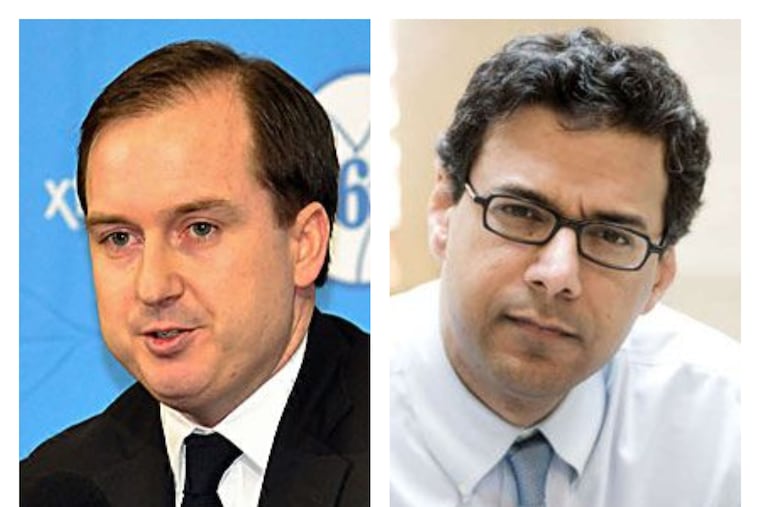
On April 6, 2016, surgeon Atul Gawande was in Boston, teaching at Harvard Medical School and working at Brigham and Women’s Hospital, when he received an unusual email. Then another. And another. And about 50 others.
On social media, 76ers fans began to tag him by name.
Every message contained some iteration of the same thing: informing Gawande that he had been mentioned in Sixers executive Sam Hinkie’s resignation letter.
And not just mentioned, but mentioned at the very top, 21 words and two sentences in.
“Each [person] was equally baffled that he would open with Atul Gawande,” Gawande said on Tuesday.
The world-renowned public health researcher, who later served on the COVID-19 advisory board and ran the United States Agency for International Development (USAID), was not alone. Hinkie’s letter stretched 13 pages. It weaved in a litany of references — everyone from Warren Buffett to Max Planck — showing how each could provide a lesson in team-building.
But Gawande’s inclusion was unique. Unlike the others, Hinkie didn’t explain why he was in there. There was not some hardcourt parallel to be drawn or analogy to be had. It was just a quick name-drop.
“I hope this letter finds you well,” Hinkie wrote. “I have been serving the Sixers at your pleasure for the past 34 months. Atul Gawande, a Surgeon at Brigham and Women’s Hospital in Boston, remains (from afar) one of my favorite reads. He laughs that reading scientific studies has long been a guilty pleasure. Reading investor letters has long been one of mine.”
Gawande wasn’t sure what to make of it. He’d never heard of Hinkie. But after a cursory internet search, the similarities between the two men began to dawn on him.
“I mean, the TTP [Trust the Process] thing,” he said, “that’s been around since John Wooden. But that is definitely my mantra as well.”
Ten years later, the letter — which was addressed to the Sixers’ equity partners and later obtained by ESPN — still fascinates. It provided insight into a general manager who rarely gave interviews. And, as all things with Hinkie and his process, the subsequent reaction was polarizing.
(To many, Hinkie is still polarizing. His teams won only 47 games over his three years in Philadelphia, in an attempt to rebuild through the top of the draft while also acquiring other future assets.)
» READ MORE: The ‘Trust the Process’ Sixers know what 2024-25 team endured: ‘Every win was like a Super Bowl win for us’
Some made fun of the letter. Others lauded it. A few deemed him arrogant. But to Gawande, a longtime Celtics fan, Hinkie’s thinking was just the opposite. It was about intellectual curiosity and humility.
“It certainly seemed to have a theme,” he said. “Many of the people he was citing were people who have found ways to get outsized results doing things that sometimes seem counterintuitive.”
A blend of analytics and humanity
Gawande didn’t know Hinkie by name, but was familiar with what he was trying to do in Philadelphia. The surgeon — a big baseball fan — had long admired the analytically driven practices of major league executives Theo Epstein and Billy Beane.
“That Moneyball approach spoke my language,” Gawande said. “That approach of [bringing] analytics to the reality of human beings is what I think a lot about. And seeing it applied in sports … I follow that all the time.”
It was not dissimilar to the surgeon’s tack within the field of medicine. He was open to any practice that would help lower the death rate, even those that seemed mundane.
In the mid-2000s, Gawande collected data from patients and doctors all over the world, to create a surgical safety checklist for the World Health Organization. It had a dramatic effect — cutting the rate of surgical death by over 40% — but was largely based on simple suggestions.
“Things like, at the start of a case, make sure everybody introduces themselves by name,” Gawande said, “so they’re more likely to speak when something goes wrong. Make sure you’ve confirmed the plan, and treat it like a huddle, like a football team, before you go to snap. Create a huddle in the operating room.”
The importance of good communication amid an unconventional process was something Hinkie understood as well. When Chris Finch was hired by Hinkie to coach the Rio Grande Valley Vipers — a Houston Rockets minor league franchise in what was then known as the D League in 2009 — he had little knowledge of analytics.
Finch had spent the last 12 years coaching in Europe. Upon his arrival in Texas, Hinkie gave him a presentation of why he’d been brought on board.
“He basically sat me down and walked me through why our teams [in Europe] had been successful,” Finch said. “He broke it all down based on analytics. And I had heard a little bit about analytics, but I wasn’t really in on it. And so once he kind of pulled back the curtain and showed me why our teams had won under that style, I had proof of concept.
“Which, compared to a lot of my counterparts at the time, who were being asked to change to a style of play that maybe they didn’t trust, or felt counterproductive to what they’ve always thought or done … they were reluctant to that change. For me, it was easy because I had proof of concept. I’d already been doing it. He just showed me the math and why it was working and then encouraged us to just kind of take it to another level.”
Finch, now the head coach of the Minnesota Timberwolves, was promoted to assistant coach with the Rockets in 2011. He spent the next three seasons working alongside Hinkie, whom he described as “really smart,” but in an unpretentious way.
The general manager would regularly invite the coaching staff to front office meetings. Finch said that these were always open discussions, where all opinions — old school, new school, and in between — were welcomed.
“Nobody felt like they had all the answers,” Finch said. “It was a very unthreatening environment. And they would often invite coaches in to pick our brains about how we would do things, given certain personnel or certain philosophy.”
He added: “Sam was very passionate about having the coaches understand the longer-term vision of roster building. And that’s not always common. Sometimes there’s a division, which is rightfully in place, but he thought it was healthy.”
Reflecting on 10 years
It’s easy to see why a 13-page manifesto that cites flightless birds and BlackBerry keyboards would be misconstrued. But perhaps the takeaway is what Finch said: that Hinkie didn’t feel like he had all the answers.
The general manager learned from basketball minds, but also from surgeons, businessmen, physicists, polymaths, and more. And 10 years later, Gawande is honored to have played a small part.
“It’s about looking at the best,” the public health researcher said, “building a process to make that possible for many more people, and trusting it to get you to a better outcome.”