Reflecting on the top 10 moments of Julius Erving’s career as he reaches 76 years old
From the rock the baby to four, four, four, we look back on the iconic career of an iconic Sixer.
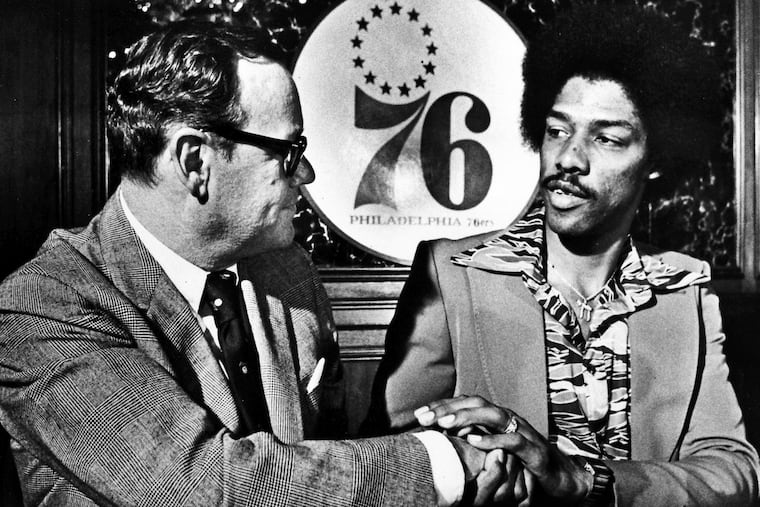
Julius Erving, an all-time 76ers great whose No. 6 is retired by the franchise, will celebrate his 76th birthday on Sunday.
As the basketball legend marks a milestone, here’s a look back at the 10 best moments of Erving’s career with the Sixers:
The Doctor is in
The Sixers acquired Erving from the New York Nets at the start of the 1976-77 NBA season, the first season after the league’s merger with the American Basketball Association was completed. The ABA’s Nets, one of four teams incorporated into the league, were forced to move on from Erving in order to pay the fees associated with entering the NBA.
The Sixers paid the Nets $3 million to acquire Erving, who was already a three-time ABA MVP by the time he joined the Sixers. The forward was also a season removed from winning the 1976 ABA dunk contest with a legendary leap from the free throw line.
All-Star MVP
Erving got off to a good start in his first NBA season with the Sixers, averaging 19.9 points before the All-Star break in 1976-77. But that season’s All-Star Game in Milwaukee was a point of arrival for the former face of the ABA.
Erving scored 30 points and nabbed 12 rebounds in 30 minutes, earning the game’s Most Valuable Player trophy despite the East losing to the West, 125-124. Erving, who was named an All-Star in each of his 18 ABA and NBA seasons, won the NBA’s All-Star MVP again in 1983.
Finals slam
Erving led the Sixers to the NBA Finals in his first season with the team, averaging 21.6 points and 8.5 rebounds in 1976-77. One of the high-flyer’s most memorable dunks came in Game 6 of the Finals against the Portland Trail Blazers. In the second quarter, Erving dribbled through three Trail Blazer defenders, leapt toward the rim and threw down a right-handed jam over the outstretched arms of Bill Walton.
Despite an NBA playoff career-high 40-point outing from Erving, Walton’s Blazers won Game 6, 109-107, to claim the 1977 NBA championship.
Baseline scoop
Walton wasn’t the only Hall of Fame center Erving antagonized in the NBA Finals. His iconic “baseline scoop” move against the Los Angeles Lakers in the 1980 Finals was a crafty way of getting around the shot-blocking ability of Kareem Abdul-Jabbar.
In the fourth quarter of Game 4, Erving drove to the right side of the basket, leapt while underneath the backboard and tossed an underhanded shot that hit the left side of the backboard and rolled in.
“I didn’t realize how long I had been in the air, but I knew I didn’t have any legs left and I didn’t have any hang time left, so I fell on the floor,” Erving said to ESPN in 2019. “Just another move.”
The scoop was two Erving’s 23 points scored in Game 4, helping the Sixers to a 105-102 victory that evened the series at two games apiece. The Lakers won the series, 4-2.
Most Valuable Doctor
Erving won his lone NBA MVP award in the 1980-81 season. At the time, Erving was the second Sixer to win the league’s top individual honor alongside Wilt Chamberlain.
Erving finished top-five in MVP voting five times as a Sixer, but the three-time ABA MVP only won the award once after the merger. Erving averaged 24.6 points, 8.0 rebounds and 4.4 assists in the 1980-81 season. He led the Sixers to a 62-20 regular season record, tied for the NBA’s best with the Celtics. The Sixers lost the 1981 Eastern Conference finals to Boston, which would go on to win the title that season.
Rock the baby
Another iconic Erving dunk, the “rock the baby” slam, came against the Lakers at the Spectrum in January 1983. Erving picked up a loose ball along the sideline just past center court, drove toward the rim and cradled the ball with his right hand before bringing it up to the rim for a dunk over Michael Cooper.
“I wanted this dunk to live on forever and to prove that people could fly,” Erving said to Sports Illustrated in 2023 on the slam’s 40th anniversary.
The Sixers held on for a two point win in overtime against the Lakers in what turned out to be a preview of the 1983 Finals.
Four, five, four
Moses Malone was the Sixer that predicted a full sweep of the 1983 Playoffs — “four, four, four” — after the team earned the top seed with a 65-17 regular season record, but Erving helped his center’s postseason prediction (almost) come true as the Sixers marched to the third championship in franchise history.
Erving and the Sixers were 12-1 in the playoffs, including a sweep of the defending champion Lakers in the 1983 Finals. The Sixers’ only loss was to the Bucks in the Eastern Conference finals. Erving averaged 18.4 points in the Sixers’ 13 playoff games, including a 21-point, six-assist performance to complete a sweep of the Lakers in Game 4.
At the time, the Sixers were the only team to complete a postseason with one loss. The 2001 Lakers and 2017 Warriors are the only teams since to take only one loss in the postseason.
Downing Dallas
Erving sank two game-winning shots at the horn during the final stretch of the 1985-86 regular season, which was his penultimate NBA season. The first shot came in Dallas on Feb. 28, 1986.
With two seconds remaining in a tie game, Erving inbounded the ball from the sideline to Maurice Cheeks. Cheeks passed it back to Erving, who launched a heave from beyond half court. The shot went in, and the Sixers won, 123-120.
Beating Boston
Erving’s next game winner came a little more than a month after his heroics in Dallas. Erving’s Sixers were down two to Larry Bird’s Celtics at the Spectrum on April 6, 1986.
The Sixers fouled Bird with seven seconds remaining, sending the league’s best free throw shooter to the line with a chance to make Boston’s lead four. Bird missed both, leaving the door open for the Sixers to win the game, 95-94, on an Erving three-pointer as time expired.
Jersey retirement
After the Sixers’ opening game of the 1986-87 season, Erving announced he would retire at the end of the season. In total, Erving played 11 seasons for the Sixers and averaged 22 points over 836 games with the team.
At the time of his retirement, Erving was the third-leading scorer in Sixers history, though he has since been passed by Allen Iverson. Erving is still the franchise’s all-time leader in blocked shots with 1,293 rejections in a Sixers uniform. The franchise retired his No. 6 jersey on April 18, 1988, in a ceremony at the Spectrum.
Erving also had his No. 32 retired by the Nets in honor of his ABA career, making him one of 16 players in NBA history to have their jersey retired by multiple franchises. Erving was inducted into the Naismith Basketball Hall of Fame in 1993.