NBA playoffs: What the Sixers need to do in Game 2 to have a chance against the Raptors | David Murphy
Marc Gasol and Serge Ibaka were effective in limiting Joel Embiid. That can't be allowed to happen this time around.
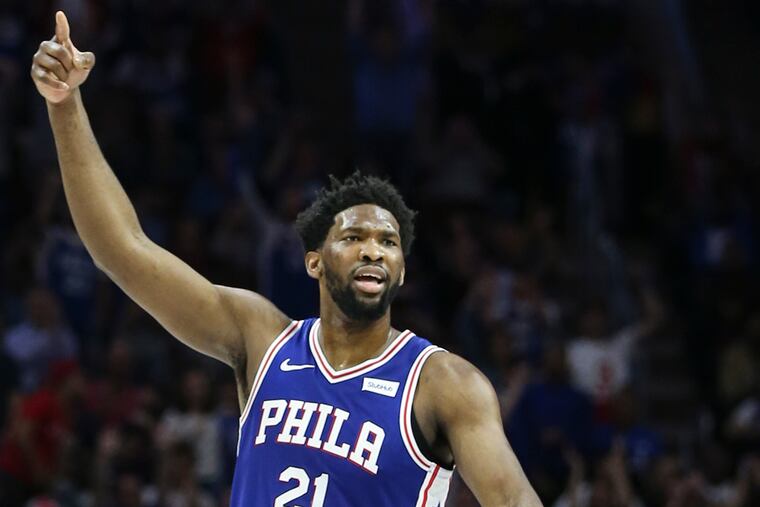
TORONTO — While the biggest question facing the Sixers in Game 2 on Monday night is on the defensive end — how do you guard Kawhi Leonard and Pascal Siakam? — the challenge they confront on the offensive end will be just as decisive.
Can the Sixers counter the difficulties the Raptors present defensively without abandoning the brand of basketball that won them 51 games and a first-round series against the Nets?
One thing is for sure: They didn’t do a very good job of it in Game 1. Whether that was a game-plan thing or a flow-of-the-game thing isn’t entirely clear. Whatever the case, the Sixers were all sorts of out of sorts, with Tobias Harris playing a particularly inefficient brand of basketball that saw him turn the ball over five times, while missing 11 of the 17 shots he attempted.
Likewise, the Sixers were nearly invisible in the post against Raptors big men Marc Gasol and Serge Ibaka. According to NBA.com, the Sixers scored just two points in the post and 14 points in the paint, averaging just 0.125 and 0.700 points per touch in those two departments. That’s a dramatic departure from their success against the Nets in the first round, when they averaged eight points in the post and 28 points in the paint per game with a scoring rate of .569 (post) and .97 (paint) points per touch.
Joel Embiid’s struggles against Gasol are well documented. In six career games in which Gasol was the opposing starting center, Embiid has never scored more than 18 points. In two regular-season games against Gasol this season, Embiid was 8-for-28 from the field with 10 turnovers and two blocked shots. On Saturday night, Embiid embodied all kinds of adjectives that we simply do not associate with him on a holistic basis: tentative, reluctant, dare we say … scared?
In the immediate aftermath of the game, Brett Brown took some of the responsibility.
“I’ve got to help him more,” the Sixers coach said. "Getting him into the post in different ways, freeing him up a little more than we did, is something that I have to look at. But I give Toronto credit for their defensive effort tonight.”
And he should give the Raptors credit. Because Embiid clearly did not feel comfortable deploying his skill set in his usual manner. If he is going to play the way he did in Game 1, this might be one of those series in which the Sixers really are better off with him attempting six to 10 three-pointers per night.
And that just might be the case, given the presence of Gasol and Ibaka. The Sixers’ struggles down low weren’t limited to Embiid. Since joining the Sixers, Boban Marjanovic has been a relatively high-volume player despite his limited minutes: against the Nets, he averaged 6.8 field goal attempts, 3.4 free throw attempts and 2.0 assists while grabbing 6.2 rebounds, all in about 15 1/2 minutes per night. During the regular season, he averaged 14.2 shot attempts per 36 minutes, nearly double his rate in Game 1. Yet in 10 minutes of action Game 1, he attempted just two shots, grabbed one rebound, and was a minus-17.
Therein lies the conundrum. Offensively, the Sixers have been at their best this season when Embiid is filling it up inside 12 feet and Marjanovic is coming off the bench to drop in buckets in short stretches of action. It isn’t hyperbole to say that, if Embiid plays the way he did in Game 1, they won’t have a chance at winning a game, much less the series. At the same time, a wall is a wall, and there is no property of matter that says that repeatedly running your head into it will change its nature. In the long run, both Embiid and the Sixers would be well served by allowing/encouraging/forcing him to figure Gasol out. In the short run, the pursuit of such a strategy could eliminate whatever chance the Sixers have of winning this series, whether that means Jimmy Butler and Tobias Harris going off or JJ Redick doing what he did in the third quarter or whatever.
The same goes for Ben Simmons. Given the result — as well as the fact that the Sixers trailed for the last 44:17 of the game’s 48 minutes — it is easy to overlook the fact that he didn’t play a half-bad game of basketball. Damning with faint praise? Not entirely. Along with Redick and James Ennis, Simmons was one of the few Sixers who had an efficient night offensively. He connected on seven of the eight shots he took and, more important, turned the ball over just twice. In other words, he was much better than he had been in three previous games against Leonard, which saw him turn the ball over 24 times and shoot 16-of-30 from the field.
“We have to be better offensively,” Redick said. “Their defense was fantastic last night. I won’t bore you with the statistics, but we were significantly better when we passed twice or more. So we have to realize this might not be a first-option offense for us.”
On the other hand, the Sixers’ first option is always to get Simmons in the open court in transition, and that’s a lot harder to do when an opponent is hitting well over half its shots. Which brings us back to the topic that dominated the conversation on Sunday, which was stopping Leonard, and Pascal Siakam. If the Sixers can’t figure out a suitable answer, it might not matter how many points they score. But they certainly aren’t going to compete in this series if they score 95 per night.