Paul George’s suspension brings back belief that he was a bad signing for the Sixers. Here’s why.
After George violated the NBA's anti-drug policy, even his most vocal supporters realize his suspension is the latest blow in a signing that hasn’t lived up to its potential.
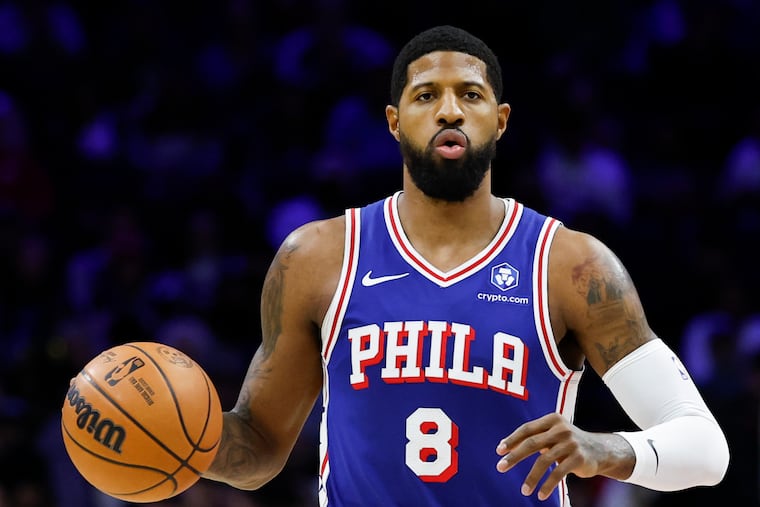
Paul George’s tenure with the 76ers was finally starting to pay dividends ... until it wasn’t.
Finally healthy, the nine-time All-Star was beginning to flourish in his role as the third member of the Sixers’ Big Three.
While the other members of the trio — Joel Embiid and Tyrese Maxey — provided the bulk of the scoring, George established himself as an elite facilitator and defender. And on occasion, when the Sixers needed additional scoring, the 6-foot-8 forward would take over quarters.
“Obviously, Joel, [and] Tyrese are our two engines,” George said in January. “Those guys are going to, rightfully so, demand attention, demand the ball in moments to score and put up points for us and, you know, I got to fit in, find my own shots, my opportunities and moments to be aggressive. That’s what I’m trying to do.”

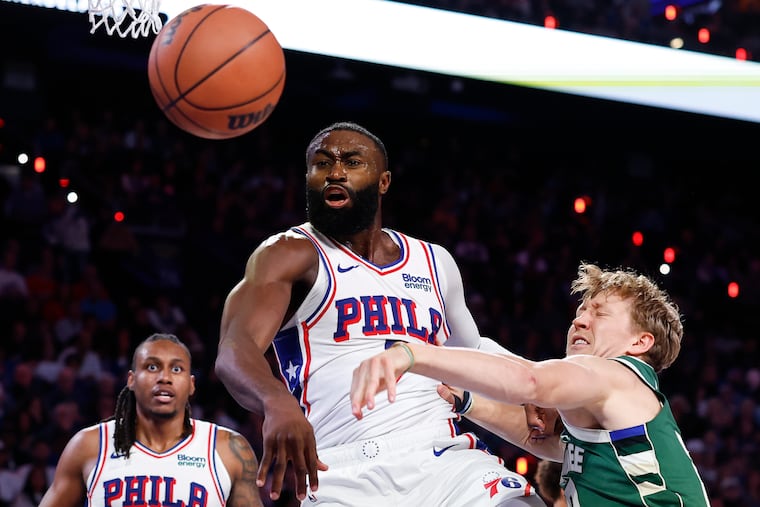
He did just that in Tuesday’s victory over the Milwaukee Bucks, scoring a game-high 32 points while making a franchise record-tying nine three-pointers.
All was great for the ascending squad until 11:48 a.m. Saturday.
That’s when the NBA announced that George had been suspended 25 games without pay for violating the terms of the league and National Basketball Players Association anti-drug program. Under the suspension, George won’t be eligible to play until the March 25 game against the Chicago Bulls at Xfinity Mobile Arena.
Just like that, George’s tenure is back to being recognized as a disaster.
In an instant, folks stopped identifying him as a dependable third option behind Maxey and Embiid. They are, once again, criticizing the Sixers for signing him to a four-year, $211.5 million contract. Even George’s most vocal supporters realize his suspension is the latest blow in a signing that hasn’t lived up to its potential.
And this is the kind of suspension that makes folks skeptical about George’s perceived return to being an impact player.
‘I can be myself’
On Dec. 14, George talked about getting over last season’s injuries after scoring a season-high 35 points while making 7 of 10 three-pointers in a 120-117 road loss to the Atlanta Hawks.
“Last year was a lot going on,” he said. “I was just trying to patch up stuff. This year, I’m a lot healthier. I’m able. I feel like I can play my game. I feel like I can be myself.
“There [are] still some things that [have] to come back. I’m not all the way [100%]. But I’m more myself than I was last year. So that’s the positive that I can take. And everything else is, with time, I’m just going to continue to get better.”
But one could argue that George didn’t have to do much to improve on the 2024-25 season.
Back then, critics regarded him as the worst free-agent acquisition in franchise history. The 35-year-old was going to set the team back for several seasons. He was washed up and untradable. That was the belief.
And here’s why.
» READ MORE: Sixers takeaways: Celebrating 2001 conference champs, another Joel Embiid domination, and more from win over Pelicans
The six-time All-NBA and four-time All-Defensive selection played in only 41 games last season due to various injuries. His final contest of the season was on March 3. And he was officially ruled out for the remainder of that season on March 17, the day he received injections in the left adductor muscle in his groin and left knee.
“To be honest, it was one of the toughest seasons for me, just with a lot of adversity on the court, off the court,” George said in April of last season. “The injury stuff … was some stuff I didn’t necessarily know I had going on until deep diving and finding out.
“There was other stuff I didn’t know that was causing my limitations, which was frustrating — not being able to do things I normally could do, and finding out the reason why. Those things are being addressed, so that’s the positive.”
But he had been missing time since the preseason of that season.
A breaking point
George was sidelined three weeks after hyperextending his left knee during an Oct. 14, 2024, preseason game, resulting in a bone bruise. He suffered the same injury during the Sixers’ Nov. 20, 2024, loss to the Memphis Grizzlies.
He’s also been hampered by left groin soreness, right ankle soreness, and a torn tendon in his left little finger. George missed 41 games because of injuries and load management.
And when he played, he had a tough time creating separation while averaging just 16.2 points, the fifth-lowest average of his 16 NBA seasons. The California native is averaging just 16.0 points this season, but that’s partly due to this season’s role.
» READ MORE: Joel Embiid hopes the Sixers’ roster remains intact beyond the NBA trade deadline
Yet, last season’s three-point percentage (.358) was the third-worst of his career. For comparison, his three-point percentage is .382 this season.
The low point of last season came in the Sixers’ 100-96 loss to the Brooklyn Nets at the Barclays Center on Feb. 12. With Embiid and Maxey both sidelined, George was expected to carry the Sixers’ scoring load.
Instead, he had two points on 1-for-7 shooting to go with six rebounds, four assists, two steals, three blocks, and three turnovers.
It was revealed the next day that George had been taking pain medication to play. And he missed six games from March 6 to 16, while consulting with doctors about treatment options for his ailing left groin and left knee. That led to his injections in the left adductor muscle in his groin and his knee, and he was ruled out for the remainder of the season.
George was expected to return in time for training camp. However, he had arthroscopic left knee surgery on July 11. As a result, he missed all four exhibition games and the first 12 games of the season.
Now, George won’t return until March 25. As a result, he will have missed 86 out of 153 possible games with the Sixers.
That’s not the type of investment the Sixers hoped to get when signing him to a maximum-salary contract. And this suspension is definitely not the attention he and the team hoped to realize.
This is just another setback for a player who has failed to live up to expectations. This one is obviously self-inflicted.
» READ MORE: Paul George’s 25-game suspension is just the latest example of Sixers’ bad karma from The Process
“I think there’s been a lot of circumstances that have been really unfortunate,” coach Nick Nurse said before Saturday’s game. “But I also feel like he’s played pretty well this year, you know, borderline very well, considering he’s played such a critical role for us, kind of slotted in like a really good role player on this particular team. I think he’s done what we needed him to do.
“But I think there’s been a lot of unfortunate things, injuries, obviously, the team’s whole situation last year, a couple of injuries early this year, coming out of some stuff. So it’s been unfortunate, but it’s where we are.”
This situation, however, raises a key question: Was this season’s improved play the result of the hard work George says he put in during the offseason, or a boost from the improper medication he took?
It is a question that may loom over George’s tenure in Philly for a while.