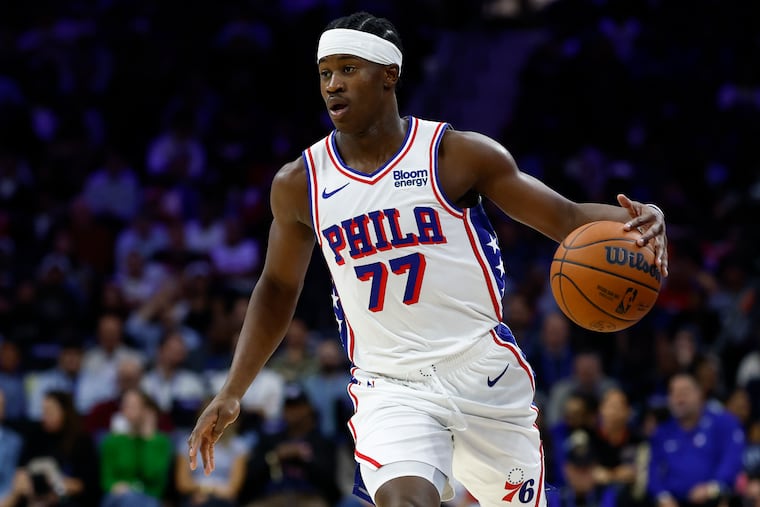
The Sixers need more out of VJ Edgecombe. That’s their problem, not his.
There’s nothing problematic about Edgecombe's performance. The issue is that the Sixers are relying on him to be something that most rookies aren’t prepared to be.
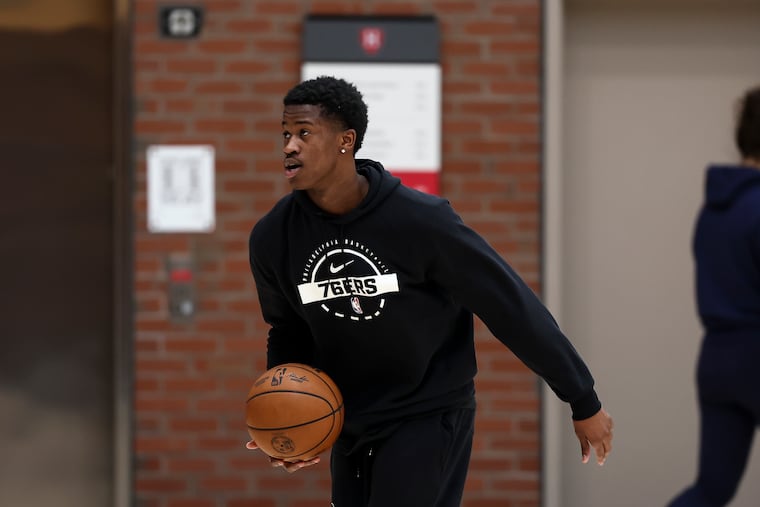
Maybe we were expecting a little too much out of VJ Edgecombe. Not that anybody thought he was going to carry the Sixers to the Eastern Conference semifinals through the sheer force of his will. But you could be forgiven if you were hoping for something more than the 13 points on 6-of-16 shooting that the rookie produced in a Game 1 blowout loss to the Celtics.
Was that really too much to ask?
Well, yeah, it probably was.
» READ MORE: The Sixers’ shooting was a big problem in Game 1. The bigger problem is it might not have mattered.
It has been 16 years since a 20-year-old Brandon Jennings scored 34 points in a Bucks loss to the Hawks. No rookie has broken 30 points in his playoff debut since. Only one has scored 20: Donovan Mitchell, who dropped 27 for the Jazz in a loss to the Thunder in 2018.
In fact, you won’t find many rookies who even topped Edgecombe’s output in the Sixers’ 123-91 loss to Boston on Sunday. Jayson Tatum scored 19 on 8-of-18 shooting in his playoff debut. Shai Gilgeous-Alexander scored 18 on 6-of-16 shooting. Just behind them is the immortal Ben Simmons, who scored 17 on 5-of-13 shooting in the Sixers’ 130-103 win over the Heat in 2018.
This is partly a function of sample size. There simply aren’t a lot of future stars who made the playoffs as rookies. Most of the present-day greats didn’t get their first taste of the postseason until Year 2 or 3 of their careers. Great players tend to get drafted by bad teams, after all. But there are enough examples to conclude that Edgecombe’s lackluster debut against the Celtics was the norm.
His 13 points in Game 1 were more than double Kawhi Leonard’s playoff debut (six points, 2012). He outscored rookies Jaylen Brown and Derrick White combined. He outscored Desmond Bane (eight points) and OG Anunoby (12 points). He outscored Domantas Sabonis (four points) and Draymond Green (two points). And, yes, Edgecombe outscored Paul George (two points) and Tyrese Maxey (three points).
Sixers coach Nick Nurse is plenty familiar with postseason growth curves. He was an assistant on the Raptors’ staff during Anunoby’s rookie playoff run. When Toronto played the Sixers in the first round in 2022, Scottie Barnes was a first-year primary scorer. The experience matters more than the stat line.
“It’s super, super important,” Nurse said. “I think I mentioned this a bunch of times, you have to get in these things, you have to get in the playoffs to get these guys the feel of it, the experience of it. It’s just invaluable experience for them to see what it’s like. They’re just getting started. They’ve got a game under their belt now.
“Now they’re seeing what it’s like going against over and over the same team, the prep and the adjustments and all that stuff. It’s super invaluable. We have to get into this thing as often as you can so these guys can grow and learn and get better from it.”
» READ MORE: Sixers defense offers ‘no resistance’ in Game 1 blowout loss to Celtics and ‘you’re not going to win like that’
Edgecombe played a big role in the Sixers’ shooting woes in Game 1, missing all five of his three-point attempts. Including their play-in win over the Magic, he is 1-for-10 from three-point range and 13-for-32 from the field overall. But there’s nothing problematic about his performance. The problem is that the Sixers are relying on him to be something that most rookies aren’t prepared to be.
It will continue to be a problem, in all likelihood. Edgecombe isn’t going to suddenly morph into a full-grown, physically mature man who can bang with guys like Tatum, Brown and White. He looked small out there in Game 1. He missed some shots he could have made, sure. For the most part, he looked physically overmatched. Because he is.
“I’m gonna be honest, intensity,” Edgecombe said on Sunday after the loss. “They’re a good team. I just think for us, it’s just we weren’t making shots. Wide-open shots. I’m gonna say wide-open. I mean, butt-naked open. Just shots — ball going in and out. Like, it’s deflating. Especially, against a really good team that’s also shooting the ball really well."

Celtics lead 3-1
Game 1: Celtics 123, Sixers 91 | Murphy: Early offseason?
Game 2: Sixers 111, Celtics 97 | Murphy: Edgecombe steps up
Game 3: Celtics 108, Sixers 100 | Murphy: Reality of this series
Game 4: Celtics 128, Sixers 96 | Murphy: Maxey should be focus
Game 5: Sixers at Celtics, 7 p.m. Tuesday, ESPN
*Game 6: Celtics at Sixers, TBD Thursday
*Game 7: Sixers at Celtics, TBD Saturday
* If necessary
That last part is important. The Celtics are as experienced and mature of a team as Edgecombe has ever faced. Remember, he was still in high school two years ago. The version of Tatum that he saw on Sunday was nothing like the one who got his first postseason experience as a 20-year-old rookie. In fact, Tatum is a pretty good base case to study.
During the Celtics’ run to the Eastern Conference finals in 2017-18, Tatum averaged 13.2 points in 32.4 minutes in his first five games, shooting .393 from the field and .313 from three-point range. Things trended up from there. In his last 14 games of that 2017-18 postseason, he averaged 20.4 points in 37.1 minutes while shooting .495 from the field and .327 from three-point range. He played a critical role in pushing LeBron James’ Cavaliers to Game 7 in the conference finals. By that point, Tatum had played more postseason games than Anthony Edwards did in his first three NBA seasons combined.
» READ MORE: ‘I want us to go down in history’: Tyrese Maxey and VJ Edgecombe’s bond will shape the Sixers’ future
Tatum’s experience by the end of that postseason might be triple what Edgecombe and fellow young Sixers Adem Bona and Justin Edwards see this year.
“I thought those guys played pretty good,” Nurse said. “They didn’t make a ton of mistakes. They took shots they should’ve taken. They were pretty good. Just keep them confident, and again, just showing them areas where they can improve or change on the defensive end or other opportunities they may have on the offensive end.”
Those sound like reasonable expectations.