Christian Pulisic’s first USMNT goal since 2024 lifts a big burden ahead of the World Cup
The Hershey native silenced his critics with a big game against Senegal. We also take a look at Mauricio Pochettino making headlines for bringing a computer to his players during a hydration break.
CHARLOTTE, N.C. — You can measure soccer’s growth in this country in a lot of ways, especially on the business side. But when it comes to fan interest, you can go by how much people complain.
Christian Pulisic’s six-month goal drought for club or country since last December raised a lot of complaints from fans of U.S. men’s soccer. How would the program’s biggest star fare at the World Cup if he arrived in such bad form?
On Sunday, the Hershey native silenced his critics. Though he only played the first half of the 3-2 win over African power Senegal, he was lively right out of the gate. Pulisic was on the ball a lot and made a series of incisive runs from his favored left-side attacking midfield spot.
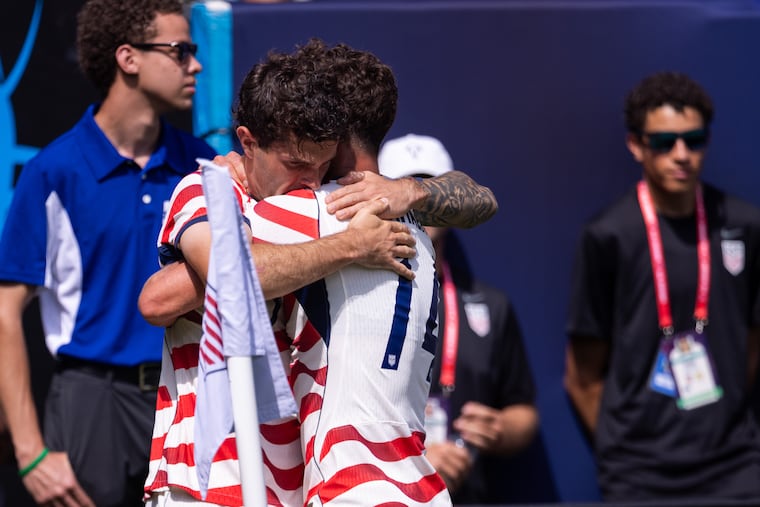
It didn’t take long for those runs to produce results. Sergiño Dest slammed home Pulisic’s low cross in the seventh minute, then Pulisic crafted his own finish in the 20th. That, at last, was his first national team goal since November 2024, a span of eight games played and 11 missed.
“It felt great,” Pulisic said. “It’s like, I’ve I felt this confidence, like I’ve played really well in recent months too, but all people seem to care about is goals. So, hopefully now people can stop talking about it.”
He was never going to fully exult in front of the press. But the emotions he showed on the field after both plays said plenty.
» READ MORE: Christian Pulisic and Folarin Balogun lead the USMNT to a 3-2 win over Senegal
“I mean, you could see it — I felt great,” he said. “I was excited. It felt good to just kind of get that one. And yeah, just ready for a big summer ahead now.”
U.S. manager Mauricio Pochettino predicted in the days before the game that Pulisic would score a goal during the World Cup. It turned out that the drought ended in the first game of any kind since those words.
“The performance of Christian in 45 minutes was really, really good,” Pochettino said. “I think he has still the potential and room to improve. But I think it’s in the way that he’s training from day one: I felt that was what he needed. And how he played 45 minutes was the habit that he created in the last week, every day training with this attitude, with this commitment, with this energy.”
Pochettino’s computer skills
To an American eye, the moment looked like something more suited for college basketball than international soccer.
» READ MORE: For Mauricio Pochettino, picking the World Cup team was ‘painful’ — and unlike anything in his career
Midway through the first half, the referee called for the mandatory hydration break that will turn the world’s game from one of halves into one of quarters — and more commercials — at the World Cup.
But on Sunday, TNT and Telemundo chose pragmatism over profit. So viewers at home got to see Pochettino gather his players by the bench, then take a laptop computer to give some tactical instruction.
— CJ Fogler (@cjzero.bsky.social) May 31, 2026 at 7:31 PM
The way the cameras showed the huddle, it felt like an ultramodern version of Phil Martelli or Bruiser Flint courtside at the Palestra. But instead of a whiteboard and marker, U.S. staff analyst Alec Scott held the computer as Pochettino asked him to press play and stop, with the broadcast’s microphones picking up a few words to the players.
As a principle, Pochettino doesn’t like the breaks. Not for nothing has soccer been defined for decades by how little managers can do in games: pick the starters, make substitutions, and hope whatever they shout from the bench is heard across the field.
» READ MORE: FIFA has gone to great lengths to appeal to American soccer fans. But they got us all wrong. | Kerith Gabriel
But no coach of either round ball would pass up an opportunity to do some coaching, so he took advantage.
“I use the water break to try to help my players, but still I don’t like it,” he said, though he acknowledged it has clear merit in really hot weather. (It was a pleasant 73 degrees at kickoff.)
Kickoff. Last I heard, the expected attendance was over 50,000. It’s starting to look the part. #USMNT
— Jonathan Tannenwald (@jtannenwald.bsky.social) May 31, 2026 at 3:38 PM
[image or embed]
“They say that they are going to help the spectacle, but we are going in a direction that we are going to change,” Pochettino continued. “Because if we add, add, add to the rules, then the soccer or the fútbol that we know is going to stop to exist, and it’s going to become another sport."
The Athletic reported Friday that coaching staffs will be allowed to give instructions with computers during breaks in World Cup games. But players will have to stay within the lines of the field, meaning a huddle like the one we saw Sunday won’t happen.
» READ MORE: Tim Ream will captain the USMNT at the World Cup
Interestingly, Pochettino also said he has used computers for halftime talks since his earliest days as a manager, at Spain’s Espanyol from 2009-12. Now he has a laptop on the sideline, and a big screen next to the field at the national training center where he can show things.
“The players need to feel, but also need to see,” he said. “They are very visual. And I think if we have the possibility to do three or four actions in how we need to improve in offense and defense, the two phases of the game, I think it’s really helpful.”
What did the players think? Mark McKenzie, who knows hoops as well as anyone on the U.S. squad, was amused.
“Yeah, it’s a bit different for sure, but for us it’s beneficial,” he said. “It gives you that minute or so to fine-tune things, maybe make some adjustments, figure out in our press or in our defense transition, whatever it may be what we can improve. But it also helps to kind of take a breath, reset yourselves as a collective.”
10 substitutions at once
The teams agreed in advance to allow up to 11 substitutions each, as soccer’s rules permit in World Cup warmup games. So it was no surprise that Pochettino used them all, wanting to test as many players as possible while reducing the risk of injury.
» READ MORE: Alejandro Zendejas wears his emotions on his sleeve, including the joy of going to the World Cup
“With the possibility [of] nearly the whole roster playing, having minutes, I think it [was] many positive things,” Pochettino said.
Still, it was a sight to see 10 changes at once to start the second half. Having already made a basketball analogy here, we can make a hockey analogy and call it a line change. Sebastian Berhalter was the lone holdover, not replaced until the 76th minute.
“Ultimately it’s trying to build into the tournament in the best way,” said McKenzie, who played the first half at centerback and played well. “Obviously, everybody needs repetition, everybody needs the ability to go out there and showcase what they can do. But at the end of the day, it shows the collective group that we have — the 26 guys all pushing in the same direction, 26 guys who have the ability to be out there and represent at the highest level.”
We’ll likely see a lot of subs again when the U.S. plays its final World Cup warmup game, on Saturday against Germany in Chicago (2:30 p.m., TBS, Telemundo 62). But the World Cup will stick to its rule of five per side, with two exceptions: if a player exits due to a concussion, and the automatic extra sub given to each team if a knockout game goes to extra time.
» READ MORE: Sebastian Berhalter had the burden of being a coach’s kid, but he earned his USMNT World Cup ticket

Nine nations will compete in five group stage matches this summer, plus two more in a knockout game on July 4. Here’s what you need to know about those countries — and what those fans need to know about Philly. Click here for more.