Before she married Tug, Diane McGraw led Philly’s bid for a World Cup. There was one problem: They wanted the Vet for two months
As Philadelphia hosts its first World Cup this month, McGraw is grateful to have played a small part. "We deserve to have it here," she said. "And I’m just sorry we missed out on it back then.”
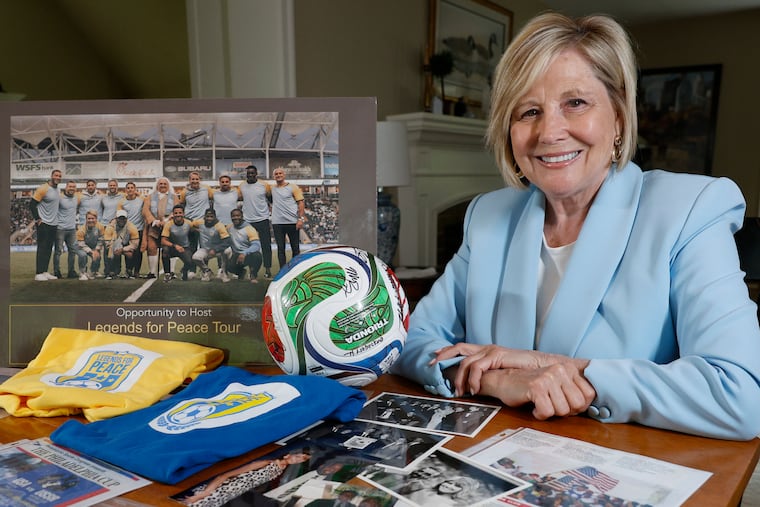
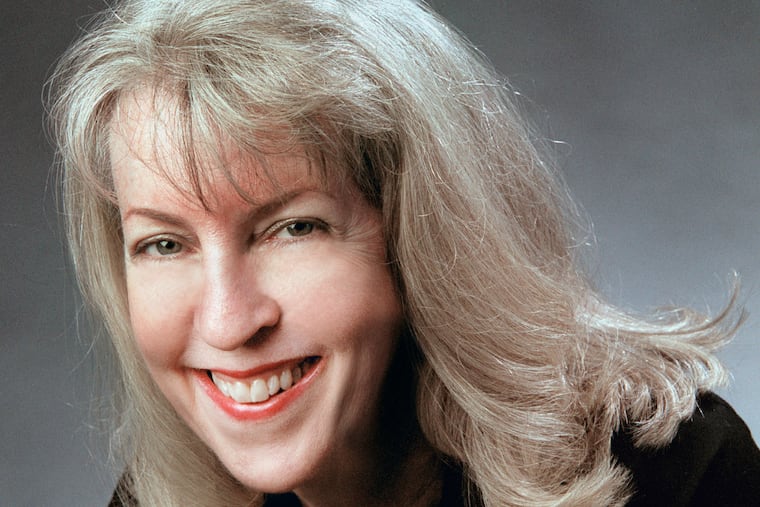
Diane McGraw was never a sports person. As a young girl in Ridley Park, she dreamed of being an actress, and paid far more attention to the film industry than she ever did to the Phillies or Eagles.
This ethos applied to her day-to-day life, as well. In the late 1960s, McGraw slipped and fell while playing field hockey for Notre Dame High School in Moylan, Pa.
It would be the end of her short-lived athletic career, but she was unbothered and quickly found a way to occupy her time.
“I was the athletic rep for my class,” she said, “that helped organize the intramurals.”
Little did McGraw know, the role would become a precursor to her future profession.
Over the coming decades, she’d organize celebrity tennis tournaments and national and international sporting events, from NCAA volleyball championships to the Ryder Cup to the MLB All-Star Game.
McGraw would find herself atop sports and entertainment commissions in four U.S. cities — Philadelphia, Los Angeles, Louisville, and Orlando — and in 1995 married longtime Phillies reliever Tug McGraw.
The aspiring actress went from having no casual interest in sports to living a life full of them. And among her most fulfilling projects was one that never came to be.
Under McGraw’s leadership, Philadelphia became one of the first major U.S. cities to host international soccer matches throughout the late 1980s and 1990s. They drew well, often with attendance numbers as high as 45,000.
» READ MORE: Philly’s path to the World Cup was paved at Newt’s, where playing on cinder was a ‘badge of honor’
In the early 1990s, she was put in charge of Philadelphia’s bid to host the 1994 World Cup. The bid was unsuccessful, but McGraw did prove something in the process.
Major corporate sponsors like Aramark and Blue Cross helped fund the bid. It was clear that there was local interest in the sport. The timing just wasn’t right.
Now, it is. As Philadelphia hosts its first World Cup this month, McGraw is grateful to have played a small part.
“I was thrilled [to hear] that it was coming here,” she said. “Finally. We deserve to have it here. And I’m just sorry we missed out on it back then.”
From acting aspirations to a life in sports
McGraw’s entry into sports was unconventional. After graduating from high school, she worked part-time as a model, which landed her a few appearances on local daytime talk shows.
In 1977, she moved to New York, determined to fulfill her acting aspirations. McGraw had no job and only a little money, but continued picking up modeling gigs here and there and was eventually hired as a personal assistant to the president of Sassoon Jeans.
Two years later, she left for a position at the Screen Actors Guild, thinking she could parlay it into a career in entertainment. That did not pan out, but the role did open some doors.
Not long after McGraw began her new job, she attended a networking event at East River Tennis Club. The pros, well aware that the SAG assistant had contacts, asked if she’d be open to organizing a pro-celebrity tennis tournament.
» READ MORE: World Cup nations playing in Philly will receive soccer balls signed by the city's biggest sports stars
It was the first of many sporting events to come. McGraw started her own business, under her maiden name, Robertson Productions — of which she was the only employee — and taught herself everything she could about the industry.
She began with tennis, but quickly broadened her scope to other sports. This meant spending a lot of time with sponsors, and one day, while on the sidelines of a New York Cosmos game, McGraw had an encounter she’d never forget.
A small, athletically built man with a warm smile approached her and asked for an autograph. English wasn’t his first language, and McGraw realized that what he actually wanted was her phone number.
She demurred, giving him the business card for Gaylord’s Restaurant, one of the sponsors of the Cosmos game. The man walked away.
A few minutes later, Gaylord’s owner, Jati Hoon, returned with the same suitor.
“He says, ‘Diane, I want you to meet Pelé,’” she recalled. “I had no idea who he was.”
By that point, McGraw was fairly used to meeting world-class athletes. Through the tennis community, she’d gotten to know John McEnroe and Björn Borg, among other stars of the game.
But her run-in with the soccer phenom was different, in that it would come to a serendipitous conclusion decades later.
After a few more years of star-studded galas and tournaments, McGraw married her first husband, Jan Hovenkamp. He was a native of Holland, and the young couple moved to the Netherlands in 1983.
» READ MORE: You don’t need a ticket to experience the World Cup in Philly
She continued to plan celebrity tennis events, and at one of them, she met the president of AFC Ajax, a professional football club in Amsterdam. He suggested that McGraw bring “real football” to the United States and offered to help provide a team from Holland and Brazil.
When McGraw returned to Philadelphia in 1986, she kept this in mind and reached out to the general manager of Veterans Stadium about renting it.
It was a short conversation.
“He said, ‘Diane, we don’t like soccer here,’” McGraw said. “‘We’re the Philadelphia Eagles. We’re only football.’”
He directed her to the group that ran Franklin Field, which directed her to the Philadelphia Sports Congress. They agreed to support the project, if McGraw could find the sponsors.
She did, and in 1989, McGraw brought the first international soccer match to the Delaware Valley. Dubbed the Philadelphia Cup, the game between the U.S. and the U.S.S.R. drew 43,000 people and was broadcast on WIP (94.1-FM), which at the time was on AM radio as SportsRadio WIP. (Holland and Brazil were unavailable due to scheduling conflicts).
A year later, in 1990, McGraw organized another match, this time between Sheffield Wednesday and the USMNT. Forty-five thousand fans showed up.
The two matches netted over $500,000 and earned McGraw a job as executive director of the Philadelphia Sports Congress — as well as a new unofficial title.
“I ended up becoming the World Cup person,” she said.
A fortuitous encounter with Pelé
Because McGraw had successfully convinced two European soccer teams to travel to the City of Brotherly Love, the Sports Congress decided to have her lead their efforts to bid for the 1994 World Cup.
This was a daunting task, as Philadelphia had never hosted an international soccer tournament. But McGraw felt strongly that they had a case, and not just because of the attendance numbers from the 1989 and 1990 matches.
The congress had collected data from the Eastern Pennsylvania Youth Soccer Association, which showed that more than 100,000 local families were actively engaged in the sport.
» READ MORE: Luis Fonsi will headline opening night of FIFA Fan Festival at Lemon Hill
McGraw couldn’t offer state-of-the-art facilities. But she did have an audience: a city full of passionate fans, who had shown they’d pack a stadium for events beyond American football.
It was a grueling process. The Sports Congress had to dole out $250,000 just to submit a bid. Once Philadelphia was approved, McGraw spent the next three years finding sponsors, mapping out hotels and security, as well as transportation and venue options.
As fate would have it, this role reunited her with a familiar face. In 1991, a group of soccer supporters testified in front of Congress.
Their goal was to convince the federal government to mint a commemorative coin as a means of fundraising for the World Cup.
Among those who testified? Pelé.
McGraw reintroduced herself and explained what she was trying to achieve. The three-time World Cup winner was on his way to a dinner, but before he left, he reached for his wallet and gave McGraw a gift.
It was a four-leaf clover.
“He said, ‘Diane, I’m going to help you get the World Cup to Philadelphia,’” she said with a laugh. “And then we got out of the car and I never saw him again.”
For a while, McGraw was optimistic — and not just because she had Pelé on her side.
The event organizer seemingly had an answer for every problem, even those as granular as the surface the athletes would play on.
(Astroturf wasn’t going to cut it.)
“We came up with a formula from a company here in Pennsylvania,” McGraw said. “They were going to grow the grass outside the stadium in trays, and bring it in, and let them fit it together. We had it all planned out.”
» READ MORE: FIFA has gone to great lengths to appeal to American soccer fans. But they got us all wrong.
But there was one quandary she couldn’t solve. FIFA wanted control of the local stadiums for roughly two months. That ruled out the Vet; Major League Baseball was not about to send the Phillies on a road trip for six to eight weeks.
The congress didn’t have any other location to offer. The bid failed.
“I’ll never forget sitting in the boardroom of the convention and visitors bureau, with FIFA on the phone, saying, ‘These are our host cities,’” McGraw recalled. “‘We’d like to thank Boston. We’d like to thank so and so.’ They never mentioned Philadelphia.”
A full-circle moment
Diane met Tug in 1992. She was in the Sports Congress office, and the former Phillies reliever was picking up tickets for an ice skating event at The Spectrum.
He invited her to the opening of Oriole Park at Camden Yards in Baltimore. A day before they were supposed to leave, McGraw gave her a call.
“He goes, ‘I want to take you out to dinner first so we can have a predate, before our regular date,’” she said. “We went to some restaurant on South Street, just to get to know each other.”
They were married three years later. Diane’s job took her all over the country — from Florida to California — but Tug accompanied her every step of the way.
» READ MORE: FIFA promised a $1 million gift to Philly to spur ‘legacy’ initiatives. The city is still waiting.
In 2003, their lives took a devastating turn, when Tug was diagnosed with a brain tumor. He died 10 months later at his son’s home in Tennessee. With two teenagers from her previous marriage and a 7-year-old to raise, it was an extremely challenging time.
But the widow saw it through. She immersed herself in motherhood and work, moving to Kentucky to lead the Louisville Sports Commission before returning to Philadelphia in 2009.
Now, McGraw plans on enjoying the soccer tournament she almost brought here all those years ago. She isn’t on the host committee, but has found a way to take part in the festivities.
The organizer will be holding a watch party in South Philly on June 12 to stream the U.S. vs. Paraguay match. All proceeds will go toward the World Peace Project (an initiative McGraw started last year) to fund a youth sports summit in a few months.
It’s McGraw’s way of giving back. Her life has taken some difficult, unexpected turns, but she is grateful for the journey and will continue to savor it — four-leaf clovers and all.
“I want to thank Pelé,” McGraw said with a laugh. “Even though it all came [true] 30 years later.”

Nine nations will compete in five group stage matches this summer, plus two more in a knockout game on July 4. Here’s what you need to know about those countries — and what those fans need to know about Philly. Click here for more.