World Cup turf experts say the grass is greener in Philadelphia, specifically at the Linc
FIFA lauds the work of the Eagles and Lincoln Financial Field for the quality of the pitch that gets put down. It also heaped praise on the guy responsible for it: Tony Leonard.
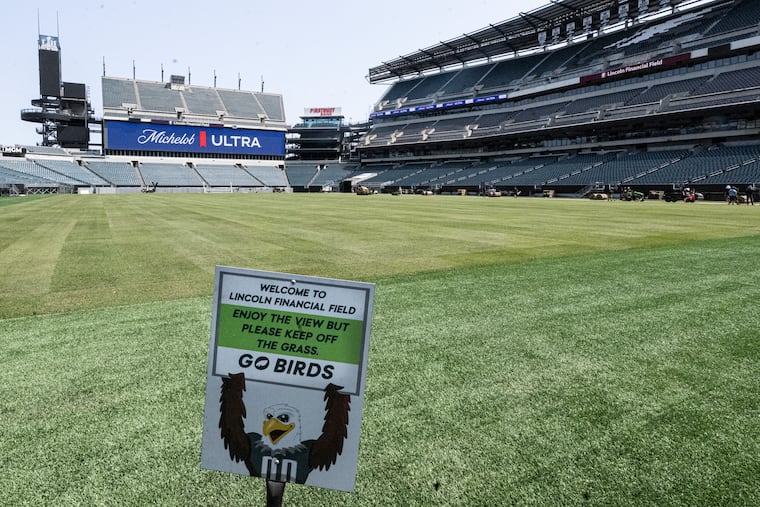
As Philadelphia hustles to prepare for the world’s largest sporting event, one aspect of that preparation is already well ahead of the game.
Last month, turf management professionals from FIFA, working in concert with professors from Michigan State University and the University of Tennessee, provided an overview of monthslong research designed to ensure that the 16 natural grass surfaces of the host cities, whether existing or installed, are up to standard for World Cup matches.
During a one-hour media briefing, FIFA’s pitch management director Alan Ferguson; John Sorochan, a professor of turf grass science at Tennessee; and John Rogers, who holds the same title at Michigan State, all lauded the work of longtime Eagles grounds crew chief Tony Leonard.
» READ MORE: Andre Blake must put the Union’s woes aside to play the biggest games of his life with Jamaica
“I would say at this point, when it comes to Lincoln Financial Field and Tony Leonard, you’ve probably got one of the top guys in the business [in Philadelphia],” said Ferguson, who doubles as a field management general for the English Football Association, which oversees the Premier League. “We’re really fortunate on the FIFA side to have guys of Tony’s caliber delivering the pitches for us.”
Ferguson said much of the praise comes from the work that Leonard and his team did for the Club World Cup, keeping the pitch pristine for Real Madrid, Chelsea, and many of the world’s biggest clubs over the course of seven matches in a 12-day span.
The field won praise from players at a time when much of the complaints about last summer’s tournament were how ineffective some of the playing surfaces were across the 12 host stadiums, with some even being referred to as a “disaster.”
Not the Linc. Instead, players praised the field in Philly. Both Sorochan and Rogers agreed with those sentiments, and added that when it comes to turf management, the Eagles and Lincoln Financial Field have it down to a science — literally.
“The Club World Cup was a bit of a scramble, but the work that Tony and his team did actually started with the sod farmer, on the farm,” Sorochan said. “They imagined the scenario of the field not being in the stadium, but right on the farm. They shifted their maintenance operation to the farm so they could work with the bluegrass right at the site, and understand how it would translate to the field for the matches.”
Added Ferguson: “By the time it got to the stadium, everyone was on the same page. They knew the cutting heights, they knew the frequencies, and they produced, I would say, without hesitation, the best field for the Club World Cup was in Philadelphia. It was commented on by a number of players and coaches. That field was superb.”
Not Philly’s first rodeo
Though the Linc is home to the Eagles, many people may not recall that the first event to test its conditions was a soccer match. In August 2003, Lincoln Financial Field opened with a friendly between European soccer giants FC Barcelona and Manchester United.
Since then, the Linc has hosted numerous soccer matches. Now, it will host its biggest when five group-stage matches, beginning on June 14, culminate with a round-of-16 match on July 4. Leonard told The Inquirer that his planning for World Cup started immediately after the last game of the Club World Cup.
When it comes to the right type of grass, Leonard and FIFA differ a bit on what works in conditions that could exceed 100 degrees on the field. Leonard is a fan of using Kentucky bluegrass, which he suggests is better-suited for the rigors of matches in extreme heat and sun. However, while FIFA is taking cues from the turf masters, the goal originally was to have all 16 pitches of the World Cup laid with Bermuda grass, which allows for optimal ball movement for the players, even if it can be a bit more of a challenge to maintain.
» READ MORE: Tim Ream is Mauricio Pochettino’s captain with the USMNT, but that doesn’t spare him any pressure
Bermuda grass, as Leonard noted, is what is laid onto the field for an NFL season. So why the change?
“My opinion was that I think Kentucky bluegrass is a better soccer surface and one that we’re accustomed to,” he said. “From a maintenance standpoint to help condition the grass, it comes down to planning and timing the watering. That actually affects the speed of play, the speed of the ball, and the surface where the ball can move the way that these players want it to move, whether that’s a 2 p.m. game or a 9 p.m. game.”
It appears that FIFA’s turf pros might actually agree.
“I think the [NFL stadiums] have done a fantastic job for us where we had to use Bermuda grass,” Ferguson said. “But it gave us a little bit more to think about. When you think most of the stadiums in the States previously, the big stadiums that transition from a number of events to soccer, there’s maybe one or two games [they need to adjust for]. But [with the World Cup] some of these stadiums will be playing seven to eight games and must maintain being a high-quality surface and really help to produce some great games of soccer. So taking all of that into account, I think some of us would be happier personally to not to use Bermuda grass if we can help it.”
‘Ahead of the game’
A decision on what type of grass Leonard and his team lays on the Linc’s field ultimately will come as the result of an agreement with FIFA. But after listening to Ferguson, Sorochan, and Rogers, any pushback should be minimal on whatever Leonard decides.
Rogers and Sorochan noted that Leonard and his team didn’t just rely on their own agronomic intuition, but have routinely visited Michigan State, Tennessee, and professors at Penn State in efforts to make sure the field that’s laid for Philly’s World Cup matches is top tier.
“Philly is ahead of the game, and it’s really because of Tony and his team,” Sorochan said. “He likes to get into the science. I just remember for the Club World Cup, because it was a summer tournament, to have Bermuda grass in Lincoln Financial Field, knowing how hot it could be in Philadelphia, was not the move.
“So when the schedule came out for the [World Cup] and when the games that were being played, with most of them in June, he knew that laying Kentucky bluegrass, he can have that ready and know it’ll be perfect when the tournament starts and can keep it going even when it starts to get hot vs. trying to wake up Bermuda grass, which needs hotter weather earlier to get it up and going.“
Sorochan added: “That was one part of his decision-making. Then there’s the research on the differences in mowing heights between the two grasses to get the ball to perform and play the same. Tony has done that over the years, and that’s why I think when it comes to this summer, Philly will be ahead of the game.”

Nine nations will compete in five group stage matches this summer, plus two more in a knockout game on July 4. Here’s what you need to know about those countries — and what those fans need to know about Philly. Click here for more.