The Union sign striker Milan Iloski, a big boost to their attacking depth
Iloski scored 10 goals in 14 games for San Diego FC on a short-term loan from April through July. After that, the Union moved to sign him — but had to jump through a pile of hoops first.
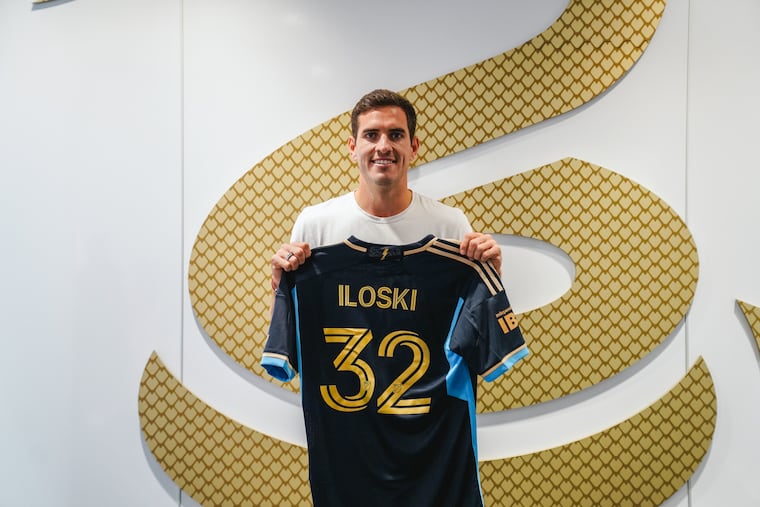
As the stretch run toward the playoffs starts, the Union gave their attacking depth a major boost on Tuesday with the signing of forward Milan Iloski.
The 26-year-old from the San Diego suburbs scored 10 goals in 14 games to start the year with San Diego FC, so it might seem surprising that his hometown club was willing to let him go. But that’s what happened, and when the Union got wind of it, they were interested.
Between that time and when the deal was completed, though, things got remarkably complicated. Multiple sources confirmed details to The Inquirer of a story that takes a while but needs telling.
Iloski had come home from Denmark’s FC Nordsjælland for San Diego’s expansion season. He initially signed for an unusual four-month loan, valid from the start of April through July 15, with an option to extend it through the end of the year. (As a further layer, both teams have the same owner.)
For most of that time, Iloski was a super sub, coming off the bench for starss Anders Dreyer and Hirving Lozano. He scored his first two goals in back-to-back games in May, then didn’t connect again until the end of the month. But when he broke his drought, he suddenly scored seven goals in three games, including a four-goal spell in just 12 minutes against Vancouver on June 26.
When it was time for San Diego to decide if it would pick up the loan option, the team and player couldn’t agree on the terms of a new deal. So Iloski asked to leave and return to Nordsjælland.
San Diego granted that, but the return didn’t happen through the usual means of the loaning club recalling the player. Nor did the sides let the loan expire. Instead, San Diego terminated the deal the day before it was to end.
» READ MORE: Three young Union prospects had a game to remember against Eintracht Frankfurt
That was done as an attempt to help Iloski get through MLS’s waiver rules for players who leave the league. San Diego knew the Union were interested in Iloski, and the two teams get along. (That’s part of why the Union have sent two young prospects out west this year, striker Anisse Saidi and attacking midfielder David Vazquez.
Unfortunately, the teams’ good relations couldn’t clear a path through the weeds that needed clearing to get him to Chester.
And this is where fans need to buckle up ...
In the weeds of MLS’s rule book
When a team takes a player on loan, it can’t initiate a sale of that player elsewhere. Only the club that loaned the player out can do so. In that context, it makes sense that the Union couldn’t acquire Iloski directly from San Diego, so the team had to negotiate with Nordsjælland.
While that was going on, Iloski played one game for the Danish club to pass the time in the rest of July.
» READ MORE: As the USMNT’s last sprint for the World Cup nears, Zack Steffen showed his talents in his hometown
That happened, and word got out in the U.S. and Denmark a few days ago that talks were underway. The deal didn’t get finished until Tuesday morning, which is another reminder — as even the transfer gossip specialists on social media will tell you — that a deal isn’t fully done until the teams announce it.
The sides agreed to a transfer fee of just under $1 million, plus performance incentives.
Most of the time, that would be the end of the story.
But this time, there was still a long way to go.
When a player leaves MLS and later wants to come back, the league’s Yellow Pages-sized rule book makes it intentionally difficult for that player to freely pick a destination. That helps create competitive balance, but it also draws howls of complaints from people fed up that it hurts the league on the world stage. (There are a lot of those people, even in teams’ front offices.)
San Diego knew that terminating his loan before its official end might get him through waivers faster, because there’s usually less demand for in-season waiver pickups than offseason ones.
» READ MORE: MLS pushes a calendar flip down the road, but perhaps not for much longer
The termination also favored Iloski’s wallet. It meant he could negotiate a larger contract upon returning to MLS than the cheap $156,000 deal he’d been on.
Had Iloski’s loan option been picked up in San Diego, he would have gone onto the waiver wire at the end of the year, and his salary for 2026 would have been whatever was in his previous contract. As those terms were with Nordsjælland, it wouldn’t have been much of a raise, and that would have made him an obvious bargain for any team.
More remarkably, had Iloski’s loan been allowed to run out, even after returning to Denmark, he would still have had to clear waivers to return to MLS. Even if Nordsjælland had agreed to a mutual contract termination upon his return, making him a free agent anywhere else in the world, he would not have been a fully free agent in any MLS return.
If you didn’t know that, you’re far from alone. Even some of the amateur capologists among the league’s most devoted fans wouldn’t know, as the scenario isn’t spelled out on the official roster rules page of the league’s website.
» READ MORE: The Union are in the midst of a sprint to the finish in the MLS playoff race
So Iloski was forced into waivers, like it or not. For an in-season waiver transaction, the team with the worst record at the time of the player’s desired entry into the league gets the first crack, then it goes on by worst-to-first order.
At the time the negotiations happened, that team was CF Montreal. So the Union (who were at the very back of the line with the league’s best record) paid Montreal for its place in the waiver order: $100,000 in allocation money (effectively extra cap space) up front, and up to $150,000 more based on performance incentives.
Much of what you just read may seem excessive and perhaps silly. A lot of people around MLS would agree with you. We’ll see if the spotlight coming from next year’s World Cup gets the league to loosen its rule book to help teams be more competitive. Commissioner Don Garber acknowledged last month at the All-Star Game that he’s under pressure to make that happen.
For now, what matters is that this deal is done. Iloski is finally out of the weeds, into daylight, and eligible to play in the Union’s Saturday game vs. Toronto FC (7:30 p.m., Apple TV). His new contract with the Union is guaranteed through 2027, with a team-held option for 2028.
“Milan is a dynamic, instinctive goal scorer who thrives in attacking transition,” Union sporting director Ernst Tanner said in a statement. “His ability to convert goal chances is extraordinary, and he has a willingness to defend. We look forward to integrating him into the team quickly.”