Yes, the Union are struggling. But how much is their payroll play to blame?
The Union have just one win across 13 MLS matches this season. But the assumption that having the league's lowest payroll plays a major part isn't entirely true.
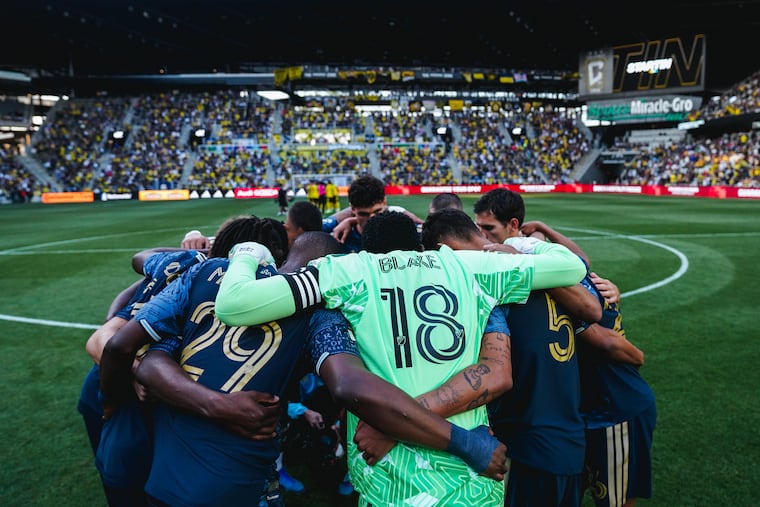
For the first time in the club’s history, the Union’s payroll is the least expensive in Major League Soccer, according to data published by the MLS Players Association on Tuesday.
The team is paying its 32 players a combined $11,696,829 in guaranteed salary, and veteran goalkeeper Andre Blake is the only Union player making more than $1 million this season.
But what does it mean for the Union to have the lowest payroll in the league? And how does it relate to their shocking start to the season? Here’s everything you need to know about the Union’s place in the latest salary guide:
What does ‘guaranteed compensation’ mean in MLS?
The MLSPA’s salary report includes two figures for each player in the league. One is the current annualized base salary, and the other is the annualized average guaranteed compensation. The guaranteed compensation includes a player’s annual salary as well as any signing or guaranteed bonuses over the length of that player’s contract, split up year by year.
The guaranteed compensation also includes marketing bonuses and agents’ fees. It does not include performance-based incentives, which could increase the value of a contract based on a player reaching set benchmarks on the pitch.
What are the Union spending on players?
The Union are paying the 32 players on their first-team roster a combined $10,065,900 in base salary this season, which increases to $11,696,829 when considering the total guaranteed compensation.
Many Union fans will remember the club spent money during the offseason to bring in the likes of Japhet Sery Larsen and Ezekiel Alladoh. The club spent a record $4.5 million to acquire Alladoh from Sweden’s Brommapojkarna in December.
But a transfer fee is paid from club to club, not club to player. Despite his club-record transfer fee, Alladoh will make $540,000 this season in guaranteed compensation, good for the ninth-most on the team.
For comparison, Sery Larsen’s transfer fee was around $1 million, but his total guaranteed compensation for the season is $675,300, making him the fourth-highest paid player on the roster.
The salary figure also does not include what the Union spends on youth development and the club’s academy program, though it does include salaries for products of that system, like Cavan Sullivan ($614,000).
According to sixonefivesoccer.com’s analysis of the MLSPA’s data, Union homegrown players account for 15.9% of the club’s salary spending, which is the highest percentage of homegrown spending in the league. The Union are paying $1,860,559 to homegrown players, a figure bested only by Inter Miami’s $2,166,223, which is 4% of its total payroll.
Who are the Union’s highest-paid players?
Blake is the club’s only player making more than $1 million this season. He will make $1,181,250 in guaranteed compensation this season, more than the $803,125 allowed by MLS for a non-designated player, but the Union bought down Blake’s cap hit with targeted allocation money.
The league’s complex salary rules allow teams to acquire targeted allocation money to reduce how much of a player’s salary counts against the league’s salary cap. The Union have also bought down the hits of Danley Jean Jacques ($702,500), Sery Larsen, Milan Iloski ($628,194), and Agustín Anello ($539,630).
The Union’s lone designated player, whose salary can exceed the league maximum for a single player, is Bruno Damiani.
Damiani is earning $847,600 in guaranteed compensation, making him the second-highest paid player on the team. Jean Jacques is third, Sery Larsen is fourth, and Indiana Vassilev ($665,000) is fifth.
How does the Union’s payroll compare to the rest of the league?
The short answer is that the Union are paying the least amount of money to players this season, but looking at some more numbers can help to bring into focus where the Union stand in relation to the rest of the league.
The team that is spending the most on player salaries is Inter Miami, which will pay out $54,574,541 to its players in guaranteed compensation this season. Lionel Messi accounts for $28,333,333 of that figure. On its own, Messi’s guaranteed compensation for this season is about 2½ times as much as the Union will spend on its entire roster.
On average, the league is spending $20,824,090 per team on guaranteed compensation for players. Of the league’s 30 teams, 15 spend more than the league average, while 15 spend less. The Union’s payroll is about $9 million less than league average.
It is worth noting that Miami is a fairly dramatic outlier. The club is spending $21,926,000 more than Los Angeles FC, which has the league’s second-highest payroll. But even with Miami’s figure excluded from the data set, the league’s average spend only drops to $19,660,281, leaving the Union still roughly $8 million away from league average.
Does spending explain the Union’s struggles this season?
It’s likely part of the explanation, though the Union and other teams around the league have been successful with low payrolls in the past. The Union won the Supporters’ Shield last season while paying their players a total of $13,430,247, the third-lowest payroll in the league.
A high payroll does not always equal success in MLS. Atlanta United is spending $27,884,035 on its players this season and sits 14th in the Eastern Conference on 10 points. The San Jose Earthquakes are tied atop the leaguewide standings through 12 matches while ranking 21st on the salary table.
But, excluding Atlanta, spending typically doesn’t hurt the on-field product. Of the 15 teams that spend more on their rosters than league average, only four — Atlanta, San Diego, Columbus and Toronto — are below the cut for the playoffs.
The two lowest spenders in the league, the Union and Sporting Kansas City, are at the bottom of their respective conference standings. Kansas City has two wins and owns the league’s worst goal differential at minus-22. The Union have a minus-10 goal differential, but also have just one win through 13 matches this season.