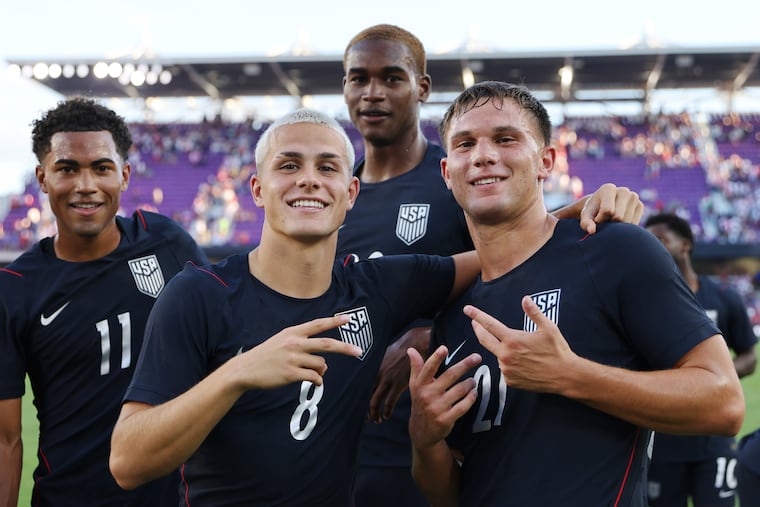
The legacy of this generation of USMNT players rests on this World Cup’s knockout rounds
Lose to Bosnia & Herzegovina, and all the promises of the last eight years go up in smoke. But with a win, the door could open to, as Gio Reyna said, "what it could really do for the sport.”

IRVINE, Calif. — The assertion on these pages of the importance of this World Cup’s first knockout round for the U.S. men’s soccer team drew a noteworthy response from a history-minded reader.
“Just because they changed how to make it from 32 to 16 doesn’t automatically make doing it more meaningful,” it said. “Not to be too ‘Bluesky reply guy’ but portraying it otherwise empowers FIFA’s money grab imo. On Wednesday the USMNT will try to do something they’ve done 5 of the last 8 men’s World Cups.”
Those are fair points, especially the one about FIFA grabbing money. The U.S. men have indeed been among the last 16 teams standing at five of the eight World Cups they played in from 1990-2022: ‘94, 2002, 2010, ‘14, and ‘22.
So the point that was made here is worth clarifying. It’s not just about being able to claim a title of being one of the best 32, 16, or any fewer national teams based on World Cup finish. It’s about the mentality of knockout soccer on the sport’s biggest stage, and how different it is from anything else.
It’s also about whether U.S. players of this era can prove themselves in the way they’ve long told us they can. Lose the round of 32 contest to Bosnia & Herzegovina on Wednesday (8 p.m., Fox29, Telemundo 62), and all the promises go up in smoke.
That pressure might not be the same as the kind the superstars of Brazil, Argentina, England, and so on face every day. But it’s still a significant burden, and a particular kind for a team with DNA built on fighting for respect.
» READ MORE: The USMNT has one World Cup knockout win ever. Right now is the best chance to change that.
“I think everyone knows in the back of our minds what this could do for this country,” attacking midfielder Gio Reyna said before Monday’s practice, the last before the U.S. team headed north to the Bay Area for Wednesday’s game in Santa Clara.
“Not that we’ve really spoke about it or thought about it much — we’re pretty much just focused on each game in front of us at this moment, as it is win or go home,” he continued. But they don’t have to.
“We feel the country rallying around us,” he said. “We see the momentum it’s bringing to the sport in this country just through the group stage. But we also understand that if we make a nice run in the tournament, what it could really do for the sport.”
Reyna and centerback Tim Ream were the two players who spoke Monday. Both were part of the 2022 team that took the U.S. back to the men’s World Cup after failing to qualify for 2018. Now Ream is this team’s captain, and its oldest player.
» READ MORE: The World Cup knockout bracket is set. Here’s what to know.
“Would it be weird if I told you I don’t really feel too much pressure at this minute?” he said. “I just think there’s so much pressure that we put on ourselves.”
He acknowledged in his next breath that “it feels very different this time around than 2022, I will say that,” though “not because of the round of 32 or because that was a round of 16.”
Instead it’s because of what is already in the players’ minds.
“I think we put so much expectation on ourselves as players — and I said this at the beginning of the tournament — but I think we felt more pressure for that first game against Paraguay than anything,” Ream said. “And that’s coming from ourselves, not from anything on the outside.”
» READ MORE: The USMNT’s sour World Cup group stage ending should be motivation for the bigger games to come
The burden might weigh a little extra on Reyna, too, and not just because of the scandal that engulfed him and his family four years ago. Even if everything back then had been clean-cut, he’d still be the son of U.S. legend Claudio Reyna, who played for the U.S. at the 1998, 2002, and 2006 World Cups — but not in 1994 because of a hamstring injury.
“I always like to say it’s just another game of football, but at the end of the day, I think everybody knows what this game is,” Gio said. “World Cups only come around every four years, and especially on home soil, this opportunity will really never come back.”

In this World Cup, underdogs have stolen the spotlight, the U.S. men made a notable run and Philadelphia not only welcomed the world but gave visitors a crash course on just how real the curse of the Rocky Statue can be.
Join Jonathan Tannenwald, the Inquirer's soccer writer, and host Lisa Carlin, analyst for CBS Sports Golazo, as they dissect the matches, the moments, and more as Philly has its moment in soccer's brightest spotlight. Watch our latest episode right here.
Watch previous episodes:
Episode 1: The Wait is Over!
Episode 2: Groups, Goals, and Glory
Episode 3: Electric Action in Philly
Episode 4: The Knockout Rounds Begin!