This 18th-century tavern with a tainted past is now South Jersey’s American Revolution Museum
The house has a long history, and it still needs a lot of work. But local historians say keeping the building alive is worth it.
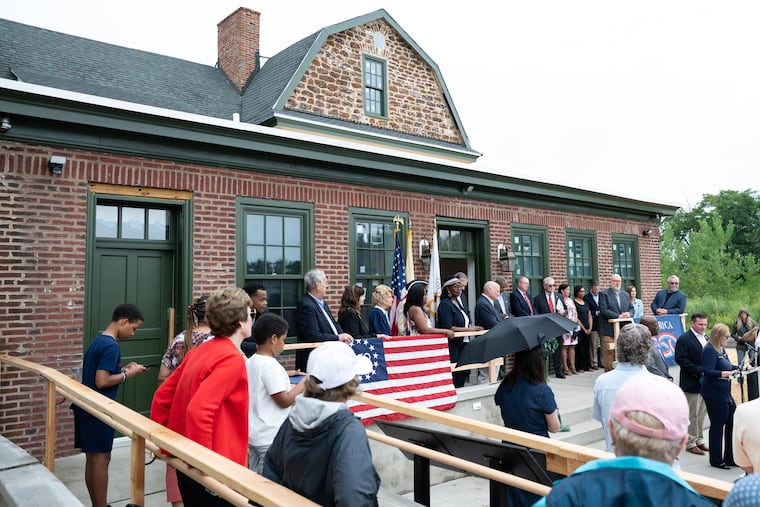
An unsuspecting property in north Camden that had a front-row seat to the American Revolution has become a multimillion-dollar museum.
Elected officials, history buffs, and local organizers gathered at the Benjamin Cooper Inn at 75 Erie St. on Saturday to celebrate the soft opening of the American Revolution Museum of Southern New Jersey. The project was funded by $4.6 million in grants from federal, state, and local sources, with the largest amount coming from the New Jersey Historic Trust.
The 18th-century stone building has taken on many identities, including a private residence, tavern, British Army outpost, shipyard, luxury yacht building site, storage unit, and dumping ground for toxic materials. In the 1760s, the land was witness to the mass auction of enslaved people. Until recently, the building was abandoned.
The museum hasn’t fully opened to the public and likely won’t for at least a little while, but leaders of the Camden County Historical Society, which has a 30-year lease with the building’s private owner, wanted to give people a taste of what the museum will be when it does. Right now, the museum is open for limited tours by appointment only.
The Inn still needs work. The building has a temporary roof installed after a 2012 fire. The floors aren’t finished, and bathrooms have no doors. The second floor, currently sectioned off, hasn’t undergone any renovations, which will require fundraising of hundreds of thousands of dollars. Dirt piles and overgrown foliage block any view of the Delaware River.
For the past six years, the society has planned to unveil the museum before America’s 250th, said Jack O’Byrne, the society’s executive director, but they kept running into obstacles. The project’s success came years after the society lost the Hugg-Harrison-Glover House, a Bellmawr home that survived the Revolutionary War, to a highway construction project after a preservation battle.
“It’s been a race to the end,” said O’Byrne, who will retire from his role on July 4. “The project probably died like 13 times.”
Zed Fox, the incoming executive director, and the society’s board will determine the future official opening date, hours, and cost. Fox said Monday that the board will meet on Wednesday to discuss those options, but he expects the museum to ready to open at full capacity by fall.
The museum is planned to serve as the trailhead for Camden County’s LINK trail, a 34 mile shared-use path in the works across 17 municipalities, and educate people on South Jersey’s role in American history.
Enjoyed this story?
Get more South Jersey news on your homepage with one click.
A long history and a damaged home
The new museum doesn’t showcase many historic artifacts. Many gems kept in the society’s archives, such as a letter written by George Washington at Valley Forge and a dozen other Revolutionary War-era items, wouldn’t fare well at the Inn with the sunlight streaming through the windows.
But scattered amid walls of weapon replicas and educational text are hints of the real thing.
There’s some 19th-century furniture originally owned by the Cooper family, a British cannon featuring wood blown off an 18th-century Royal Navy ship in Gloucester City, framed New Jersey bank notes from the 1760s and 1770s, and a front door key from when the Inn was a saloon called the “Old Stone Jug.”
A bell hanging in one room rang to announce ferries landing at Cooper Street Ferry in 1800, and a cheval-de-frise, a sharp wooden log, once blocked British ships from sailing the Delaware River.
In the same room, there’s a mantel from Hugg’s Tavern in Gloucester City, salvaged in 1929 before the building was demolished. Betsy Ross married her first husband, John Ross, in front of the fireplace at the tavern in 1773, though the mantel at the museum isn’t the original.
But local historians say the displays aren’t the main attraction.
“The building itself is an artifact,” O’Byrne said. “You know, it’s the most historic building in Camden.”
Before the house was built, a teenage Benjamin Franklin was said to have slept at the property while traveling from Boston to Philadelphia.
In 1734, Joseph Cooper, a Quaker, built a 2½-story Dutch Colonial stone home for his son and daughter-in-law, Benjamin and Hannah Cooper, at what became the historic building. Benjamin Cooper, a ferryman, also used the residence as an inn and a tavern.
In 1777, the Benjamin Cooper Inn was used as a outpost for British Col. Robert Abercrombie. Hessian troops, German auxiliaries to the British Army, marched through Cooper Point during the war, and at one time, local historians say Benjamin Cooper’s sons, Samuel and Joseph Cooper, were jailed in Haddonfield in 1778 on suspicion of being American spies.
But the property has a more troubling past.
In the 1760s, the site was used for the auction of enslaved people. Though some who were forced to stay on the Cooper’s property until being sold managed to escape, “all were pursued and re-captured,” according to the Inn’s 2021 historic preservation plan.
O’Byrne said the museum is working to educate people about that history. One of the museum’s few rooms, which the society has titled “The Declaration’s Promise,” informs visitors about how immigrants, Black people, and the Lenape, who lived in the region before white settlers arrived, shaped South Jersey’s history.
“What we’re trying to do is make this a balanced history and not just about, you know, white people,” O’Byrne said.
Camden’s ‘most historic building,’ under threat
When demolition crews tore down the Hugg-Harrison-Glover House in 2017, the Camden County Historical Society viewed the outcome as a huge injustice to historic preservation.
“That was a gut punch,” said Chris Perks, board president. “We had invested a tremendous amount of time and the community’s time into that site.”
Then, in 2018, a private company, 75 Erie St. LLC, purchased the Benjamin Cooper House from Agathon Realty for $1.1 million without knowing the building’s history. The house was in poor condition and graffitied. The windows were boarded up. It was difficult from the street to even know the building was there, because the house faces the river instead. The waterways were the real highways back then, O’Byrne said.
“When we heard this just got purchased, we were like, ‘Oh, my God, we can’t let Camden’s most historic house go under,’” O’Byrne said. “It took me two years, and I was able to get a 30-year lease.”
That lease will last at least through 2051. Perks declined to share how much the historical society will pay monthly.
The 2021 historic preservation plan for the building estimated that if the building opened in 2025 as originally projected, museum operations would have required an operating budget of $300,000 full time, or $132,000 part time.
While several organizations came together to fund the Benjamin Cooper Inn’s restoration, O’Byrne said the society will require more revenue beyond the funding for the restorations to maintain operations. O’Byrne applied for an operating support grant from the state and is working to raise $750,000 to match a New Jersey Historic Trust grant to restore the tavern’s upper level.
“We opened this thing, and it’s a minor miracle that we were able to pull all the funds together and make it in time,” O’Byrne said. “But in some respects, capital fundraising is easier.”