Born in The Inquirer’s newsroom, the AP women’s basketball poll ‘has stood the test of time’
From Immaculata dominating the AIAW days of the '70s to the Norristown-raised Geno Auriemma's dynasty at UConn, the AP women's basketball poll has chronicled it all.
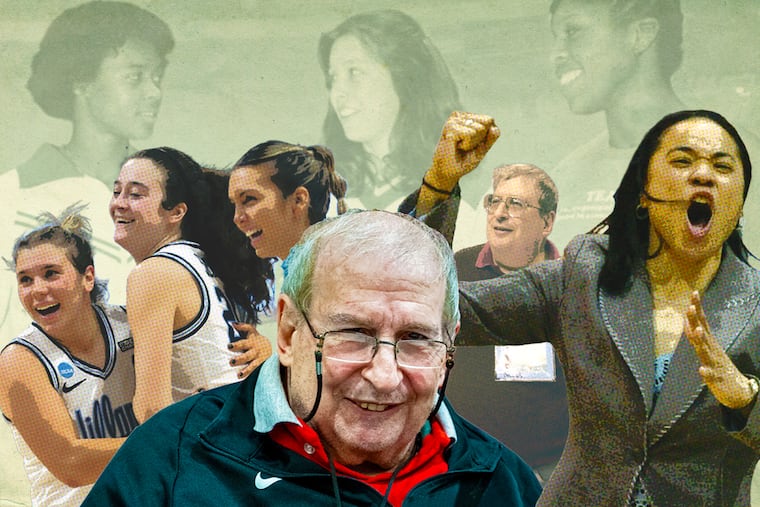
Paging through the bulky Sunday Inquirer on Nov. 28, 1976, readers encountered a sports section that might have been compiled in Mount Athos, the tiny Greek republic that’s been off-limits to women for centuries.
It was stuffed with man’s-world staples — stories, stats, and standings on the NFL, NHL, pro and college basketball. There were columns on hunting, golf, boys’ high school sports; features on boxing, men’s cross-country, minor league hockey; an entire page devoted to horse racing.
The ads were no less macho-flavored, promoting car batteries, rifles, tires. A prominent one hyped January’s U.S. Pro Indoor Tennis Championship at the Spectrum with its lineup of “50 of the world’s top male pros.”
» READ MORE: Philly has long been a special place for tennis legend Billie Jean King. And she wants to see the WNBA succeed here.
About the only indications that women participated in sports were an account of a West Chester State field hockey game and, buried on the gray scoreboard page, a truncated leaders’ list from that weekend’s LPGA tournament.
But for those who reached Page 16, a strange interloper awaited. Sandwiched between two men’s basketball previews, as if editors thought it incapable of standing alone, was one of the earliest and most consequential harbingers of a bubbling sports revolution — the first women’s college basketball poll.
Conceived by then-Inquirer sports editor Jay Searcy and obsessively nurtured by a Temple-educated newspaper clerk named Mel Greenberg, its headline read like a polite plea for recognition: “Move over guys, here comes another Top 20 poll.”
It came. And it stayed. Week after week, year after year, Greenberg’s poll accumulated popularity and heft, becoming a building block in the growth of women’s basketball. A sport that had been widely ignored and loosely governed by the Association for Intercollegiate Women’s Athletics now had validation, a common sense of purpose, and unity.
“That poll gave coaches and others around the country an opportunity to know what was going on everywhere with women’s college basketball,” said Marianne Stanley, a star on Immaculata’s 1970s championship teams and later a successful college and WNBA coach. “Prior to that, there was only word-of-mouth. Newspapers didn’t cover it, and no one was tracking what was happening nationally.”
Revisiting that debut poll in this, its 50th anniversary year, is eye-opening. Its top 10 might today be mistaken for a ranking of Division III field hockey teams — Delta State, Wayland Baptist, Immaculata, Tennessee Tech, Fullerton, Mercer, William Penn, Montclair State, Queens, and Mississippi College.
The large state schools that dominate in 2026 mostly were absent.
But not for long.
Motivated by the mandates of 1972’s Title IX and by a desire to see themselves in the new rankings, many started to invest in the sport.
By 1981, when the NCAA replaced the AIAW as the game’s overseer, there were 234 women’s Division I programs. That jumped to 284 in 1991, 317 in 2001. Last season there were 325 D-I programs, and more than 1,000 when Division II and III are included.
“The fact that so many schools where women’s basketball was nonexistent or an afterthought went all in is a credit to Mel and his poll,” said Jim Foster, the retired women’s coach at St. Joseph’s, Ohio State, and elsewhere.
Deirdre Kane, the retired West Chester University coach, said that “until Mel’s poll, the NCAA wasn’t even acknowledging our existence. That poll made people realize, some of them for the first time, that women’s collegiate basketball was being played.”
» READ MORE: The AP women's basketball poll is turning 50. Its story started here at The Inquirer.
Greenberg built a national network of coaches and administrators, contacting them weekly for information and input. As newspapers beyond Philadelphia added his poll, its significance deepened.
“We were all fighting for recognition, but none of us were getting much,” said Geno Auriemma, the Norristown-raised, spectacularly successful coach at Connecticut. “Mel came along, and he was one of the few who gave us a little. His poll helped us all grow the game.”
It grew so widely that in 1996 the NBA launched a women’s pro league, stocked with the stars of the college game. The WNBA now has a national TV contract, recognizable superstars, and a lineup of big-city franchises that in 2030 will include Philadelphia.
“When Philadelphia gets that team,” Foster said, “they ought to call it the Philadelphia Mels.”
» READ MORE: What should Philadelphia's new WNBA franchise look like? We asked six local artists.
Philadelphia roots
It took 28 years after the inception of the Associated Press’ men’s college basketball poll for the women to get one. In 1976, Searcy, who before arriving at The Inquirer had covered women’s sports for the New York Times, decided the time had come. His motivation likely sprang from developments in that Bicentennial year.
Women’s basketball made its Olympic debut that summer in Montreal. A few months earlier, Immaculata had appeared in its fifth straight AIAW national title game. The Mighty Macs, who in 1971 played in the first nationally televised women’s game, had won the first three and were runners-up the next two years.
Searcy reached out to Greenberg, an editorial clerk who by then was the de facto Immaculata beat writer.
“Jay called me into his office and said, ‘What do you think of the idea of a women’s basketball poll?’” Greenberg said. “And I said, ‘I think you’re nuts.’”
» READ MORE: Unrivaled’s Philadelphia spectacle delivers not just a big crowd, but a profitable one
As Greenberg prepared for the poll’s November launch, Searcy promoted it. He revealed his plan to Temple students during a campus visit. In that audience was Foster, then a physical education major who also coached Bishop McDevitt High School’s girls.
“It was really exciting news for anyone interested in the sport,” Foster said. “He told us he was going to start a women’s basketball poll that would be just like the men’s.”
Still, many scoffed. Women’s basketball, after all, existed deep in the shadows. Most newspapers and TV stations ignored it. With few exceptions, games were played before tiny crowds, often in substandard gyms. Rules weren’t standardized, qualified coaches and referees were in short supply, and, until the AIAW’s 1971 founding, there was no universally accepted end-of-season tournament.
“The only people who followed women’s basketball then were the people involved in the game,” Kane said.
» READ MORE: First St. Joseph’s women’s basketball varsity team didn’t need much to be successful | from 2022
But if there was a hotbed, it probably was the Philadelphia area. Numerous elementary schools, high schools, and colleges here had teams. West Chester State, with its strong physical education program, gained prominence in the 1960s under coach Carol Eckman, now known as “the mother of women’s college basketball.” And it was a West Chester grad, Cathy Rush, who turned Immaculata into the nation’s best team in the early 1970s.
“There was always a huge basketball presence in Philadelphia,” Stanley said. “But it wasn’t until Immaculata that many people noticed the women. Then, the AIAW was formed, and that was big. Now, here comes the poll, and suddenly we’ve got a way to track and pay attention to what was happening not just here but across the country.”
Despite Greenberg’s occasional stories on the Mighty Macs, few readers knew much of the women’s basketball world beyond. And few sports editors and writers besides Searcy and Greenberg saw its potential.
“I loved women’s basketball,” said Dick Weiss, a veteran sportswriter who then was covering men’s college basketball for the Philadelphia Daily News, “but most of us never saw it becoming a regular beat. All our energy went into the Sixers with Julius Erving and the Big 5, which still had NCAA teams filled with local talent.”
» READ MORE: Kahleah Copper shares North Philly with Unrivaled teammates: ‘I really made it because of y’all’
Launching the poll proved problematic. If women’s programs were second-class on most campuses, so were their support staffs. Gathering schedules and stats was nearly impossible. When Greenberg reached out to the AIAW for help, the organization balked.
“They told me women’s sports shouldn’t get involved in things like newspaper polls because that would lead to the evils of men’s athletics,” he said.
So he built a Rolodex of contacts, then he and some basketball contacts painstakingly collected information over the phones.
“Mel based the poll operation in our sports department,” said Gene Foreman, then The Inquirer’s managing editor. “His volunteer helpers were several tall women.”
Coaches telephoned in their votes on Sunday nights. One, N.C. State’s Kay Yow, provided an early indication of the poll’s impact.
On Jan. 2, 1977, Immaculata visited N.C. State, which typically played before small gatherings. But the new rankings promised a compelling matchup. The Wolfpack were ranked No. 15; Immaculata, which triumphed, 95-90, was No. 2.
“I remember Yow calling and talking about how excited she was,” Greenberg said. “It was snowing before the game, but there was a long line of fans outside the arena waiting for tickets.”
In 1978, the Associated Press began distributing the poll, giving most news outlets access. Then, in 1994, Greenberg ceded its compilation to the AP, and media members replaced coaches as the voters.
The poll was a cornerstone of the game, and in 2000, another Sunday Inquirer spotlighted women’s basketball’s maturity.
Philadelphia was hosting that year’s Final Four. Its lineup of Connecticut, Tennessee, Rutgers, and Penn State revealed the game’s progression from the days when little Immaculata could win three straight titles. Its two sessions attracted nearly 40,000 fans. Millions more watched on ESPN.
The April 2 Inquirer ballyhooed that night’s title game on Page 1. Inside was an entire section previewing the event from every angle. There were profiles of coaches, players, even the referees. There were analyses, features, columns, statistics, photos and predictions.
And the poll?
Well, the championship game itself proved just how plugged in it was. Connecticut, the No. 1 team in the regular season’s final rankings, defeated No. 2 Tennessee.
Greenberg retired from The Inquirer in 2010 but still compiles a widely read blog. Organizations, including the Naismith Basketball Hall of Fame, have recognized him and his poll’s contributions.
“Mel was a gift to the women’s game,” Stanley said. “He was so passionate, and so dedicated and so single-minded. Who knows how long it otherwise would have taken for anything of substance to occur? Not many news outlets gave a crap about it, but Mel and The Inquirer decided to do something about women’s basketball. And that poll has stood the test of time.”