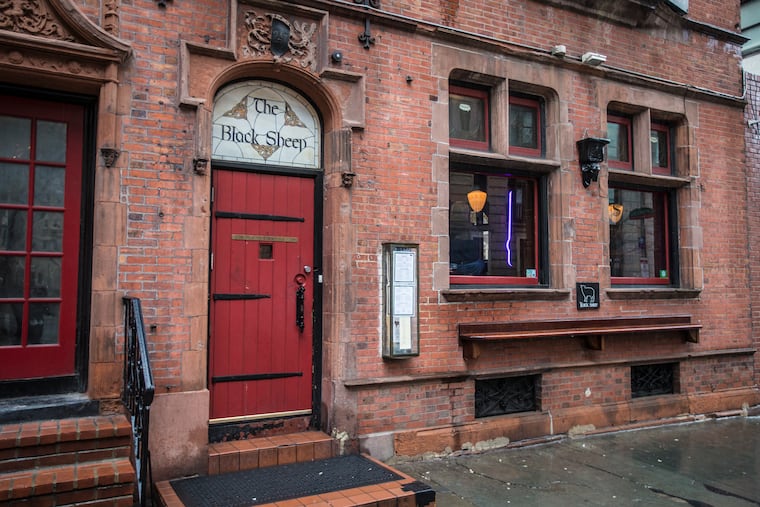
This week, Black Sheep Pub suffered a devastating fire. Philly’s Man United Fan Club has already raised over $25,000 to help.
Patrons of the Black Sheep, including its community of Manchester United supporters, have rallied around the establishment.
On Monday evening, Andrew Pickering was in Chicago for a work trip when he looked down at his phone and saw a concerning text.
It was in a WhatsApp chat of expats from Northern Ireland who now live in Philadelphia. One of his friends asked another, James Stephens, if he was OK.
Pickering didn’t know what was going on.
“There was a bit of a fire in The Black Sheep [Pub],” Stephens explained. “We’ll be open [soon].”
A few hours later, the fire reignited. This time, the damage was far worse. Flames rose from the kitchen up through the roof, breaking windows and covering the floors with ash and soot.
For Stephens, the owner of the bar at 17th and Latimer Streets since 2000, this was a devastating loss. He knew firsthand how hard it was to rebuild a business.
Growing up in Belfast in the 1970s and 1980s, Stephens had witnessed his father pick up the pieces, literally and figuratively, of his hotel after it was bombed during the Northern Ireland conflict.
This was nothing compared to that; an accidental fire that Stephens attributed to “heat and old wood.” But he had no idea how long it would take to reopen, and knew it would be difficult to retain his staff.
Pickering decided to step in. For years, the Black Sheep Pub had been the home to Philadelphia’s Manchester United Fan Club, following the legendary soccer team in the English Premier League. Stephens would wake up early in the morning to host watch parties, bringing donuts to the bar if there wasn’t any food.
Pickering was the club’s unofficial spokesperson; their friend, Kim Haggert, organized group events and ran social media. By Tuesday morning, they received dozens of messages from MUFC Philly members who wanted to help.
“It was like, ‘I’m an iron worker, I’ll volunteer,’” Pickering recalled. “‘I’m out of work at the moment. I can come into the city and help dig [things] out.’
“And [Stephens] goes, ‘Look, we’ve got 20 guys, we’ve hired people, don’t worry about it.’”
The Club started a GoFundMe to cover any costs Stephens and his staff would incur. It raised over $7,000 within the first few hours and more than $31,000 by Friday afternoon.
The fundraiser has now reached Manchester United fans internationally, including not just from Britain and Ireland but beyond.
“It’s just incredible,” Stephens said. “They can say what they want about Philadelphia. But the people of Philadelphia have a great heart.”
Expats in Philly
Stephens first met Pickering at Dickens Inn on South Second Street in the 1990s. The two were watching a soccer game between Northern Ireland and Austria, but there was fog on the field and it was hard to make out what was going on.
So, the two men struck up a conversation, and realized they had more in common than they thought. Pickering grew up in Dungannon, about 50 miles west of Belfast.
They both played rugby at Protestant grammar schools and were diehard Manchester United fans.
The expats became close friends. Their mothers would travel together to Philadelphia. Whenever Pickering and Stephens returned to their native land, they’d go as a pair and stay with Stephens’ family in Belfast.
Pickering had long been a patron of the Black Sheep, but he started regularly watching games there in 2019. He’d just moved back to the city, and wasn’t far from the neighborhood bar.
Man United, while a historically great team, had endured a tough stretch over the past decade by its standards. Waking up early to support them wasn’t always an enjoyable experience.
Pickering and his fellow members had a nickname to describe this.
“We weren’t the Philadelphia Manchester United Fan Club,” he said. “We were the Philadelphia Masochist Society. Because we would show up at 7:30 [a.m.] to watch us getting beaten by a Bournemouth, or whatever.
“But the misery was helped with company. Put it that way.”
Stephens didn’t run the Black Sheep like a normal Philadelphia sports bar. Manchester United games always took precedence. If the Eagles were on, American football fans would have to wait for the bartender to change the channel.
This didn’t bother the regulars.
“If we overlap with an Eagles game, the TVs don’t get switched over until the end of the Manchester United game,” Pickering said. “Guys will walk in and go, ‘What the hell is going on here? The bar is packed and they’re watching soccer.’”
Under Stephens’ leadership, the Black Sheep became far more than a place to imbibe. He created a community. Staff members stayed on for decades. Patrons would meet future husbands or wives inside its brick walls. People would host baby showers, engagement parties, christenings.
Which is why they are now so eager to help. At first, Stephens was reluctant to accept it. He is used to giving, not taking. But he thought about his staff, and what their next few weeks or months could look like, and relented.
“The outpouring of support … it’s made me so emotional,” he said. “It’s really … I knew we were a big part of the community, but the outreach, it’s been very touching. And it’s meant a lot to me and my family and my staff. We’re very lucky.”
‘We’re going to try to keep it the same’
When Stephens and his partners, Matt Kennedy and Gene LeFevre, bought what became the Black Sheep Pub in 1999, it looked very different. The building just off Rittenhouse Square had been vacant for about two years.
Cement covered its windows. Its basement had a “dark, dungeon-y” feel, according to Stephens. On the first floor was a square bar, right in the middle, and on top was a wide-open space for dancing.
The property was in disrepair, but its bones were still intact, and they were beautiful. Stephens and LeFevre found the blueprint from when the building was constructed in the mid-1800s and decided to recreate it.
This was a laborious process, but Stephens, Kennedy, and LeFevre were determined to get it right. They dug a few feet down, and removed the dropped ceilings to open the basement up.
A local designer, Bill Whiting, installed some artwork and leather wallpaper to give the pub a vintage feel. Brazilian black cherry wood stretched across its floors, and old tin lined its stained glass bay windows.
The windows alone took years to complete (and continued long after the bar opened in September 2000). Stephens met two artists while playing darts at a bar one night.
They’d since moved to Doolin, a village in Ireland not far from Galway. When the couple visited Philadelphia, they’d bring one or two stained glass windows with them.
When Stephens returned home, he’d stop to see them to pick up one or two more.
“Very cautiously,” he said.
Stephens knows that the future of his pub is uncertain. He doesn’t know when he’ll be able to open it, or what that will look like.
But the black cherry wood is still mostly intact. The Irishman lost two of his coveted stained glass windows but can order some more.
The artwork and the wallpaper can all be replaced, and so can the old tin.
“We’re going to try to keep it the same,” Stephens said, “and hopefully, it’ll be like we were never closed.”