Howie Roseman will have a role in remaking the Eagles offense. Here’s his offseason to-do list.
The fixation is on the Eagles getting a new play-caller. They also need more skill-position players to run those plays.
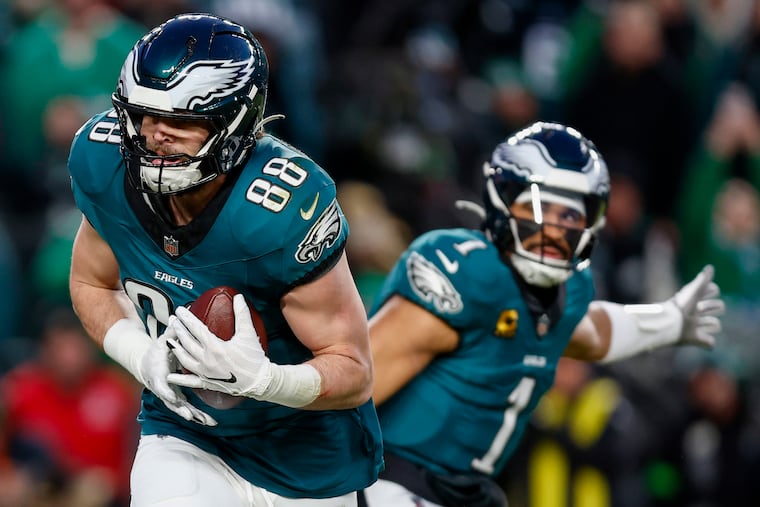
Diversification should be the operational word for Howie Roseman and his front office this offseason.
You’ve heard it said that the Eagles have more talent on their roster than any team in the NFL. The claim is more often than not the source of the shade thrown at Nick Sirianni and his coaching staff. When the Eagles win, it is because of their overwhelming talent. When the Eagles lose, it is because of how their overwhelming talent is coached.
That claim wasn’t true at the end of the 2025 season, and I’m not sure it was true at any point. The Eagles were getting less than 100 percent of Landon Dickerson and Cam Jurgens and zero percent of Lane Johnson. Even if A.J. Brown was 95 percent of the player he had been over the previous three years, that missing five percent is often what distinguishes very good players from unstoppable ones. Same goes for Saquon Barkley, whose name popped up on the injury report late in the season and who lacked at least some percentage of the lateral improvisation and finishing abilities that he’d displayed during the Eagles’ 2024 championship run.
All of these things could prove to be temporary, the result of the shortened recovery period that comes as a result of a season ending in mid-January rather than early February. It stands to reason that those most impacted would be players whose competitive advantage lies in their sheer physicality. Johnson, Brown, Barkley, Dickerson, and Jurgens weren’t as physically capable as they were in 2024. Yet, here we are, fixated on the play-calling.
That’s not to say the Eagles offense won’t benefit from a new strategic direction. But their problems clearly are not singular in nature, given the depth and breadth of their issues. For three seasons, the Eagles’ scheme was the logical conclusion of their personnel. They went to two Super Bowls and won one in a blowout because their talent allowed them — heck, required them — to keep it simple.
What we saw this season was a team whose elite performers could be mitigated enough to place the onus on those operating in their shadow. This reality expressed itself most clearly in the form of Dallas Goedert. He scored eight more touchdowns and averaged nearly as many targets per game as he did in 2022, when he averaged 59 yards per game and arrived at the Super Bowl being compared to Travis Kelce. But, this season, Goedert averaged just 39.4 yards per game, his lowest output since he was a rookie.
» READ MORE: Eagles need more than a new coordinator to revamp their offense
If the path forward for the Eagles is a scheme that does not rely as heavily on the singular abilities of players like Johnson and Brown and Barkley — and it almost certainly is — the path forward requires a roster that allows for such a scheme. It is a roster that has a third wide receiver with much better ball skills, and/or physicality on routes, than Jahan Dotson brings. It is a roster that has a second tight end who brings positive value as a run blocker and makes a catch or two a game. It is a roster that has a change-of-pace back who adds a different dimension from Barkley.
Let’s address those in order:
1) Fix the tight end position
Tight end is as important as it has ever been. Among the 13 highest-graded run blockers at the position according to Pro Football Focus, only two played for teams that missed the playoffs.
All three Eagles tight ends ranked among the 15 lowest-graded run blockers at the position (among 94 total).
Goedert’s future isn’t the only question. He’ll be a free agent after playing 2025 on a one-year deal. But the Eagles also need to find a TE2 who can complement the starter.
The Eagles were one of only five teams in the league that didn’t have a second tight end with at least 100 yards receiving. That’s partially due to the presence of two top-end wide receivers who were targeted on nearly half of Jalen Hurts’ pass attempts. But there is also a chicken-and-egg component to the Eagles’ narrow pass distribution. Would Hurts distribute the ball more evenly with a wider set of options? The Rams had four tight ends with at least 200 receiving yards despite Puka Nacua and Davante Adams combining for nearly half of the team’s targets.
The Eagles missed out on last year’s bumper draft crop at the position. They are missing what they once had in Goedert — a young, three-dimensional player who is poised to step up the way he did alongside of and then in place of Zach Ertz. They have no choice but to focus on the free-agent market. Jake Tonges is likely to return to the 49ers as a restricted free agent. The Ravens’ Isaiah Likely is unrestricted, but is likely to have a significant market. The Eagles need to find this year’s version of Colby Parkinson and move aggressively the way the Rams did post-2023.
2) Replace Jahan Dotson
A lot was made of the non-pass interference call deep down the left sideline in the Eagles’ playoff loss to the 49ers. But a receiver needs to earn those calls. Dotson has not.
In the entire NFL, there was only one wide receiver who caught fewer than 29 passes while playing at least 575 snaps. It was Jahan Dotson. He caught 18.
The Eagles’ fourth-leading receiver was Saquon Barkley with 50 targets, 37 catches and 273 yards. Dotson was behind him with 36 targets, 18 catches and 262 yards.
Only three playoff teams didn’t have a fourth pass-catcher with 300-plus yards: the Eagles, the Seahawks, and the Panthers. Of the 14 teams that made the playoffs, eight had at least five players with 300-plus receiving yards, including six of the eight teams that advanced to the divisional round.
That doesn’t prove anything, of course. There are lots of different ways to operate a functional passing offense. Nobody is saying the Seahawks would be better off if more of Jaxon Smith-Njigba’s targets went to Elijah Arroyo. But even the Seahawks’ pass distribution was fairly broad beyond their top three target-getters. They finished the season with eight players who had at least 22 targets and 144 receiving yards. The Eagles had five players with more than 13 targets and 92 receiving yards while throwing the ball about as often as Seattle (slightly more, in fact).
» READ MORE: Nick Sirianni’s forceful vote of confidence from Howie Roseman
Let’s not forget the whole point of this exercise. While functional NFL passing offenses take all sorts of forms, the Eagles’ passing offense was not functional. Assuming Brown returns and continues to draw the same coverages he and DeVonta Smith faced this season, the Eagles need a third wide receiver who can actually take advantage of the lack of attention paid to him.
3) A change-of-pace back
The Eagles need their version of the Ravens’ Justice Hill, a player who can take a screen pass 20-plus yards or gash a defense on the infamous third-and-long Will Shipley draw. Tank Bigsby was an excellent find by Roseman, but he brings a similar dimension to Barkley. The goal here is to find a veteran back with quickness and pass-catching ability who can be more than a lesser version of the lead back.
Long story short, the Eagles either need to upgrade the breadth of their skill sets behind their Big Three (Brown, Smith, Barkley) and/or find a fourth player who brings his own dynamic skill set that can exploit the defense’s focus on the stars.
Sure, they need a play-caller who can enable their skill players to fully express themselves.
They also need the skills.