How NASCAR driver Natalie Decker is balancing motherhood and racing after NICU scare
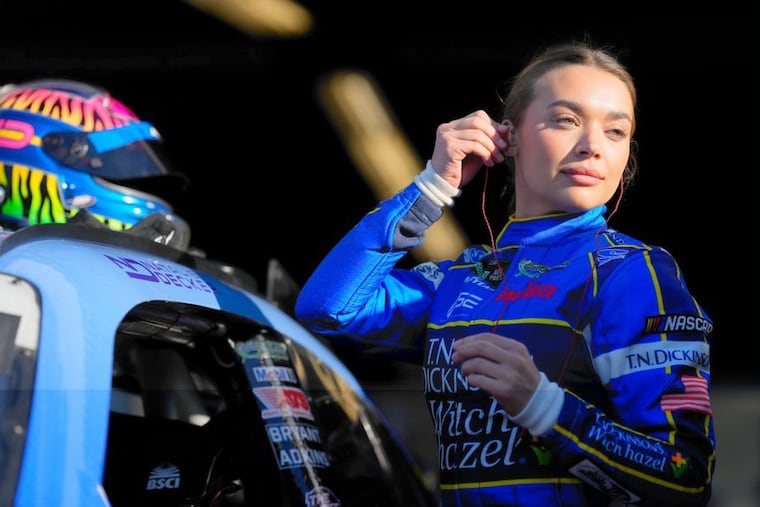
Natalie Decker, who drives Saturday at Pocono Raceway in the MillerTech Battery 250, continues to overcome any obstacle thrown her way — from NICU scares to racing through autoimmune diseases.
As a 9-year-old girl growing up in Eagle River, Wis., Natalie Decker would hop out of her purple go-kart, make her way over to a tiny toy stroller, and push her baby doll around the go-kart tracks.
Nearly two decades later, in August 2025, a 27-year-old Decker was still pushing around a stroller in between races. But this time the purple go-kart was replaced with a NASCAR stock car, and the stroller she was pushing belonged to her first newborn child, Levi.
“I always saw myself as being a mom one day,” Decker said. “Now, it’s real. It’s so crazy. In my racing suit, walking around in the garage area, carrying my baby, pushing him in the stroller. And I feel so grateful that I have the opportunity to be Levi’s mom. Once Levi was here with me, I was like, it’s life-changing. But in the most positive, best way ever.”
Levi attended Decker’s first race back from maternity leave, just six months after Decker gave birth, as she competed in the NASCAR Xfinity Series at Daytona International Speedway. Since then, Decker has continued to compete, including Saturday at Pocono Raceway in the NASCAR O’Reilly Auto Parts Series MillerTech Battery 250 race.
“Pocono is called the tricky triangle,” Decker said. “And it is tricky. I’m so excited to be racing there with T.N. Dickinson’s. But I haven’t been to the Poconos in years. I think it’s been five years since I’ve raced that. So, I’m really excited to get back.”
Ahead of her race, Decker reflected on her journey, discussed dealing with outside noise, balancing both motherhood and racing, and overcoming an autoimmune disease that should have limited her time on the track.
Start your engines
Decker grew up surrounded by racing. Her father, Chuck, was a former professional snowmobile racing world champion who owned the Eagle River Derby Track in Wisconsin. Chuck, along with his brothers Steve, Mike, and Allen formed Team Decker, one of the most decorated snowmobile racing dynasties.
“I grew up with a family that loved motorsports on my dad’s side,” Decker said. “I grew up around snowmobile racing and my dad always watched NASCAR on TV. So, I fell in love with it at a very young age. I didn’t necessarily like racing snowmobiles. I tried it. It didn’t go well. And it was cold.”
» READ MORE: Kyle Larson and the Urban Youth Racing School are teaching Philly students STEM
With no passion to follow in her father’s footsteps of racing snowmobiles, Decker asked him to buy her a go-kart. And after years of asking, he finally gave in on her ninth birthday, thinking they would just resell it after a few weeks.
But four years later, Decker was in a full-size stock car racing all across the United States. A few years after that, at 14 years old, she was racing the Super Late Model, the highest, fastest class you can get into on the asphalts.
“The motorsport industry is a small circle and everybody knows everybody,” Decker said. “I love [being part of a racing family]. My cousins [Paige and Claire] raced with me growing up. They both married into racing families. Once you’re in it, you don’t ever want to leave it.”
Balancing motherhood
Decker is starting her own racing family with her husband Derek Lemke, a fellow NASCAR driver. In February 2025, they became parents to their first child, Levi, who already has a love for race cars.
“He just turned 16 months,” Decker said. “And he is obsessed with race cars. Every time he sees a race car or anything with wheels, he goes ‘vroom, vroom.’ He just loves racing and it makes me really happy.”
After giving birth, the Deckers had a bit of an early scare. As soon as Levi was born, he was rushed to the NICU with holes in his lungs. Fortunately, he was able to heal on his own.
“He didn’t have to do any surgery,” Decker said. “He was a strong little man and was in the NICU for four days but it felt like four years. Now he’s a healthy, strong little baby. They’re so resilient but it was very terrifying at the moment.”
Six months later, Levi attended his mom’s first race back postpartum. And since then Decker has been balancing motherhood and racing, even if that means squeezing in a light workout while Levi sits and watches Mickey Mouse in the living room.
“It’s a lot to balance it all,” Decker said. “I would not be able to do it all without my family. Everyone’s so involved and I feel so lucky to have this much support around motherhood for me with Levi. When they say it takes a village to raise a child, it truly takes a village. And I have a village.”
Being a mother has also impacted how she handles herself on the racetrack.
“Racing is definitely a really physical sport,” Decker said. “And when it does get physical, it can start getting in your head a little bit. But, I’m like ‘Oh, this is nothing compared to carrying a baby for nine months and pushing this baby out. Like, I can literally do anything. I can conquer anything physically.”
The physical demands of NASCAR
The physical side of racing can be very taxing on the body, and for Decker this is especially so as she battles a number of autoimmune diseases. At 2 years old, she was diagnosed with juvenile rheumatoid arthritis. Since then, she’s developed Hashimoto’s disease, psoriatic arthritis, and psoriasis.
» READ MORE: Not your grandpa’s NASCAR: How Michael Jordan, Carson Hocevar, Rajah Caruth, and more are changing the sport
“It definitely changed my mindset at a very young age,” Decker said. “All my friends are going out to the birthday parties and the sleepovers and I have to go to my doctor’s appointment or stay home and take my methotrexate shot, it was the chemo drug. I realized life is not fair but it doesn’t mean you stop showing up.”
While taking methotrexate, Decker kept herself active with racing, hockey, and dance.
“I had to take it every week and it made me feel sick, more sick than the actual autoimmune disease,” Decker said. “So we would plan the shots around racing events or hockey games or whatever I was doing.”
To manage racing, Decker knows her own physical limitations and keeps that in mind when it comes to her training regimen.
“With my autoimmune diseases, my training does look different,” Decker said. “I do very low impact workouts and I don’t necessarily even lift weights. A lot of walking, walking on an incline on the treadmill and Pilates-type workouts. But I do everything at home.”
“The biggest thing [my autoimmune diseases] have taught me is to advocate for myself wherever that is, in the doctor’s office, or at the race shop with my team.”
Eliminating outside noise
Being an athlete in the sport is already challenging enough. But being a woman in the sport has added to the outside noise.
“The toughest thing about being a female in the sport is not necessarily with my competitors or my team,” Decker said. “It’s with the outsiders and the fans. They’re not as accepting. And this year, I’ve gotten into viewing a lot of hate that comes from social media and some of the NASCAR fans.
“It’s a privilege that our fans in the motorsports industry are just that dedicated and love the sport that much that they speak their opinions so strongly. So, that’s how I started trying to view it so I don’t get down on myself when there’s a bunch of hate going on online.”
Decker has tried her best to eliminate the outside noise.
“I have such a great support system around me,” Decker said. “That’s how I always raced and that’s how I will always do it. And that’s why I enjoy it so much. So, at the end of the day, if I have a bad weekend or a good weekend, I get to come home with my family and then go back to the race track again with my family.”