After striking gold in Paris in 2024, can NBC do it again at the Winter Olympics in Milan?
The winter edition has historically drawn lower audiences than the summer Games no matter the circumstances, but NBC once again is going all-in.

NEW YORK — In the lead-up to the Summer Olympics in Paris two years ago, there was no small amount of fear that the Games were losing their luster.
It probably didn’t help that there were three straight Olympics in Asia, which meant most of the action was overnight for U.S. television viewers. And the pandemic definitely didn’t help, because sports without crowds in the stands weren’t as fun to watch.
But NBC went all-in on Paris anyway, and was rewarded with huge ratings. Yes, people did still care, and they showed up to prove it.
Now the network faces the challenge of bringing that energy to next month’s Winter Olympics in Milan and Cortina d’Ampezzo, Italy. The winter edition has historically drawn lower audiences than the summer no matter the circumstances, but NBC once again is going all-in.
“We know the Winter Olympics haven’t been fully attended in eight years,” NBC’s Olympics executive producer Molly Solomon said at a media preview event last week. “We can’t take anything for granted. The media landscape has completely changed since 2018. So what have we got to do? We’ve got to win back viewers, we’ve got to show them why they should watch.”
As with two years ago, there will be a lot of coverage on the big broadcast network, starting with at least five live hours a day. Because of the six-hour time difference between Italy and the eastern United States, the traditional prime time show will be like it was in Paris, with a mix of highlights and features.
There will also be a lot of broadcasts on the USA Network and CNBC cable channels, and every event will be live on NBC’s Peacock streaming platform.
If it feels natural to say all that, veteran Olympics fans will remind you quickly of how different things used to be. For many years, NBC held back showing some big events live to save them for the big prime time show.
Paris was the first time NBC really opened everything up. It isn’t a coincidence that those were the first Games after Rick Cordella was promoted to president of NBC Sports, and the first outside of Asia after Solomon was promoted to her job in 2019.
“The Olympics in Paris proved the Olympics are back, and remain an unrivaled media property with the unique abilities to captivate the nation and generate audiences across all demographics for 17 days and nights,” Cordella said. “We expect Milan-Cortina to carry on that legacy.”
Solomon said she “felt as though we handed the viewer the remote control, and we said, ‘Hey, we’re going to give you different ways to watch the Olympics.’ And we’re now going to take all those learnings and build on them for Milan-Cortina.”
A big bet paid off
For as much as fans welcomed NBC’s change in philosophy, there was no guarantee it would succeed. If the prime time show’s ratings had flopped, some critics might have said the old way was more profitable.
Instead, the network shot out of the gate. An average of 34.5 million viewers watched the first three days of competition in what were seen as the two “prime” slots, live coverage from 2-5 p.m. Eastern time then the nighttime highlights show — including a massive 41.5 million on the first Sunday.
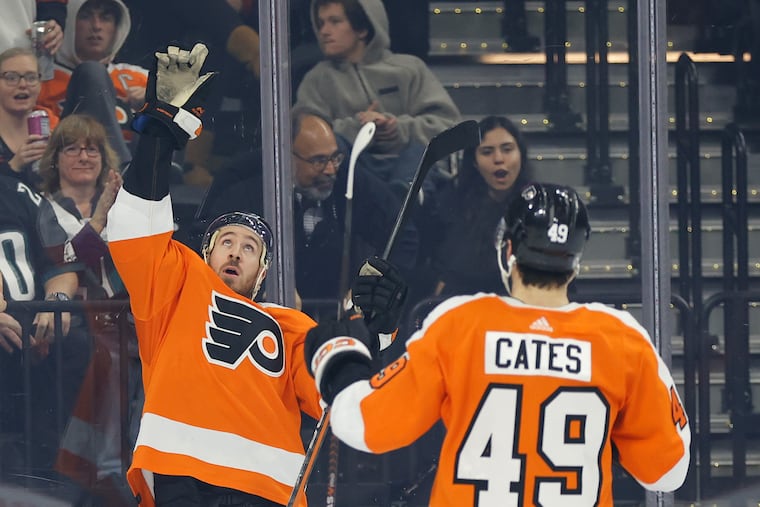
» READ MORE: Auston Matthews and the Tkachuk brothers headline USA Hockey’s men's Olympic roster
The average over the whole Summer Games ended at 30.4 million, which NBC said was up 80% from 2021 in Tokyo.
Solomon said that when Cordella called her after the first weekend with the early returns, “I burst into tears, because those numbers — I didn’t think it was possible. … We didn’t even dream that big.”
NBC’s lead Olympics host Mike Tirico said he could tell from the studio that things were working.
“We saw that there was a formula for the prime time show: that [showing an event] live and then showing it again, and there was enough differentiation in what we showed again, that it was connecting with viewers,” he said. “And then hearing back from people who were home: ‘Hey, this is so great, I’m enjoying watching it at night after we watch all the daytime events.’ Probably day four, I would say that Monday or Tuesday, was [when] I got feedback that it was working.”
The 2028 Summer Olympics in Los Angeles will be different again, since they’ll be on home turf. Then the 2030 Winter Olympics will be back in Europe in the French Alps.
Who knows what the media landscape will look like by then, given how quickly things change these days, but it’s hard to believe NBC will ever revert to its past.
“Just as a sports fan, I would say not,” Tirico said. He emphasized he was speaking just for himself, not his bosses, but his opinion counts for something.
“I think we’ve seen because of streaming, you can access anything you want at any time,” he continued. “There’s still the largest audience sitting there at the end at night, and you want to give them the biggest events [as highlights]. So holding them doesn’t make any sense in this day and age. And we had long talks about that before Paris, and I think we saw a formula that worked.”
» READ MORE: Hilary Knight set to make 5th Olympics appearance for USA women’s hockey
This year’s new additions
There will be a few new toys for viewers to enjoy next month. Peacock will have extra camera angles available for figure skating — including some behind-the-scenes ones — and ice hockey.
Solomon worked with the International Olympic Committee to get live drone cameras into coverage, to get microphones on some athletes, and to get into warmup areas to show how athletes get ready for their big moments.
“We’ve really pushed everybody to go places, and take the viewer places they’ve never seen before,” she said. “Because in the winter, you’re covered with goggles and head gear. So we need to be at the place before they put this stuff on. We need to see faces. And the International Olympic Committee has been great about granting us that access.”
The biggest new thing might be an expansion of the popular “Gold Zone” whip-around live highlights show. From 8 a.m. to around 4 p.m. each day, it will be televised not just on Peacock but on the recently relaunched NBCSN cable channel.
That means more viewers will have access, but it also takes away an incentive to subscribe to Peacock if you don’t yet.
“I think the NBA would say that would drive people to subscribe to Peacock, or Premier League [soccer], and now that’s available on NBCSN,” Cordella said. “And so our view of NBCSN is that we’re going to be agnostic to how people consume our content, as long as we’re getting adequately paid for it [by distributors]. We did a deal with YouTube [TV], we’ve done a deal with our parent company Comcast, and hopefully we’ll do a deal with others, but NBCSN is a big part of our strategy moving forward.”
For the most part, everyone speaking at the media preview event stayed away from another addition to the landscape: the United States’ current hostilities with Venezuela and Greenland, the Russia-Ukraine war, and the turmoil within U.S. borders over ICE and many other subjects.
But they did not stay away from the subject completely.
“I’ve just been thinking a lot about this: In this increasingly divided and isolated world, there’s not many moments when we all come together anymore,” Solomon said. “Sports does bring us together, but I think the Olympics is really even more unique.”
Comcast CEO Brian Roberts also alluded to wider affairs in his speech at the end of the event.
“Bringing our country together when a lot of things are pulling us apart is just a fabulous opportunity,” he said.