Longtime NFL commissioner Paul Tagliabue dies at 84
Tagliabue helped bring labor peace and riches to the NFL during his 17 years as commissioner. He came under fire for his failure to take stronger action on concussions.
Former NFL commissioner Paul Tagliabue died Sunday, his family said. He was 84.
The apparent cause of death was heart failure complicated by Parkinson’s disease, according to Mr. Tagliabue’s family, who said he died at his home in Chevy Chase, Maryland.
Mr. Tagliabue succeeded Pete Rozelle as commissioner in 1989 and served until he retired in 2006 and was succeeded by Roger Goodell.
“All of us in the NFL are deeply saddened by the passing of Paul Tagliabue, whose principled leadership and vision put the NFL on the path to unparalleled success,” Goodell said in a statement. “Throughout his decades-long leadership on behalf of the NFL, first as outside counsel and then during a powerful 17-year tenure as commissioner, Paul served with integrity, passion and an unwavering conviction to do what was best for the league.”
Mr. Tagliabue presided over a period of explosive, lucrative growth for the NFL as it expanded to its current 32 teams and established itself as the country’s most popular and prosperous professional sports league. He had a close relationship with Gene Upshaw, the longtime executive director of the NFL Players Association who died in 2008, and helped orchestrate a period of labor peace for the league following a players strike in 1987.
“Paul was the ultimate steward of the game - tall in stature, humble in presence and decisive in his loyalty to the NFL,” Goodell said in his statement. “He viewed every challenge and opportunity through the lens of what was best for the greater good, a principle he inherited from Pete Rozelle and passed on to me. During his Hall of Fame NFL career, Paul fostered labor peace with our players, oversaw the expansion of the league to 32 teams, ushered in an era of state-of-the-art stadiums and laid the important groundwork of establishing the league as a global brand.”
Mr. Tagliabue postponed the NFL’s games on the weekend following the Sept. 11, 2001, terrorist attacks, eventually rescheduling them at the end of the regular season. He was a staunch advocate that the Saints franchise would remain in New Orleans after the city was ravaged by Hurricane Katrina in 2005, which forced the team to play home games that season in East Rutherford, New Jersey; San Antonio; and Baton Rouge.
“He helped modernize the structure of the league office and its business operations, providing the playbook for the NFL’s strategic embrace of his era’s emerging technologies including cable, satellite and the internet,” Goodell said. “Paul was a fierce advocate for diversity and inclusion and guided the league through the challenges of 9/11 and Hurricane Katrina. I am forever grateful and proud to have Paul as my friend and mentor. I cherished the innumerable hours we spent together where he helped shape me as an executive but also as a man, husband and father.”
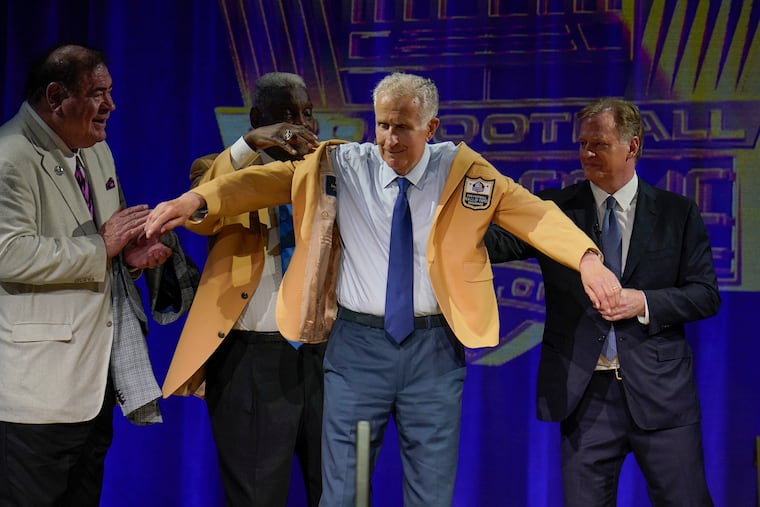
The NFL’s systems of free agency and the salary cap were established during Mr. Tagliabue’s tenure as commissioner. He was elected to the Pro Football Hall of Fame as a contributor in 2020.
Former Green Bay Packers executive Andrew Brandt wrote on social media that Mr. Tagliabue “[led] the NFL with grace and humility. As an experienced lawyer, [he] was great at seeing both sides of arguments. Always impressed by him.”
Following his retirement as commissioner, Mr. Tagliabue handled the appeals of the disciplinary measures imposed by Goodell on Saints players in the “Bountygate” scandal in 2012. He overturned the suspensions of four current and former Saints players and declined to fine them for their roles in the team’s alleged bounty scandal.
Mr. Tagliabue, appointed by Goodell to hear the players’ appeals, agreed that the team conducted a program that paid players for hits that injured opponents and that three Saints players - linebacker Jonathan Vilma and defensive linemen Will Smith and Anthony Hargrove - were guilty of conduct detrimental to pro football. But because the case had “been contaminated by the coaches and others in the Saints organization,” Tagliabue wrote at the time that he would not impose fines. A fourth player, linebacker Scott Fujita, did not engage in conduct detrimental to the NFL, Mr. Tagliabue concluded in his 22-page decision.
Goodell had suspended former Saints defensive coordinator Gregg Williams indefinitely; Sean Payton, then the Saints’ coach, for the entire 2012 season; General Manager Mickey Loomis for eight games; and assistant coach Joe Vitt for six games.
Paul John Tagliabue was born in Jersey City on Nov. 24, 1940. He played basketball at Georgetown and was a Rhodes Scholar finalist. He graduated from law school at New York University and was an attorney for prominent firm Covington & Burling. That led to his association with the NFL, first as an attorney for the league.
“We are deeply saddened to learn of the passing of Paul Tagliabue, one of the most respected and influential leaders in the history of the game,” Steve Hatchell, the president and CEO of the National Football Foundation and College Football Hall of Fame, said in a statement. “His impact reached far beyond the NFL, extending to every level of football, including the college ranks, where his steady leadership and forward-thinking vision helped forge relationships that helped strengthen our sport for future generations. His enduring commitment to education and excellence included endowing an NFF National Scholar-Athlete Award, a lasting testament to his belief in the power of football to develop future leaders.”
Mr. Tagliabue is survived by his wife Chandler, son Drew and daughter Emily, his family said.