Here’s how lacrosse became the sport of choice in this North Philly neighborhood
The Philadelphia branch of the Harlem Lacrosse program began in 2017. Today, it boasts six programs for both boys and girls starting in the sixth grade, serving more than 200 children.
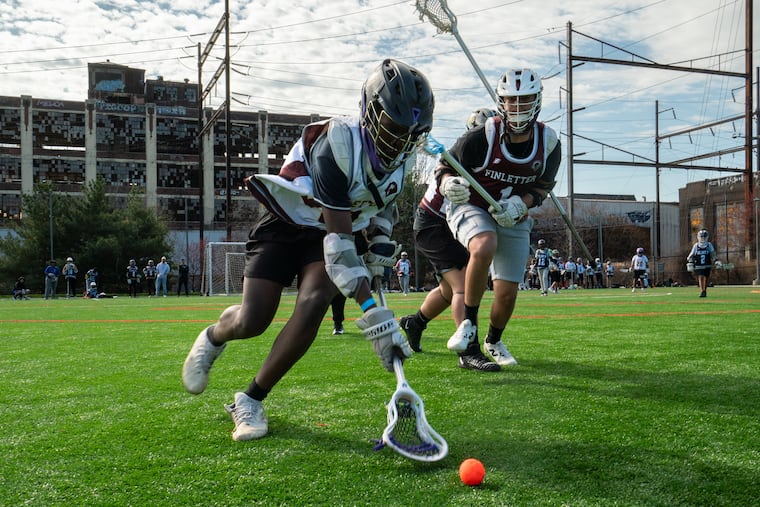
When Dami Olabisi picked up a lacrosse stick at 12 years old, he was the only Black player on his team, and that remained true through high school.
A decade later, Olabisi signed up to volunteer for a summer camp hosted by Harlem Lacrosse. He was surprised to see something he had never seen: Almost the entire camp comprised kids of color.
“This is my first time being able to not only coach, but be around other Black lacrosse athletes like myself,” said Olabisi, who is now the assistant coach for the organization’s boys’ program at Thomas K. Finletter Middle School in Olney. “So it’s really just been a pleasure.”
Harlem Lacrosse, founded in New York City in 2011, has since spread across the country with a vision of reaching kids at risk of academic decline and teaching them social-emotional skills through mentorship and team-building, with lacrosse as the vessel.
In Philadelphia, the organization is bringing lacrosse, a predominantly white sport at the youth and professional levels, to Olney, a neighborhood that is nearly 50% Black and roughly a quarter Latino.
There are 39 programs across Harlem Lacrosse’s branches, with 92% of its students identifying as either Black, Latino, or multiracial. Philadelphia’s branch began in 2017, now has six programs for boys and girls starting in the sixth grade, and serves more than 200 children.
The Philadelphia branch received a $250,000 grant from the state in April aimed at supporting “a wide range of community-based violence prevention and intervention efforts.” Anita Roberson, the chapter’s executive director, said kids in urban areas have lower access to extracurricular opportunities.
“Kids need stuff to do,” Roberson said. “Within certain communities, these resources and opportunities simply don’t exist.”
When Philadelphia reached a record 562 homicides in 2021, the Olney-Feltonville neighborhoods experienced 23. Since then, the murder rate has dropped significantly across the city, including in Olney, where there were five fatal shootings last year, according to city data.
Research has linked participation in youth sports with lower crime rates. A 2012 study of nearly 1,200 public high schools found that those with higher athletic participation rates had lower serious crime rates and suspensions, even when controlling for location and student-teacher ratio.
Simon Cataldo, a math teacher, founded Harlem Lacrosse in 2011 to help grow the sport among children of color. Cataldo turned to lacrosse to help his students when he noticed low classroom participation. He says his classes went on to post the highest grades in the state at year’s end.
Philadelphia’s program began working with the middle and high schools in Olney in 2022. Harlem Lacrosse practices year-round, but when lacrosse season starts in the spring, the coaches and directors coach the Olney schools. Kids in Harlem Lacrosse’s school programs participate in academic coaching, which allows them to get attention they may not get from a teacher in a dedicated office for the coaches.
“The mission is growing them in the academic space, growing and becoming an even better citizen, and, of course, as a lacrosse player,” middle school director Aidan Peck said. “I like lacrosse. It’s fun, but it’s because of what it’s doing for these kids. Being in the schools has been super helpful, just knowing that they can always stop by and they know where I am in the office, so if they’re having an emotional day, I’m there.”
White players have predominantly dominated lacrosse. According to NCAA data, 621 Black men played the sport in college compared to 13,593 white men in 2025. In the women’s game, 399 Black women played college compared to 11,386 white women.
“That’s something a lot of kids get when they get to Olney High School,” said Siena Childs, the girls’ high school director. “They’re like, ‘What do you mean? You’re playing lacrosse? That’s not a sport for y’all. We don’t play lacrosse.’ And it’s like, ‘No, we do play lacrosse. We actually are really good at it, and you guys should come watch us play.’”
Much of the racial disparity in the sport comes down to cost.
The average family spends around $1,289 on gear per child, according to SportsEpreneur. Harlem Lacrosse funds equipment costs for kids in their programs, said Roberson, who added that playing lacrosse helps the kids open an avenue to higher education.
“It’s no surprise that many of our students, because of their love of the game, then have a desire to continue to play, and one of the places they can continue to play is college,” she said. “So it serves as a motivator for them to seek higher education, which may or may not have been on the radar initially, before starting with the Harlem Lacrosse program.”
Childs said being part of a team leads to personal growth for her players.
“Being part of a team really helped them learn themselves as individuals,” Childs said. “That I think really shows when they do come back, and they’re coaching our kids, and they’re being a part of our program all over.”

Temple University’s Logan Center for Urban Investigative Reporting and the Claire Smith Center for Sports Media, in partnership with the Philadelphia Inquirer, have launched a series examining the state of North Philadelphia’s recreational facilities and youth sports programs and whether investing in them should be a cornerstone anti-violence strategy for City Hall.
We’ll visit parks, pools, and playing fields north of Girard Avenue to document the conditions of facilities and compare them to others throughout the city. We’ll also outline the challenges leaders face in maintaining activities for young people in the city’s poorest neighborhoods most impacted by gun violence.