‘Quad God’ Ilia Malinin talks ‘Fortnite,’ the pressures of being a role model, and bouncing back from his Olympic stumble
Malinin sat down with The Inquirer to discuss the challenges he faced heading into the Olympics, how the experience shaped him, and much more.
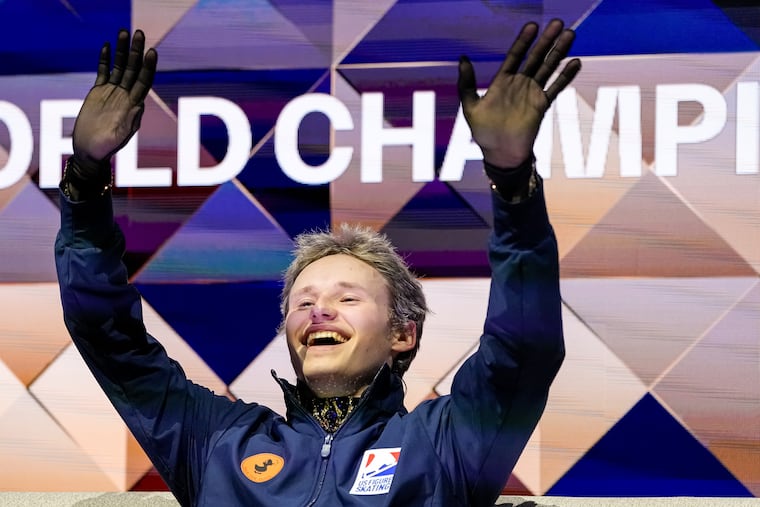
The U.S. figure skating team showed strength in the Winter Olympics behind the women’s trio known as the Blade Angels — Alysa Liu (the gold medalist), Amber Glenn, and New Jersey’s own Isabeau Levito. However, there was another star on the team: “Quad God” Ilia Malinin.
The 21-year-old is a three-time world champion, three-time Grand Prix final champion, seven-time Grand Prix gold medalist, four-time Challenger Series gold medalist, four-time U.S. champion, and an Olympic gold medalist.
His nickname came from his ability to land difficult quadruple jumps; in 2022, he became the first skater to land a fully rotated quadruple Axel in competition. In addition to the quads, he also can land on-ice backflips.
Entering the 2026 Winter Olympics, Malinin was seen as an early favorite for gold. Although he won a gold medal in the team event, he finished eighth in the men’s individual event after falling twice in his free skate. He quickly recovered after the Olympics, and won his third consecutive world championship.
After both events, Malinin sat down with The Inquirer to discuss the challenges heading into the Olympics as a gold-medal favorite, how the experience shaped him, and more …
» READ MORE: South Jersey figure skater Isabeau Levito reached the peak this year with the Olympics. She wants more.
Q: At what moment did you realize you wanted to be an Olympian?
A: When I was younger, it was just something about me. When I started skating, everyone asked me, ‘Are you going to go to the Olympics?’ So, at first, I didn’t know what that was, and then obviously I did some research about it, and it inspired me to want to go.
Both my parents were two-time Olympians themselves in skating. [Tatiana Malinina and Roman Skorniakov competed for Uzbekistan at the 1998 Nagano and 2002 Salt Lake City Winter Olympics.] So I felt like it would have been right to follow the dream, follow the family tradition of them being Olympic skaters.
Q: How do you think the Olympics have shaped you into the person that you are today?
A: It has changed so much. I really came into the Olympics thinking that I was prepared, thinking that it was going to be just like anything else. But, coming back, realizing that it was such a different experience from anything I’ve ever experienced. And it really just changed me for the better. I just learned so much about it, and really gained a new perspective on life and sports.
» READ MORE: Alpine skiing star Mikaela Shiffrin discusses post-Olympic life, her ‘inspo’ Kylie Kelce, and more
Q: What were some of the challenges that you faced going into things as a gold medal favorite?
A: Everyone was basically saying ‘Oh, he’s going to win.’ Like, it was everyone saying that. There was so much tension and so much pressure, and I think it really got to me and, you know, did what it did. But in the end, I feel like that’s a lesson that I can learn from. And everyone can see we’re still human.
It’s not like we’re robots and we’re programmed to go out and be as perfect as we can. It’s what we love to do, and that’s why it’s so beautiful, [but] you never know if it’s actually going to work or not.
What’s something you wish people asked you more about?
A: How draining it really is. It’s pretty draining to have an expectation of everyone to seem as if you’re a perfect person and perfect role model. But I think people need to realize that it’s OK to be unique. It’s OK to have your own individuality and just knowing that it’s OK to be different.
Q: Where do you see yourself four years from now?
A: I see myself looking forward to the next Olympics, but also I really see myself being a completely different person than I am even in this moment. I like to appreciate life, to be grateful for everything, and know that everything has a purpose. So I feel like everything happens for a reason.
I’m really looking forward to what the next four years are going to be like for me, and how big I can help my sport grow, and how I can grow myself as an athlete.
And what is post-Olympic life looking like for you so far?
A: Post-Olympic life has still been pretty chaotic. I only had two weeks after Olympics to prepare myself for the World Championships and then after that, I flew straight from Prague [Czech Republic] to Japan for ice shows. And then now I’m here [in Philadelphia, for a Comcast event].
So what do you do to unwind?
A: Just finding free time and doing what makes me happy. And that’s also performing the shows themselves. I love to skate, and that’s my passion. That’s why I’m still skating, and I think it’s pretty simple to think that way. So just anything that makes me happy is how I wind down.
I saw you also like to play Fortnite. How often are you playing?
A: I do. Very big in it. Every chance I get, that’s what I’m doing. I wish I had a custom skin, but I have a custom setup that I play with. It’s called a superhero skin, and my main colors are black and gold. So I like to do a combination of those colors.
Would you want to see your own emote on there? If so, what would it be?
A: I would love to, yeah. I’d love for it to be a quad Axel. But, I think at least if it’s a figure skating move or maybe even a backflip in there, then I’d love that.