Mike Gansey will have one big question to answer as his Sixers tenure begins
How much will the Sixers value players who make them a better team now vs. players who might make them the team they’ll need three years from now? Gansey’s first task is to sell fans on that vision.
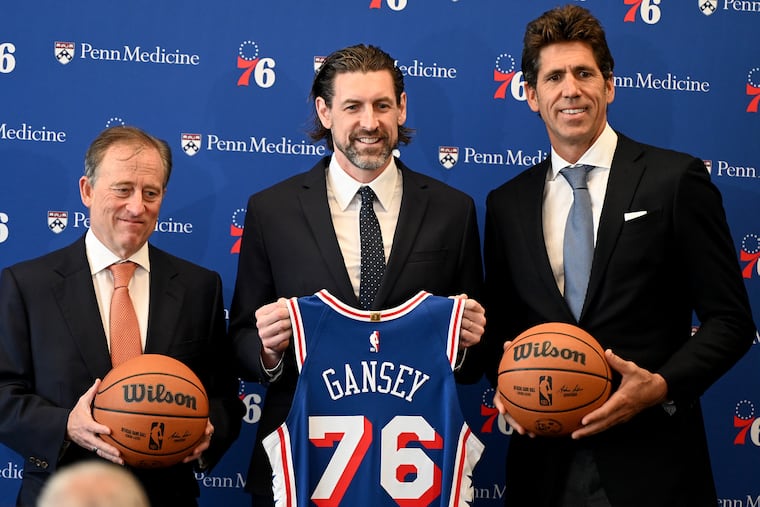
It is fitting that the Sixers will introduce their new personnel chief on a day that could end with the Knicks one win away from their first NBA championship in 53 years. The last time they held one of these press conferences, the Knicks were coming off their sixth straight season with fewer than 33 wins and heading into a campaign where their starting lineup would include Nerlens Noel and Elfrid Payton.
By the end of Daryl Morey’s first season as president of basketball operations, the Sixers would have a 15-game winning streak against the Knicks dating back to 2017. Six years later, there’s no better way to measure the organization’s stagnation than against the ascendancy of its closest neighbor.
In short, the Sixers have selected a heck of a contextual backdrop for Mike Gansey’s first meeting with the Philadelphia media. Not only are the Knicks up 2-0 in the NBA Finals, but they are there with a starting lineup that features four players drafted no earlier than 23rd overall, plus a center whom Joel Embiid once used as his literal and figurative punching bag. Granted, the Knicks were not the team that drafted any of the five. But they also weren’t the team that traded one of them away.
» READ MORE: Mike Gansey is the guy for Bob Myers and the Sixers on paper. But what exactly will that mean in practice?
The Villanova angle has been well trod. For good reason. It is a remarkable twist of the knife. Less examined are the more painful connections.
In 2017, the Sixers traded up for Markelle Fultz in a first round where OG Anunoby went at No. 23 and Josh Hart at No. 30. They are two of five players from that year’s draft who participated in this year’s conference finals.
The following year is the year best known as the one where the Sixers drafted Mikal Bridges at No. 10 and then traded him away for a guy who would play 13 career games. It was also the year where they drafted Landry Shamet seven spots before the Mavericks took Jalen Brunson. The kicker is that Shamet is now on the verge of a ring as a key reserve with the Knicks.
This exercise is mostly an example of the fun of cherry-picking your hindsight. But there is some level of truth in it. Like Morey, Gansey will be inheriting a team that is largely a function of some consequential missteps in its long ago past. The original vision was to lose a lot of games in the hopes of drafting a homegrown triumvirate like Fultz, Embiid, and Ben Simmons. The Sixers ended up with more chances than they deserved at executing a pivot. Each time — with Bridges and Jimmy Butler, notably — they kicked the ball right back out of bounds.
Now, somehow, they have another chance.
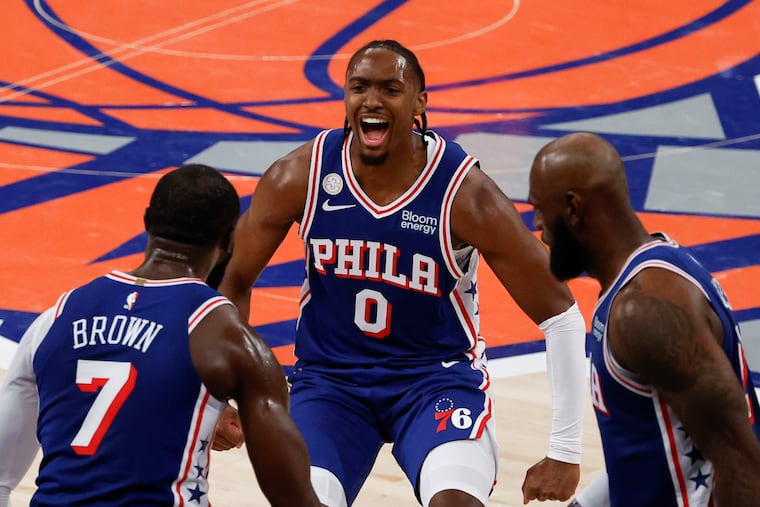
Gansey’s hiring comes at a critical time for the Sixers. Somehow, they find themselves at an inflection point that could prove just as critical as those they deflected in the past. Tyrese Maxey and VJ Edgecombe are both gifts from forgiving gods. Maxey was selected with the No. 20 overall pick that the Sixers initially traded to the Magic in the Fultz draft and then reacquired by trading a then-floundering Fultz to the Magic. Edgecombe was selected with the No. 3 overall pick that the Sixers landed because of how bad they were in Year 1 of the Paul George/Embiid Era.
» READ MORE: Sixers promote Jameer Nelson to executive vice president of basketball operations
Monday’s press conference will hopefully be an opportunity to hear Gansey’s response to a question that nobody from the Sixers has yet answered. Bob Myers and Josh Harris took turns dodging it a month ago in the wake of Morey’s firing. They surely posed it during their interview sessions with the former Cavaliers general manager. However much say Gansey ends up having relative to Myers, his hiring is pretty good evidence that their philosophies are all in alignment here at the beginning.
Where do the Sixers go from here?
While the futures of Embiid and George are clearly the biggest variables, they also might be beside the point. There is only one answer. Their future is here, with the Sixers. Each of their contracts renders impossible a mutually beneficial trade, at least for next year. Gansey’s real challenge is how to factor that reality into his attempts to build around Maxey and Edgecombe.
Maybe that is giving him and the Sixers too much credit. I suppose there is a chance he comes out and says he sees a roster that is built to win now, that Embiid is still the centerpiece of this team and George is still a fine championship-caliber starter. I suppose he could look at the No. 22 pick in this year’s draft and the Sixers’ relative wealth in future drafts and see mostly the capital it would take to add a win-now player to George, Embiid, Edgecombe, and Maxey.
But I doubt it.
If that was a philosophy Myers and Harris agreed with, they wouldn’t have had a reason to part ways with Morey. The change at the top only made sense if they sought a change in vision. Let’s hope we hear Gansey articulate that vision.
There are lots of different ways to build a championship contender. There are lots of different timelines. The Knicks remade their entire roster from scratch in the span of a couple of seasons, but they built a team so sensible that it feels like it was drafted and developed together. The Spurs hit on three top-five draft picks in Victor Wembanyama, Stephon Castle, and Dylan Harper.
In the push-pull between present and future, how much will the Sixers value players who make them a better team now vs. players who might make them the team they’ll need three years from now? Gansey’s first task as president of basketball operations is to sell his fan base on that vision.