NBA’s revised draft lottery could be huge for the Sixers ... in a strange, unadvisable way
The NBA’s so-called “3-2-1″ proposal could end up being a massive boon to a team in the Sixers’ circumstances.
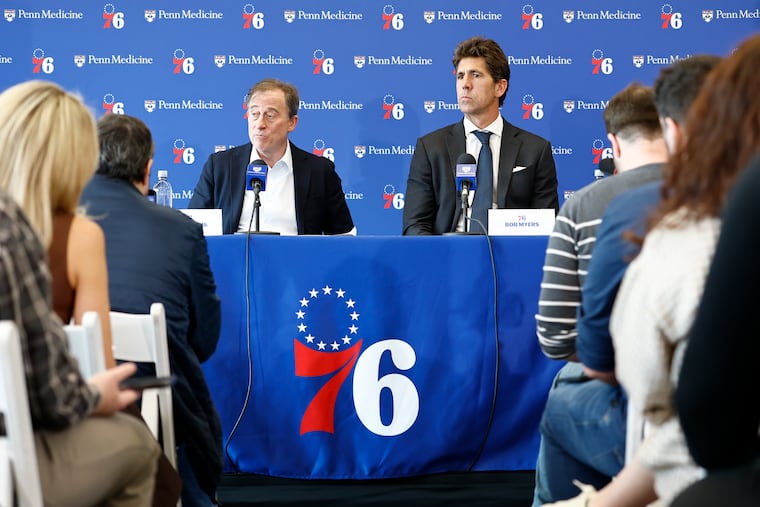
While I’m skeptical that tanking can be legislated out of a league with the talent scarcity of the NBA, I’m also a sucker for a tire fire. So count me in favor of the lottery reforms that the league office is pushing. Sixers fans should also be in favor, given how much their team stands to benefit.
The NBA’s so-called “3-2-1″ proposal could end up being a massive boon to a team in the Sixers’ circumstances. So much so that they might be better off remaining in their circumstances rather than trying to build on their surprise run to the Eastern Conference semifinals. If that sounds suspiciously like a perverse incentive, it should. Because it is. Tanking might be out. But strategic mediocrity is in!
» READ MORE: What national reporters and fans are saying about the Sixers’ search for a new president
Under the new lottery framework, which could be in place in time for next year’s draft, the Sixers would effectively have been penalized for winning 10 of their last 16 games and then beating Orlando to get the seventh seed in the playoffs. Despite winning just one more game than the Hornets and two more than the Heat, the Sixers would have been shut out of the lottery while both Miami and Charlotte would have a 1-in-4 chance of landing a top five pick and a five percent chance at landing No. 1 overall.
The 3-2-1 system would work like this:
Thirty-seven lottery balls would be distributed among 16 teams, with each team getting either three, two or one ball.
The teams with the three worst records would get two balls apiece.
The teams with the fourth through 10th worst records would get three balls apiece.
The ninth and 10th seeds in each conference would get two balls apiece.
The loser of the No. 7 vs. No. 8 play-in game in each conference would get one ball apiece.
The end game is less complicated than it sounds. Effectively, the 14 worst teams in the league would each have relatively even odds at the top overall pick and every pick thereafter. The seven teams with three balls would have a 23-ish percent chance at a Top 3 pick; and the seven teams with two balls would have a 16-ish percent chance at a Top 3 pick. That’s not a punitive difference, but it is a meaningful one. The important aspect is the elimination of any incentive to lose as many games as possible. Under the new system, there would have been no Process. But there might’ve been something even worse.
A lot depends on a wrinkle that is effectively bearing the weight of the whole apparatus. The NBA has said that the league office will have the power to penalize a team’s lottery odds if it engages in any shenanigans. Silver and Co. haven’t said what would constitute shenanigans, nor have they said anything specific about the process for declaring shenanigans. One imagines this will be a know-it-when-you see it kind of thing. And maybe the ambiguity is the cudgel. If so, it will need to be a massive one. As things have been explained thus far, there is a massive incentive for mediocre teams to finish as the ninth seed or lower rather than shower themselves with the glory of losing a first round playoff series.
There’s no better example of the potential unintended consequences than the Sixers and the bottom of the Eastern Conference this season.
With 20 games left in the regular season, the Sixers were one of six teams within three games of either the No. 5 seed or the No. 10 seed. Under the current system, the Sixers were a high likely to surrender their top-four protected first-round pick to the Thunder, regardless of how the rest of the season played out.
But in the new system, the 34-28 Sixers would have better than a 1-in-5 chance at landing a top-four pick ... assuming they finished as the No. 9 or No. 10 seed. Imagine the conspiracy theories that would have been floated when Joel Embiid was held out of a game against the Wizards due to an illness and then was sidelined with appendicitis.
One can argue that the Sixers ended up being an example of the benefit of giving it the old college try. But their victory over the Celtics was a black swan. The conventional wisdom down the stretch is that they were paying for the right to get blown out in the first round. Does the revenue from a couple of home playoff games really cancel out a 25 percent chance at landing a potentially franchise-altering draft pick?
The NBA’s goal is to eliminate the race-to-the-bottom incentivized by awarding the best lottery odds to the worst teams. The new proposal certainly accomplishes that. It also opens up a whole new carton of rancid cottage cheese. Before, the race to the bottom was out in the open. Under the new system, the spoils will go to the teams that can best disguise their attempt to be just bad enough.
A concrete example of the perverted calculus that a team like the Sixers must perform can be found in their decision-making about Quentin Grimes. In theory, the Sixers can go over the cap to re-sign the unrestricted free agent, since they own his Bird Rights.
But they are also heading into a season in which they could easily finish as the ninth to 12th-worst team in the conference, thereby guaranteeing themselves two or three lottery balls. The Pacers will be back near the top of the conference, joining the Knicks, Pistons, and Cavs as the presumptive top four seeds. Behind them are teams on the rise like the Raptors, Hawks, and Hornets. The Heat are lurking. The Magic are good enough on paper to join the top group. What sense would it a make for the Sixers to overpay a player for a few more marginal wins when the wins on the margins could cost you serious draft capital?
To be clear, the new system is a boon for a team like the Sixers. In fact, it seems tailor-made. Their 2028 unprotected Clippers pick is more valuable, given the likelihood that the Clippers end up with two or three balls. Each of their own first-round picks is more valuable, since their most likely outcome over the next two to three years will be not-good-enough but also not awful. The question isn’t whether they will play it honest. The question is what honest even looks like.