A beginner’s guide to watching figure skating at the 2026 Milan Cortina Olympics
What's the difference between pairs and ice dance? How about all those jumps? From that to Chock and Bates, local ties, and the Quad God, we've got you covered.
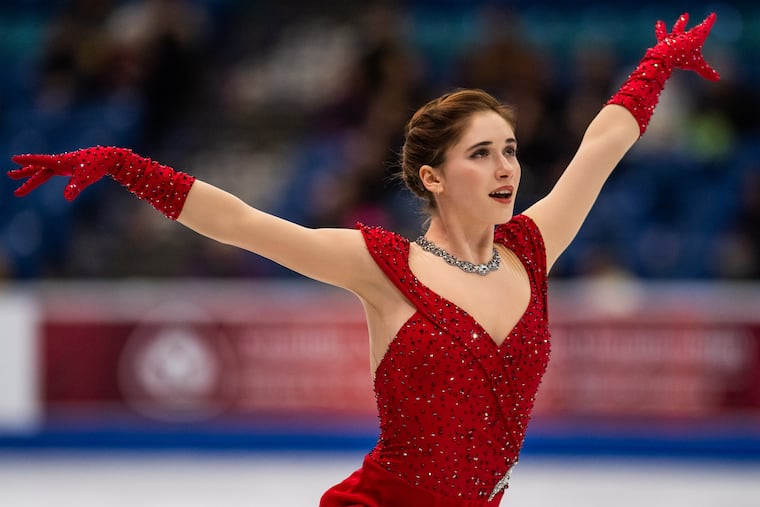
Figure skating is one of the most popular events at the Winter Olympics.
But many only follow it every four years, which can make it confusing when the rules change — as they do annually. Most of the names also are new since 2022.
Plus, figure skating is a judged sport, so sometimes the skater you love might get dinged on rules you don’t know and not place as well as you’d expect.
Here is a breakdown of how to watch the Olympic figure skating events:
What are people talking about?
The Blade Angels
The American skaters! Team USA has been a powerhouse off and on, but 2026 is very much an on year.
On the women’s side, all three women — who call themselves the Blade Angels — have major titles to their name. South Jersey’s Isabeau Levito is the 2023 U.S. champion and the 2024 world silver medalist. The 18-year-old was born in Philadelphia and lives and trains in Mount Laurel.
Amber Glenn is a three-time U.S. champion and won the Grand Prix Final in 2024.
Alysa Liu is a two-time national champion and the reigning world and Grand Prix Final champion.
The Quad God
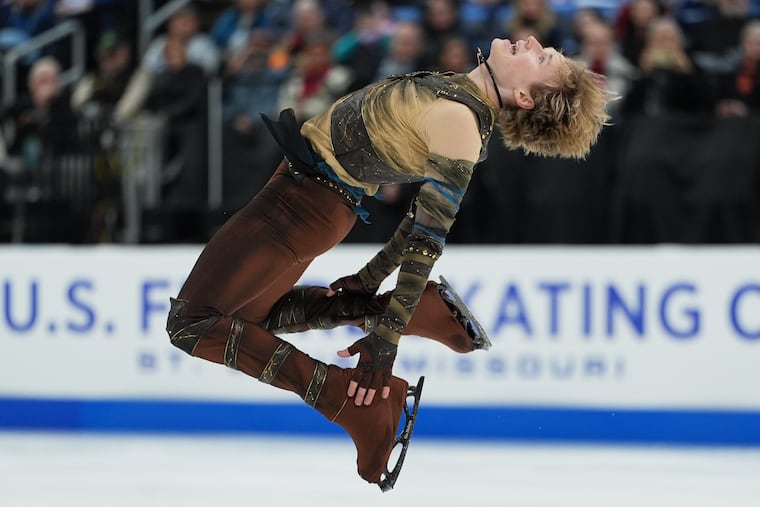
Ilia Malinin named himself the Quad God early on, and he’s lived up to that name, landing seven triples (the six major jumps plus one in combination at the 2025 Grand Prix Final in December.
He is the only man in the world to land a quad axel in international competition. Sometimes called the quaxel, it is 4½ revolutions in the air with a forward (read: harder) takeoff.
The quad axel was the talk of the 2022 Olympics in Beijing because Japan’s Yuzuru Hanyu was going to attempt it. But he did not land it cleanly.
Malinin has competed it many times since then. Thanks to the difficulty of the move and his consistency, he has not lost a competition he skated in several years.
» READ MORE: South Jersey’s Isabeau Levito wins bronze at the U.S. Figure Skating Championships with a clean program
Second-generation skaters
All three men on the U.S. team are second-generation skaters. Malinin’s parents represented Uzbekistan at two Games.
Andrew Torgashev’s Ukrainian mother, Ilona Melnichenko, competed for the Soviet Union and was the 1987 World Junior champion in ice dancing. His Russian father, Artem Torgashev, was a pairs skater, also for the Soviet Union, and is a two-time World Junior Championships medalist.
Maxim Naumov’s parents, Evgenia Shishkova and Vadim Naumov, were world champion pairs skaters and Olympians. They were killed last year in a midair plane crash over the Potomac River that also killed many young figure skaters, their parents, and coaches.
Ice dancer Anthony Ponomarenko’s parents, Marina Klimova and Sergei Ponomarenko, are the only ice dancers to have won an Olympic medal of every color. They are the 1992 Olympic champions.
Chock and Bates
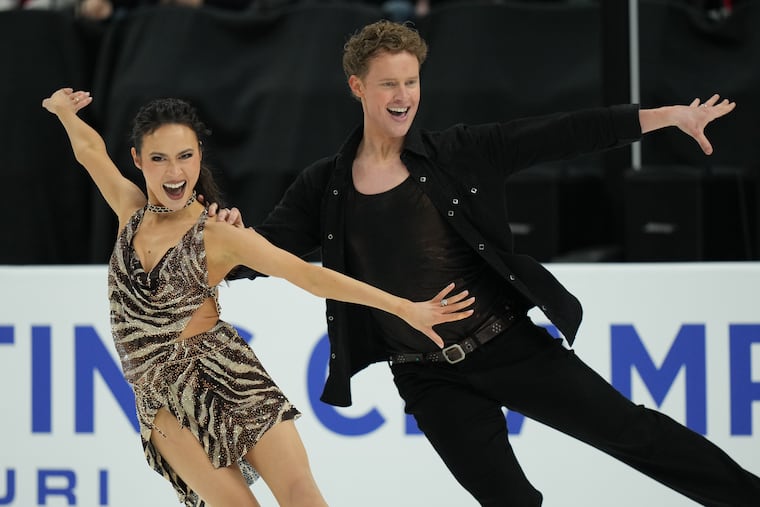
American ice dancers Madison Chock and Evan Bates are back for their fourth and fifth Olympics, respectively. The married couple has a team gold medal from the 2022 Winter Olympics. They are seven-time national champions and three-time world champions. The only title they haven’t earned yet is an individual Olympic medal. There are a few other teams who could challenge them for Olympic gold, but they have the edge entering the event.
The oldest competitor and whether she can skate
Deanna Stellato-Dudek is 42 and competed in singles for the United States when she was a teenager. She retired because of injury but came back 16 years later when she realized her unfulfilled Olympic dream. She competed in pairs for Team USA before teaming up with Maxime Deschamps and eventually getting her Canadian citizenship.
She was injured in training and had to withdraw from the team event. In the next few days, her team will decide if she can skate in the individual pairs event.
Russian skaters
After a four-year ban because of the war in Ukraine, Russia was allowed to send a limited number of skaters to an Olympic qualifier competition to compete as neutral athletes. They were not considered if they had shown any support for the war. Two women qualified: Adeliia Petrosian and Viktoriia Safonova. Petrosian is in contention for a medal and likely will be the only woman to attempt quads at the Games.
One neutral Russian man was cleared to compete, Petr Gumennik. No pairs or ice dancers were allowed.
Who else is on Team USA?
The other U.S. dance teams in Milan are Ponomorenko and Christina Carreira, who’s from Canada and recently became a U.S. citizen. They are the 2026 U.S. bronze medalists and medaled twice at the World Junior Championships.
Emilea Zingas and Vadym Kolesnik teamed up in 2022 and quickly found success. They are the 2026 U.S. silver medalists.
In pairs, Ellie Kam and Danny O’Shea, the 2026 U.S. silver medalists and 2024 champs, are fan favorites because O’Shea competed through three Olympic cycles before he made the team. They are 13 years apart.
Emily Chan and Spencer Akira Howe overcame a rough short program to place fourth (and win the pewter medal) in January’s U.S. championships. They made the team because other top teams’ skaters didn’t share citizenship. Chan and Howe are the 2023 U.S. silver medalists. Howe is in the World Class Athlete Program of the U.S. Army and hopes to become an Army chaplain.
» READ MORE: Competitors are not always rivals. Just ask the top American women’s figure skaters, Isabeau Levito and Amber Glenn.
What is the team event vs. the individual?
Normally, skaters compete individually or in pairs. In 2014, the team event was added to Olympic competitions. Different skaters can skate the long and short programs for each event (men’s, women’s, pairs, dance), but a team can repeat in two events.
Only the ones chosen to skate win medals, rather than the entire Olympic team.
The team event began with ice dance on Friday and ran through Sunday. Individual events begin Monday, also with ice dance.
In 2022, Russia was poised to win the gold, with the United States right behind it and then Japan. But after 15-year-old Kamila Valieva was found with banned drugs in her system, she was retroactively banned for four years. (That period recently expired, and Valieva is training again.)
After a nearly two-year legal case, the United States was moved up to the gold medal position, Japan to silver, and Russia to the bronze. The U.S. skaters received their gold medals at the 2024 Summer Olympics in Paris.
In past team events, the United States won bronze in 2014 and 2018. Russia and Canada were the other medalists both years (Russia won in 2014, and Canada in 2018).
What is the difference between pairs and dance?
Pairs has the big jumps, throws, and lifts. Dance is almost entirely footwork and is based on ballroom dance.
What is the difference between the short program and the long program?
The short program has a set of required elements that the skaters must perform. They have some freedom within those restrictions. For example, if they are told to do a triple jump, they may choose any triple jump. Generally, they choose the harder jumps because they earn more points. But they may also choose the jump they do best.
If skaters miss a required element, they get a zero for it. For example, if a triple jump is required and the skater does a double instead, it is as if he or she didn’t jump at all.
In dance, the short program is called the rhythm dance. A theme is chosen every year. This year, it is “the music, dance styles, and feeling of the 1990s.”
The long program has more freedom, but it still must be a “well-balanced program,” meaning a combination of elements covering the full surface of the ice.
How long are the short and long programs?
The short program for singles and pairs is 2 minutes, 40 seconds, plus or minus 10 seconds. The rhythm dance is 2:50, plus or minus 10 seconds.
The long program for all is four minutes, plus or minus 10 seconds.
What are the differences between figure skating jumps?
The skating blade looks flat, but it actually is sharpened to a curve with two edges.
Jumps take off from an edge (axel, loop, Salchow) or from the skater tapping in his or her toe (flip, Lutz, toe loop).
The axel is a forward entry but lands backward. All other jumps start and land backward.
The flip and Lutz are very similar toe jumps, but the flip is from an inside edge, and the Lutz from the outside, meaning the Lutz requires slightly more rotation, and thus is given more points.
A common mistake is that a skater will aim to do one but change the edge at the last minute. Commentators often talk about that as a “flutz.”
Another common mistake is a “cheated” jump, meaning the blade lands at least a quarter turn short of rotation. That results in a deduction or sometimes even a downgrade, meaning an intended triple jump is called a double.
Which skaters are expected to do well?
Along with the U.S. women, the Japanese women are very strong. They are led by three-time world champion Kaori Sakamoto, who won the Olympic bronze medal in 2022.
On the men’s side, along with Malinin, the top contenders include Yuma Kagiyama of Japan, who earned the silver medal at the 2022 Olympics and is also a three-time World silver medalist. France’s Adam Siao Him Fa and Kazakstan’s Mikhail Shaidorov are others to watch.
The top ice dancers are Chock and Bates. Canadians Piper Gilles and Paul Poirier earned the silver medal behind Chock and Bates in the last two world championships.
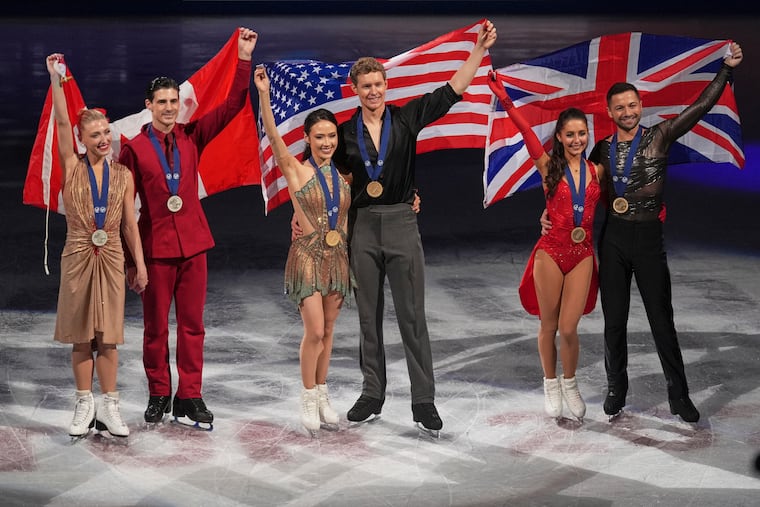
The pairs contenders are led by Riku Miura and Ryuichi Kihara of Japan, the reigning world champions. Others include Sara Conti and Niccolò Macii (Italy), Minerva Fabienne Hase and Nikita Volodin (Germany), and Anastasiia Metelkina and Luka Berulava (Georgia).
How is Olympic figure skating judged and scored?
The judging system was changed after the 2002 Salt Lake Olympics judging scandal, when two judges allegedly colluded to make certain skaters champions. The 6.0 system was replaced by IJS, the international judging system, which defines how many points each element is worth.
The officials include judges and a technical panel. The technical panel determines an element — including whether a triple should be downgraded to count as a double — and the judges decide the quality of the element. Skaters may be given a positive or negative grade of execution depended on how the element was performed. They also are given points for skating skills, transitions between elements, and performance. This is how a more artistic skate with fewer big jumps, can still do well. It is also how a skater with lots of impressive jumps but easier footwork may not win.