Japan’s Kaori Sakamoto wins her fourth figure skating world title; South Jersey’s Isabeau Levito places fourth
Sakamoto became the first four-time World champion since American Michelle Kwan. Levito’s free skate score was a 134.83, which was seventh place, but her overall score kept her in fourth.
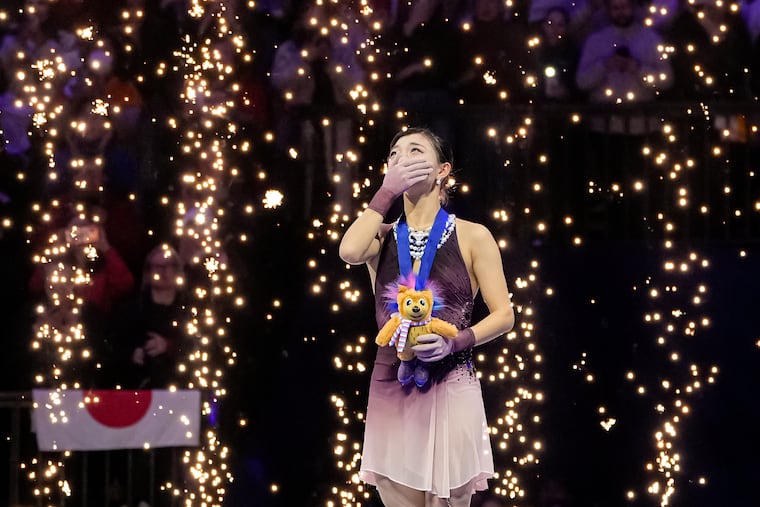
South Jersey’s Isabeau Levito placed fourth Friday at the World Figure Skating Championships for the second year in a row.
The sentimental favorite, Japan’s Kaori Sakamoto, won her fourth world championship at the competition in Prague, Czech Republic. Sakamoto skated to Non, je ne regrette rien by Patricia Kaas and Édith Piaf. Sakamoto, who previously said she was retiring at the end of this season, also had been the favorite to win the Olympics, but did not skate her best there and placed second to the United States’ Alysa Liu in Milan, Italy.
Sakamoto even surprised even her longtime coach by saying after the Olympics that she still wanted to skate Worlds. She became the first four-time world champion since American Michelle Kwan.
In Liu’s absence, Sakamoto’s teammate Mone Chiba won the silver. Nina Pinzarrone, from Belgium, earned the bronze.
Levito, who lives and trains in Mount Laurel, skated a clean short program Wednesday in Prague, redemption for a 12th place finish at the Olympics. Levito was fourth in the short.
But the upgraded jump combination that benefited her on Wednesday gave her trouble during Friday’s free skate, or long program.
She opened her free skate with a tripe Lutz-triple loop (the loop replaced the slightly easier toe loop). But while her exit from the Lutz was on a strong edge, it may have been too deep for a comfortable takeoff for the loop, which had a rough exit and was judged as downgraded.
A downgraded triple loop is not simply considered a double loop, though, but rather a mediocre double loop, which hurts in the execution grading.
Her triple Lutz in that same combination also was given an exclamation point, which means she did not take off on a clear outside edge. But that is not marked as harshly as a jump that the technical panel says obviously took off on the wrong edge.
Levito’s triple flip-double Axel sequence also was called a quarter of a rotation short.
» READ MORE: British ice dancers — now Olympians on their way to the World Championships — find their footing in Aston
Her layback spin was called as a Level 4, the highest, but her step sequence and combination spin were called at Level 3.
Levito’s free skate score was a 134.83, which was seventh. But her overall score kept her in fourth.
Still, her program, to Cinema Paradiso by Ennio Morricone, was beautiful, balletic, and highly detailed.
“She is the most elegant skater possibly in the whole world,” said commentator Mark Hanretty, who also is a former British ice dancer.
The other commentator, former U.S. silver medalist Tonia Kwiatkowski, agreed. “Her elegance, her poise, it’s just unparalleled,” she said.
But the elegant skater had the third-highest program component (read: artistic) score, after Sakamoto and Chiba.
Levito’s teammate, Amber Glenn, was in third in the short program and started her free skate with a beautiful triple Axel and looked powerful and clean enough to stay in medal contention. But in the middle of the program, she popped two jumps, losing too many points to stay there. Glenn placed ninth in the free skate and sixth overall.
Their third U.S. teammate, Sarah Everhardt, skated two strong programs but also had some rotation problems. She does not have the program components to elevate her score. She was ninth in the short and 11th in the free skate to place 11th overall. But she also was a last-minute replacement on the team after Liu withdrew (as many skaters do after the Olympics) and the first alternate, Bradie Tennell, declined the spot.
While fourth, sixth, and 11th are not what the Americans hoped for, they retained three spots for U.S. skaters at the 2027 World Championships. The top two skaters’ scores can’t add up to more than 13 to keep those slots.