Philly wants more community sports programs for kids. What’s lacking? Dedicated coaches.
As more kids increasingly flock to for-profit programs, community coaches are disappearing. A trend the city hopes to reverse by partnering with programs training teens to become the next generation.
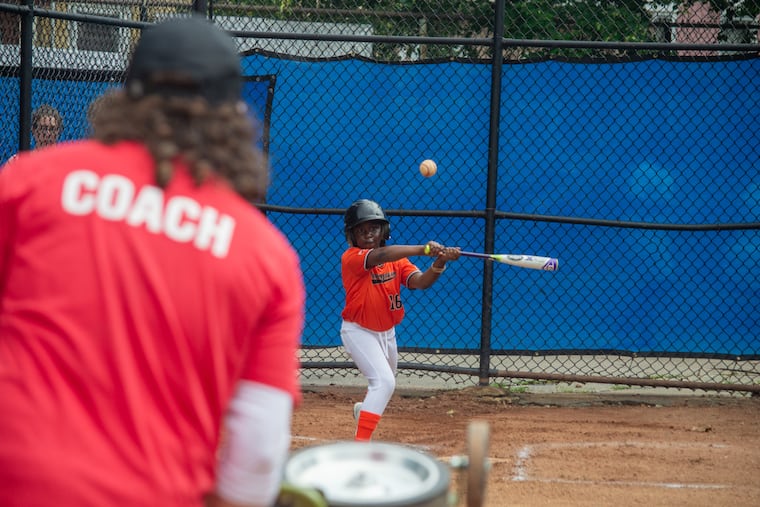
As a child, Andre Wright experienced firsthand the importance of having a sports coach in his life.
“I’ve seen people get shot,” said Wright, a coach and founder of Give and Go Athletics in Brewerytown. “I’ve seen people die. You have to find ways to help young kids cope.”
Wright’s father wasn’t always in his life, but he said he was able to call his coach when he had a problem.
“I always needed that male role model that I could, one, look at as an example, but also be able to talk to about things that might be sensitive that I couldn’t talk to my mom about,” Wright added.
As youth increasingly flock to professionalized, for-profit programs, community coaches like Wright are disappearing, a trend the city hopes to reverse by partnering on two programs that train youth to become the next generation.
One program, Career Connecting Learning PHL (C2L-PHL), is a long-running citywide program to hire young adults during the summer months and after school that added a focus on coaching in 2023 to improve access to high-quality youth sports programs, said Mike Barsotti, the director of youth sports for Parks & Recreation.
» READ MORE: Allen Iverson co-signs Arkansas freshman Darius Acuff as he receives a historic Reebok deal
Parks & Recreation employed about 1,300 youth this summer as camp counselors, with participants earning stipends ranging from $1,300 to $1,500.
The other program is a partnership, with the Philadelphia Youth Sports Collaborative (PYSC) and AmeriCorps’ Coach Across America, focused on developing a cohort of a dozen coaches through intensive training. The part-time positions teach the cohort trauma-informed youth development practices through working at recreation centers, which nets participants a $13,500 living stipend from PYSC and an award of roughly $3,700.
Both programs are responding to what sports providers see as a talent drain of current and future coaches toward privatized youth sports, threatening the survival of community teams.
War between public-private
“A lot of kids are leaving recreational programs and such to go to these bigger tournament-style groups to get the experience that they think they should be getting,” said Dan Singleton, the board president of Parkwood Youth Organization in Northeast Philadelphia. “We’re losing members to that too.”
The explosive rise of club and travel teams, with children born in the 1990s three times as likely to participate in them as those born in the 1950s, according to a new study from Ohio State, which has led to a dearth of community coaches, said Barsotti.
“Not only is the best kid getting pulled out, but the top three or four kids are all getting pulled out of their local programs to go play on high-priced travel teams, and so their parents are getting pulled out, too,” he added. “And those are the parents who coach, who carpool, who bring snacks, who do all the things that make local programs affordable, accessible, and great.”
» READ MORE: To kick-start a generation of city kids playing soccer, it will take more than just a place to play
Research suggests the decline in community teams threatens a key mental health outlet for children. Receiving support from a coach was correlated with signs of better mental health in adolescents, according to a 2024 study in the European Journal of Sports Science.
A 2022 study from Plos.org of more than 11,000 children aged 9 to 13 found that organized team sports were associated with fewer mental health difficulties among participants compared to their peers.
“Many of our players have developed lifelong relationships with their coaches,” said Dan Winterstein, the commissioner of Mt. Airy Baseball. “That wasn’t because of their baseball knowledge. Teaching kids to play the game the right way, with confidence and joy, is what we look for in coaches.”
In 2012, Parks and Recreation had 51 community teams in its baseball league. Thirty-one of those have since ceased to exist or provide baseball at the same level they once did, Barsotti said.
‘The right kind of people’
Tyrone Young, who founded and leads North Philadelphia’s Heritage League, said the lack of community coaches has more to do with a general lack of involvement of adults with children as a whole.
“People don’t get involved with the kids,” said Young. “Especially not with baseball. Some people don’t care about the community or kids. You need the right kind of people.”
Wright said he thinks Parks & Recreation could help by offering support to already existing coaches.
“I got two coaches, coach Phil and coach Jake,” Wright said. ”They’re volunteering. They live in the neighborhood already. If they were to get an opportunity to work at the Rec center, which is right there in the neighborhood, to be able to go there to work part-time right in the neighborhood where you already know the kids, I think that will go a long way.”
For coaches like Young and Wright, the city programs don’t immediately benefit their nonprofit teams. But Barsotti said the city’s work training coaches and collaborating with nonprofits can assist those nonprofits during transitions in leadership.
» READ MORE: Philly’s Mo’ne Davis selected 10th overall by Los Angeles in first Women’s Pro Baseball League draft
“I know a lot of these nonprofit groups that are coming in to do, you know, work in our spaces are run by, like, incredibly dedicated people who, like, commit their entire lives to making these programs work,” Barsotti said. “But if that person who’s so passionate suddenly isn’t a part of that organization anymore, is there someone ready to take it on after them and carry on that level of work that they were doing?”
Josh Throckmorton, the director of program development at PYSC, said the C2L-PHL program works as both a short-term summer staffing solution and long-term recruitment strategy for Parks & Recreation.
“If they can find great high-schoolers to provide great experiences for kids at summer camp, they might be building a pipeline of future employees, both from the C2Ls who might love their summer experience working with [Parks & Recreation] and the young kids who are having positive experiences with them,” Throckmorton said.
Today, many full-time recreation center workers are past participants in C2L-PHL, Barsotti said. The program previously existed under the name WorkReady.
Programs and partnerships like C2L-PHL’s and PYSC’s are a start to try to solve a greater issue, Throckmorton said, but are contending with a youth sports system that has been under-resourced for decades. The important part is what the program represents as a partnership between everyone involved in delivering youth sports programming in the city, he added.
“When they’re invested in a shared vision, then I think it can be really successful,” he said.

Temple University’s Logan Center for Urban Investigative Reporting and the Claire Smith Center for Sports Media, in partnership with the Philadelphia Inquirer, have launched a series examining the state of North Philadelphia’s recreational facilities and youth sports programs and whether investing in them should be a cornerstone anti-violence strategy for City Hall.
We’ll visit parks, pools, and playing fields north of Girard Avenue to document the conditions of facilities and compare them to others throughout the city. We’ll also outline the challenges leaders face in maintaining activities for young people in the city’s poorest neighborhoods most impacted by gun violence.