Girard Avenue’s antique trolleys have been missing from the streets. Here’s when they’ll ride again.
The restored historic street cars have not been running since early May because of a sinkhole next to the tracks on Girard Avenue.
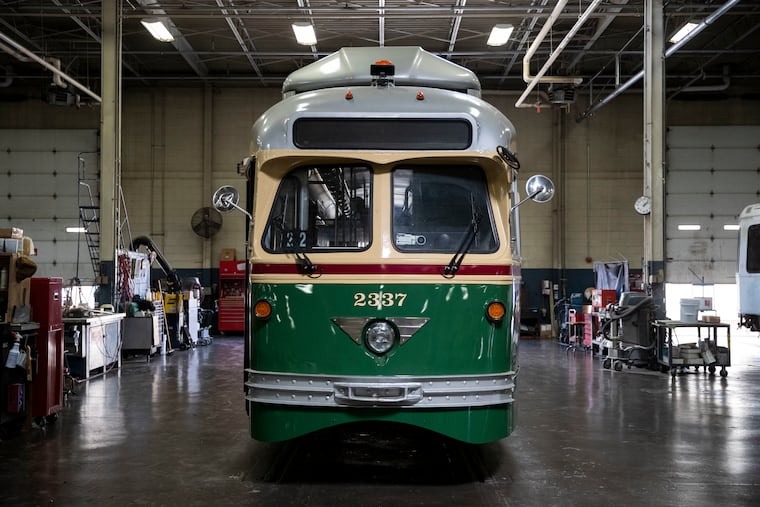
SEPTA’s beloved cream-and-green antique trolleys have not been running since May 5, when a sinkhole opened on West Girard Avenue at 49th Street, threatening the tracks.
People noticed.
But, in welcome news for fans of the restored 1947 PCC II streetcars, the sinkhole has been filled and the vehicles should be back in service Monday on Route 15, SEPTA spokesperson Andrew Busch said.
Emergency repairs to fix the gap on West Girard finished on Friday, Busch said. Last Monday, an unrelated water-main leak flooded the roadway and SEPTA tracks at Berks Street and East Girard Avenue. Repair of the leak was expected to wrap up Saturday.
Buses have been substituting for trolleys on the route.
The sinkhole developed as the Philadelphia Water Department was working in the 4900 block of Girard Avenue, SEPTA says.
Bill Conner of Center City said he called the transit agency’s customer service center right away to ask what was going on and got the mistaken impression that the PCCs might be pulled for good.
He was happy to be wrong.
“They disappeared out of nowhere,” Conner said. “It didn’t make sense the trolleys would not come back after SEPTA spent a few million rebuilding them.”
SEPTA restorers took apart and reassembled dented and rusted trolleys from the frame up at the Woodland Shops in Kingsessing after they were taken out of service in January 2020 for evaluation and maintenance.
Already buses had replaced the streetcars east of Frankford Avenue for eight years because of extensive Pennsylvania Department of Transportation construction on I-95. SEPTA officials said it was a good time to update the trolleys.
They had last been overhauled in 2002 at a factory in Western Pennsylvania.
In June 2024, rebuilt PCC trolleys began rumbling again along the entire 8.2 miles of the route, from the Richmond-Westmoreland Loop in the east to 63rd Street and Girard Avenue.
On a normal day, both PCCs and buses serve Route 15, which is being renamed Route G1. Eight of the antique trolleys are operational, and three more are nearing completion, Busch said.
A note about the detour around the sinkhole was posted on SEPTA’s website, along with dozens of other service alerts. It had not been clear that the trolleys would be offline so long.
“We know folks love the trolleys and watch out for them,” Busch said, adding that SEPTA would be clearer with future advisories “so people don’t think the trolleys are permanently sidelined.”
For the record, SEPTA plans to switch the G1 to all buses during the FIFA Fan Fest at Lemon Hill in Fairmount Park from June 11 to July 19.
That is so SEPTA can “quickly adapt to road closures or anything else that might come up” and still maintain frequent service to the festival, Busch said.
Philadelphia has operated a trolley network long after most cities converted to buses in the decades after World War II, though its size did shrink quite a bit.
Five trolley lines run through West Philadelphia and in Delaware County on street-level tracks and in a tunnel beneath Market Street in Center City — 40 miles in all.