SEPTA trolleys will use AI cameras to catch drivers breaking no-parking rules in Philly
Parking violations are the enemies of surface transit, slowing buses and trolleys, making them less reliable and putting riders in danger.
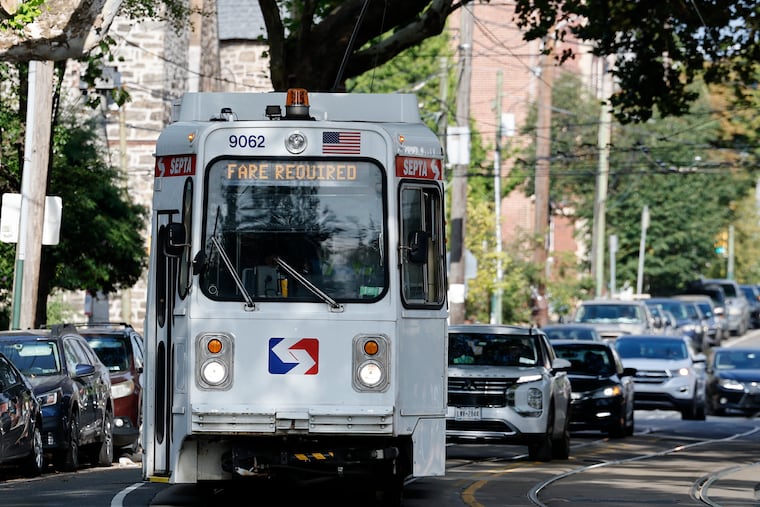
Beginning Monday, people who illegally park in SEPTA trolley lanes and stops could be caught in the act by automated enforcement cameras, the Philadelphia Parking Authority announced Thursday.
Plans call for installing AI-camera systems on 30 trolleys across the six lines in the city to identify and ticket the owners of vehicles obstructing the streetcars or making it hard for passengers to board by blocking stops.
Violations will carry a $51 fine as of April 1. Before then, warnings will be mailed instead of tickets.
Parking violations are the enemies of surface transit, slowing buses and trolleys, making them less reliable and putting riders in danger.
Already, 152 SEPTA buses have been using cameras mounted in their windshields to enforce parking rules; ticketing began last year.
SEPTA, PPA, and the Philadelphia Office of Transportation and Infrastructure Systems are collaborating on the effort. It uses camera systems made installed and maintained by Hayden AI, a San Francisco-based tech company.
“A single illegally parked vehicle can disrupt service for thousands of riders and create unsafe boarding conditions that force passengers into moving traffic,” PPA executive director Rich Lazer said in a statement.
“This is more than a minor inconvenience,” he said.
Legislation sponsored by Councilmember Mark Squilla and enacted in 2023 authorized using cameras mounted on buses and trolleys to enforce no-parking rules in Philadelphia.
“One of the most annoying things about this city is people stopping their cars wherever they want to stop them, in bus lanes, double parking. It just screws everything up,” then-Mayor Jim Kenney said at a news conference.
According to a 2019 study SEPTA commissioned from Econsult Solutions, Center City congestion causes 1.7 million hours of passenger delays per year, adding $15.4 million to yearly operating costs.
And then there is the almost incalculable cost to people who depend on buses and trolleys.
“In a city where 42% of Black residents and 50% of impoverished households do not own a car, efficient public transit is paramount to creating a strong transportation network that better provides economic opportunity for all,” said Christopher Puchalsky, director of policy and strategic initiatives for OTIS.
In a 70-day trial in the spring of 2023, windshield-mounted video cameras recorded 36,392 instances of illegally parked vehicles blocking Center City bus-only lanes and bus stops in West Philadelphia and Upper Darby.
In some situations, SEPTA bus operators can steer around parked cars. Trolleys, running on fixed rails, don’t have any real flexibility when they are boxed out of their lanes.
SEPTA officials say bus speeds have improved on routes using the cameras. An average of about 14,746 violations are issued each month, according to PPA.
The cameras use artificial intelligence to determine if a car is stopped or parked to obstruct transit lanes and stops. Then, the systems transmit the vehicle’s license plate number and precise location to the Philadelphia Parking Authority using cloud technology.
“Keeping trolley zones clear isn’t just about enforcing parking rules — it’s about keeping Philadelphia moving,” said Marty Beard, CEO of Hayden AI. He added that Philadelphia will be the first city to deploy the cameras on trolleys.