SEPTA trolley tunnel will remain closed through at least the end of December
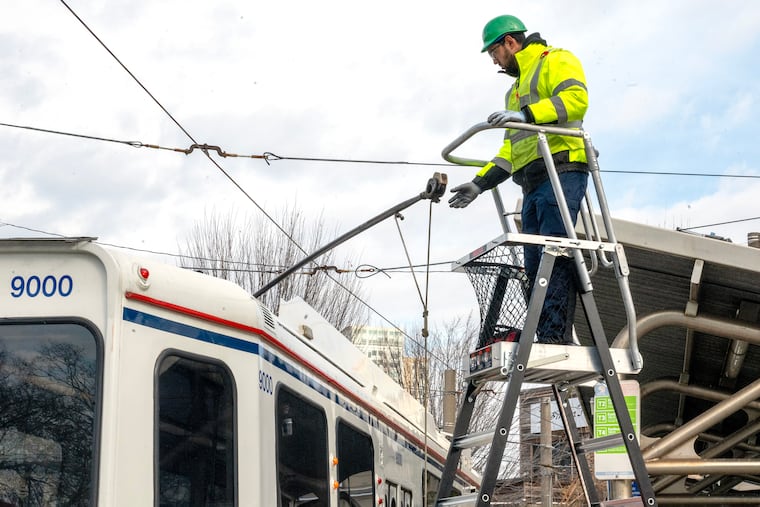
Crews are repairing damaged overhead wires on the Center City passageway.
There will be no Christmas miracle for trolley riders.
The Center City trolley tunnel will remain closed at least through the end of December, SEPTA said Wednesday. Officials did not offer a precise reopening date but were hopeful service would resume in January.
The tunnel has been closed since the beginning of November for repairs to its overhead catenary wire system. In October, damage caused two separate incidents in which trolleys were stopped and hundreds of riders were evacuated inside the tunnel.
“We want to make sure that we don’t reopen before we feel that the risk has been reduced as low as possible that we could have another event in the tunnel,” said Kate O’Connor, SEPTA’s assistant general manager of engineering, maintenance, and construction.
Issues began earlier this fall after SEPTA changed the size of the brass sliders that hold chunks of carbon that rub off and coat the wires carrying electricity to the trolleys. The carbon coating helps the trolleys move smoothly.
The switch from 3-inch to 4-inch sliders was meant to prolong their lifespan and lower maintenance costs, but it proved to do the opposite. Inside the tunnel, where there are more curves on the tracks and more equipment holding the wire to the ceiling, the new sliders and carbon burned through more quickly.
SEPTA had tested the 4-inch sliders before the change was made, but observed no issues, O’Connor said. The tests proved to be too limited, she said, and did not adequately measure how the sliders would work across an entire fleet.
SEPTA changed back to the 3-inch slider, but because the overhead wires were now damaged, the once-reliable sliders began to wear out more quickly, too.
“We could hear the rubbing on the brass” after less than a day, said Jason Tarlecki, SEPTA’s deputy chief engineer of power.
SEPTA determined it needed to replace the tunnel’s roughly five miles of overhead copper wiring, Tarlecki said, after the excess wear left it “shattered and raw” in sections.
Those repairs have taken longer than originally projected. According to SEPTA officials, supply-chain issues stemming from the pandemic have created longer wait times for new parts. New wiring needs to build up a carbon coating over time, and SEPTA has been running trolleys along the system during the closure for the patina to develop. And the transit authority has been conducting tests, like experimenting with reduced-speed zones and readjusted wire tension, to ensure that the issue does not arise again.
On Thursday morning, City Councilmember Jamie Gauthier and State Rep. Rick Krajewski (D., Philadelphia) plan to lead a canvass pushing for SEPTA and the city to help riders during the closure of the tunnel.
“I know how challenging and frustrating it’s been for the tens of thousands of West and Southwest Philadelphians who rely on the trolley to get to school, work, and other essentials. [Market-Frankford Line] riders dealing with crush crowds and drivers stuck in trolley diversion gridlock are suffering too. … Only a sustainable investment from our state government can solve the root cause of this problem: SEPTA’s aging infrastructure,” Gauthier said in a statement.
Even once the tunnel does reopen and service returns, the slider saga might not be over. O’Connor said that it was possible SEPTA would close the tunnel again occasionally, possibly for a weekend, as it continues to replace sections of the wiring.