A new bridge could replace another spanning the Delaware River. Eventually.
Construction of a new bridge connecting the Pennsylvania and New Jersey Turnpikes could begin in 2031. One of two options will be chosen next spring after detailed analysis and more public hearings.
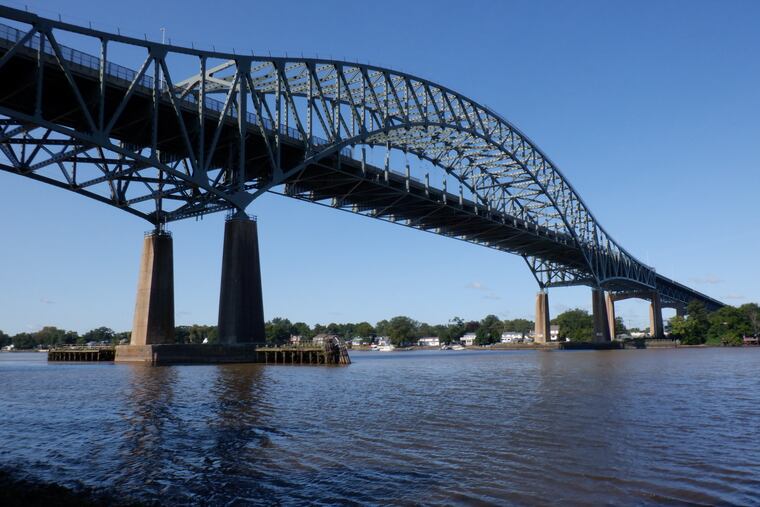
Pennsylvania and New Jersey turnpike officials have settled on two alternative plans for replacing the Delaware River Bridge that has linked their toll roads for 70 years.
Traffic has mushroomed since the interchange with I-95 opened in 2018, and the four-lane span is often congested, along with highways and roads in Bucks and Burlington Counties.
“We have a lot more traffic here … and it will keep growing,” said engineer John Boyer, the Pennsylvania Turnpike Commission’s project manager. “We need additional capacity.”
Before the I-95 connection was finished, about 42,000 vehicles a day crossed the Delaware River Bridge. Now, that’s up to around 67,000. Average daily traffic is projected to be 90,000 vehicles by 2050.
What are the two ‘finalist’ options for a new bridge?
In one scenario, the new bridge would be constructed at once about 75 feet north of the existing span over four years. Pennsylvania- and New Jersey-bound lanes (six in all) would be built 15 feet apart. When finished, all traffic would be moved to the new bridge. The existing bridge would be removed.
The other option: constructing the new bridge in stages, about 40 feet north of the existing bridge — over eight years. Initially, the first half of the new span would go up. Then four lanes of traffic would be diverted to the new half while the old bridge is demolished, after which the second half of the new bridge would be built. When complete, there would be six traffic lanes.
What are the next steps?
Turnpike officials are preparing a new environmental impact statement, required for federal approval and funding. The 2003 version is outdated.
The plan is to unveil the site decision in the spring. Then would come final design and the rest of the bureaucratic steps in building transportation infrastructure.
Construction could start in 2031.
The final cost of the project has not yet been estimated, officials said, but it won’t be cheap.
What’s the history of the project?
Talk of fixing the crossing started more than 30 years ago, and by 2003, after exhaustive environmental impact and engineering studies, authorities proposed building a modern bridge alongside the old one, which would be refurbished.
Federal highway officials signed off, but it never came together.
In 2010, the Pennsylvania Turnpike Commission formally deferred the project “due to funding constraints,” spokesperson Marissa Orbanek said.
A crack in a steel truss supporting the bridge closed the span for six weeks in 2017 and rekindled the idea. Engineers combed through nine possible sites north and south of the bridge and decided to replace rather than refurbish the span, as first planned.
The Pennsylvania Turnpike Commission and New Jersey Turnpike Authority are working together on the project.
Beginning in 2007 with Act 44, the Pennsylvanian Turnpike assumed a major role in state transportation funding that limited its ability to spend on other things. The law used turnpike toll revenues to secure bonds that would provide revenue for public transit and highway and bridge projects.
In addition, the turnpike prioritized the connection to I-95 and widening the roadway to accommodate the additional traffic, as well as other projects — including removal of toll booths and switching to gantries that charge drivers by reading an EZ-Pass or snapping a picture of a vehicle’s license plate.
Act 44 was a workaround for a state constitutional prohibition on the use of the gas tax for public transit and legislators’ reluctance to hike that tax for highways and bridges.
The turnpike would contribute $750 million a year to the Pennsylvania Department of Transportation, split evenly between transit and roads.
That formula was tweaked in 2013 with Act 89, which raised the gas tax to finance roads and bridges and cut the turnpike’s annual payment to $450 million — with all of it going to transit — through 2022.
The toll road’s obligation to PennDot then dropped to $22 million a year.
Will the Pa. Turnpike need to acquire properties? Where?
It’s too early to say. Officials working on the project said they would have a better idea after the final proposal is chosen, expected in spring 2026. The two northern options are seen as likely to have fewer impacts than other alternatives considered.
What about a shared-use path for bikers and walkers?
Pennsylvania Turnpike officials have ruled that out, citing regulations barring pedestrians or nonmotorized vehicles on turnpikes and interstates — the connector is part of I-95 — as well as future maintenance costs. Advocates still want access.
John Boyle, a staffer for the Bicycle Coalition of Greater Philadelphia, pointed to several toll bridges with free paths that accommodate cyclists and pedestrians.
The Great Egg Harbor Bridge on the tolled Garden State Parkway, for instance, has bike and pedestrian lanes.
So does the Mario M. Cuomo (Tappan Zee) Bridge, which carries the New York Thruway over the Hudson River about 20 miles north of New York City.
And the Gordie Howe International Bridge, a toll facility between Detroit and Windsor, Ontario, nearing completion, will have separate shared-use lanes.
What considerations guide the choice?
Boyer said they boiled it down to picking a site that would have the lowest negative impact on the built and natural environments.
“We’re looking at it from a 10,000-foot view in the entire corridor: commercial impacts, industrial impacts, residential impacts, and potential impacts to billboards or cell towers in the area,” Boyer said.