‘A Hundred Years On’ could’ve been a more searing look back at 1876 America, but it is still remarkable
Featuring the Philadelphia Orchestra and the Crossing choir, Peter Boyer's backward gaze at Philadelphia’s 1876 Centennial Exposition assures us that, despite it all, America somehow still prevails.
American centennials arrive in uncertain times.
Amid the current 250th birthday of America, the country hasn’t been so divided since the 1976 Bicentennial when Vietnam and Watergate were open wounds.
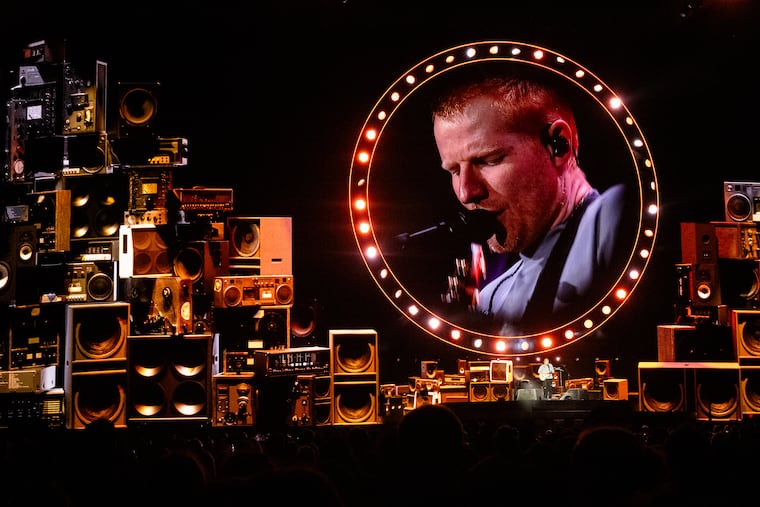
But in a backward gaze at Philadelphia’s 1876 Centennial Exposition, A Hundred Years On, composed by Peter Boyer, had the message that America somehow prevails. Commissioned by and premiered at the renovated Highmark Mann Center on Wednesday, the oratorio revisited how, amid the residual traumatizing of the Civil War, Philadelphia emerged in one of its peak years with innovations that supported its “city of firsts” reputation.
Since America in general, and Philadelphia in particular, needs to feel good about itself, the total effect of this vocal/video/orchestral package featuring the Philadelphia Orchestra and the Crossing choir prompted roaring approval from an audience that one hoped would be larger (the inside seats were half full).
With any luck, this ambitious, communicative piece will have a further life.
Even if you didn’t leave the concert with renewed faith in the future, you could at least aspire to that kind of belief — and be impressed with the program’s range of American expression from John Williams to Julia Wolfe.
Special event pieces such as A Hundred Years On are, by definition, written in broad, sometimes heavy-handed strokes. But librettist Mark Campbell looked back to 1876 in a series of arias and chorus with touchstones that had dimensions — ones that avoided whitewashing history.
An entertaining upbeat stand-in for Alexander Graham Bell extolled the magic of global communication through a single wire (while also predicting our wireless era). But there was also an aria for a mother still grieving for her son’s Civil War death. The invention of the dishwasher promised to save female hands for other things — though such hands still didn’t have the right to vote. A Black restaurant waiter reminded the world that this post-Civil War era had a limited effect on civil rights.
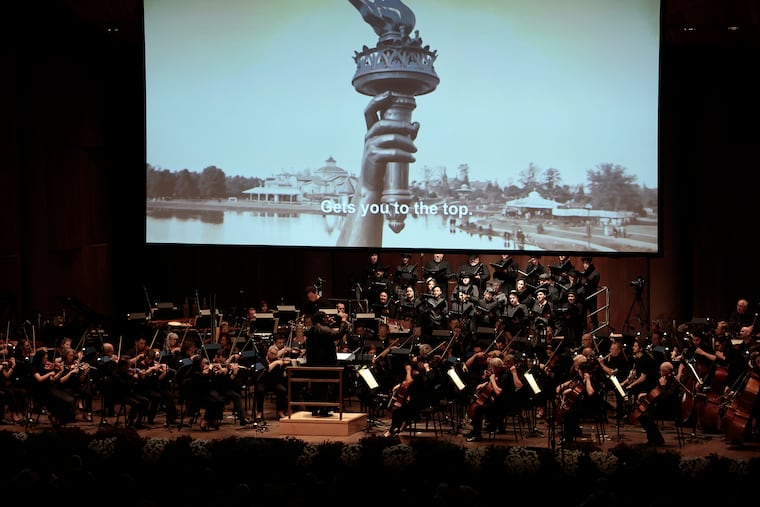
One visually surreal moment translated into a section rich in implications: The disembodied arm of the still-unfinished Statue of Liberty invited visitors to explore the insides of her torch. Video projections designed by Rasean Davonté Johnson lifted and animated images usually seen in vintage photographs in ways that took you deep into that era. Virtually, you were there. Live singers were in period costumes with supportive stage direction by Tazewell Thompson.
Overall, the piece didn’t quite have the searing authenticity of Boyer’s Ellis Island: The Dream of America, which included spoken firsthand immigrant accounts of their harrowing experiences. But Campbell’s poetic extrapolations of the 1876 experience clearly inspired Boyer to write essentially lyrical arias with all sorts of details heard in these individual journeys, such as the blues inflections of Ignatius Thomas, the Black restaurant waiter.
Boyer steered clear of songlike tunes that would’ve distracted from the message at hand, and given less depth to performances by the excellent vocal soloists, Mary Dunleavy, Meredith Lustig, Eve Gigliotti, Malcolm J. Merriweather, and especially David Portillo. Boyer didn’t resist writing difficult but atmospheric harmonies for the supercapable Crossing choir, as well as descriptive vocal gestures suggesting the budding mechanization of the 19th century.
In general, he used the orchestra as a frame to give focus and scope to the bigger idea of what 1876 meant then and now. The guy definitely knows the art of orchestration.
In the concert’s first half, the “Star-Spangled Banner,” “conducted” by Mayor Cherelle L. Parker was the necessary starting point. Then, John Williams’ “Liberty Fanfare” had conductor Anthony Parnther luxuriating in the rich harmonies, memorably played by the Philadelphia Orchestra brass section. “Liberty Bell” by Julia Wolfe (who grew up in the area, near all of the bell’s cracks and crevices) was a miniature symphony of sorts, falling into four distinct sections.
First came the difficult birth of democracy with a series of whiplash rhythms, almost suggesting the passing of kidney stones. What followed was repose, but the apocalyptic ending was reminder that storms are always ahead.
Sousa’s “Stars and Stripes Forever” was strangely perfunctory. Sorry, but I was spoiled by the late Arthur Fiedler, who had a way of suspending time during the thrilling piccolo solo. No big deal, really, especially since all other performances were shipshape.
And that’s not often the case with a program featuring something as complex as “Liberty Bell” and a piece with as many moving parts as A Hundred Years On. No hints of strain. Remarkable!