Inside the Calder Gardens, the art has no labels and plays with the wind and the sky
The process of discovery at Calder Gardens is a treasure hunt with BYO clues. That is how one starts the journey with art we’re meant to puzzle out ourselves. It's all “open to interpretation."
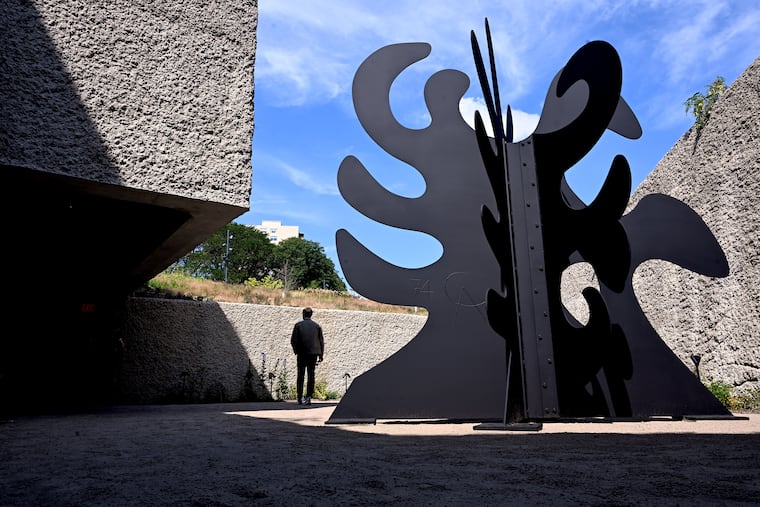
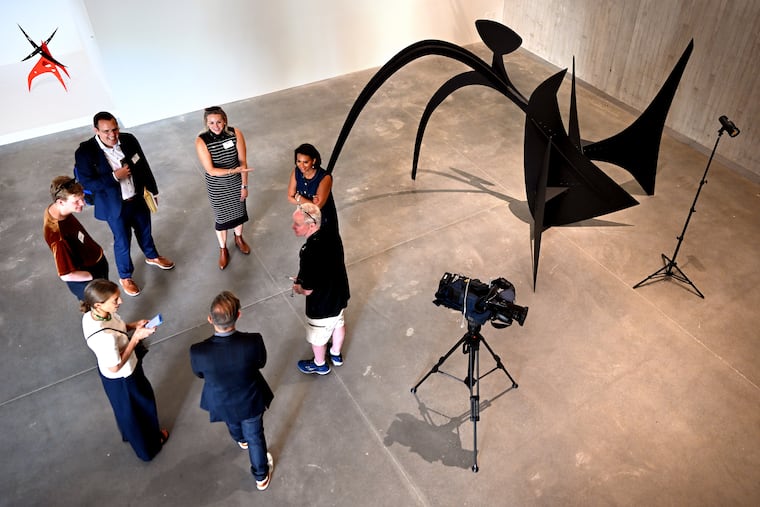
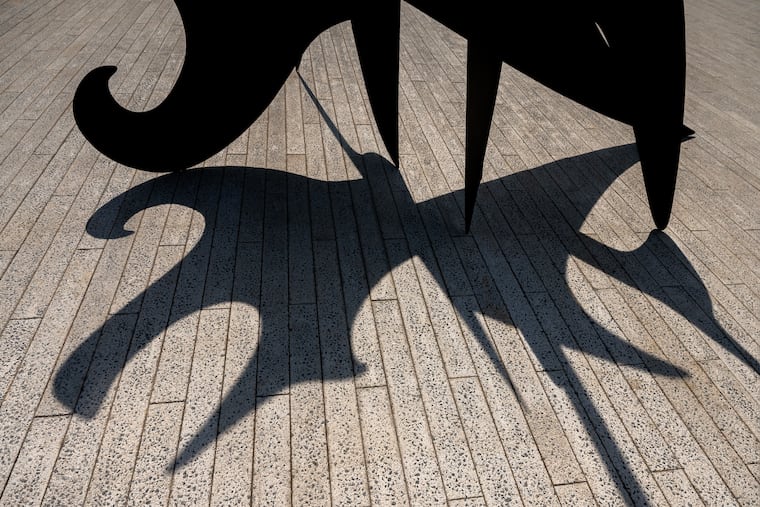
At the summit of Calder Gardens, a wondrous black stabile stands its ground near the building’s facade. Two of its legs, if they are legs, balance like a ballerina en pointe.
Wait, isn’t one an airplane propeller? And what about the fetching shape that functions as a kickstand and resembles a stylized wave?
Did Alexander “Sandy” Calder name this sculpture, and if he did, wouldn’t it help to know now?
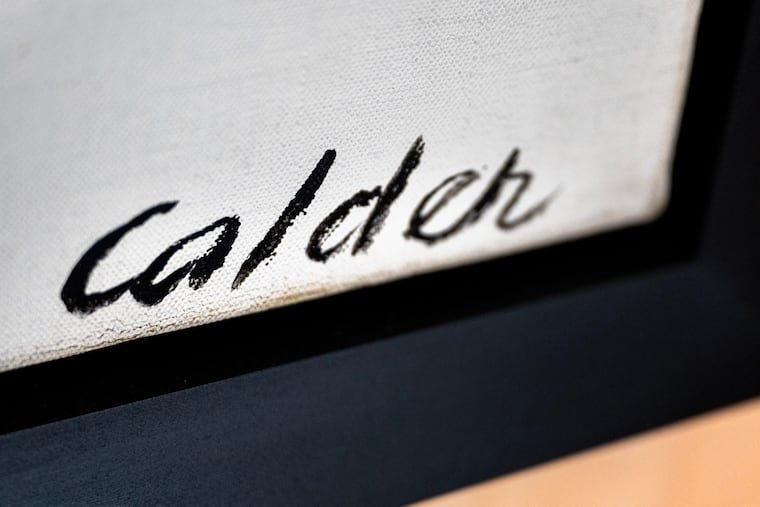
Calder Foundation president and Calder’s grandson Alexander “Sandy” Rower, who was instrumental in the recent opening of the Parkway’s Calder Gardens, doesn’t think so: titles and dates are stored offstage. This radical choice to confine such information to its website is a mild irritant.
But mostly, we “get over it.”
The Barnes Foundation, the gardens’ centenarian comrade in art across the Parkway, is similarly label-free, albeit differently justified. Both venues value our agency to see what we’re looking at. Used interchangeably in speech, “look” and “see” connote different aspects of perception. Looking requires no conscious effort. Engaged attention is essential for seeing, or “close looking,” in Barnes parlance.
“What you see is what you get,” the vintage computer koan WYSIWYG advised. The process of discovery at Calder Gardens is a treasure hunt with BYO clues. So begins our serendipitous encounters with abstract art with no prebuilt meaning, art we’re meant to puzzle out ourselves.
Or, as Bob Dylan put it, “You don’t need a weatherman to know which way the wind blows.”
In the entrance lobby, an unobtrusive ticketing station commandeers attention. But there’s more here than meets the eye. Feigning indifference to our presence, an agile black mobile overhead easily escapes notice. Note to visitors: Look up on the way out. Whimsy is fair play at Calder Gardens.
A broad wooden stairway leads to subterranean galleries. Initial sightings of the ground level art are teasingly partial, horizontally edited by the building’s complex edges and vertices. When the sun is unhampered by clouds, shadows pattern the walls.
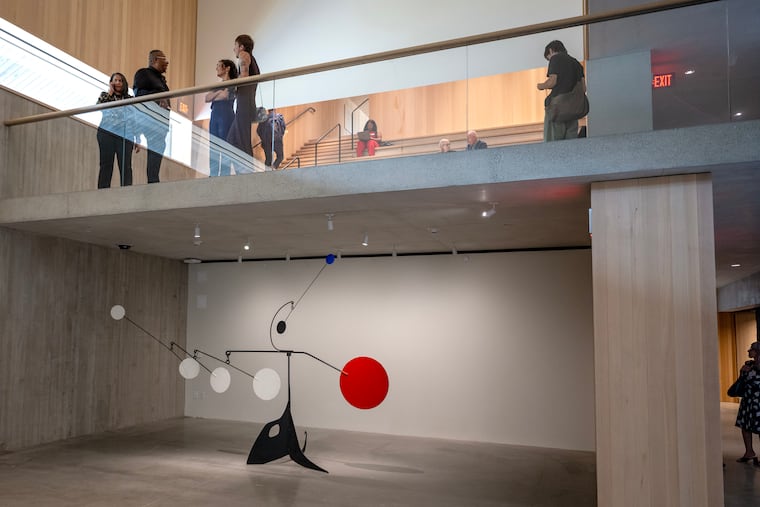
At the balcony overhang on the mezzanine level, it’s possible to take the measure of the ingenious structure by Herzog & de Meuron. Alternate stair treads lengthen horizontally to become way station viewing banquettes. They’ll double as audience seating for the gardens’ anticipated series of ground floor performances.
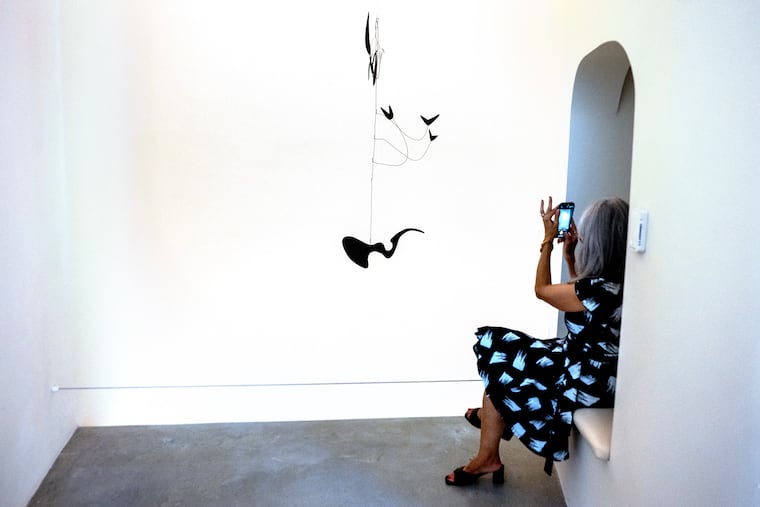
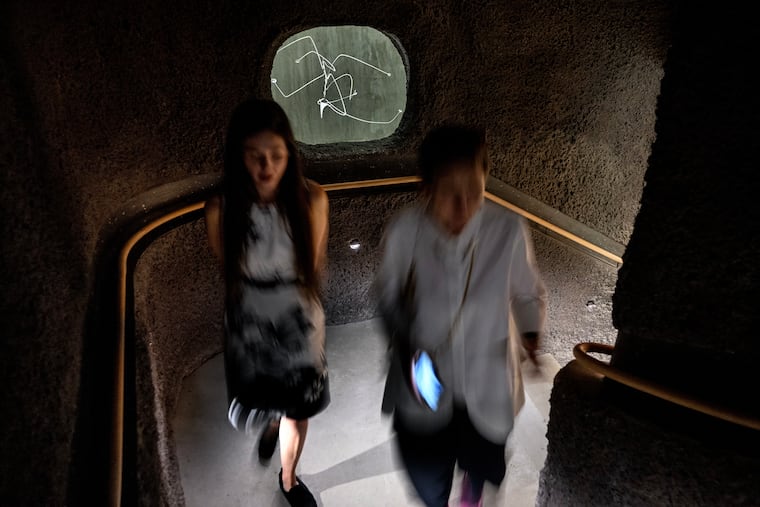
A black, textured corridor branches off the mezzanine. Several steps in, the gardens’ smallest gallery punctuates the darkness at eye level. This brightly lit, glazed habitat seems teasingly familiar. Its sole tenant is a leggy, white mobile. But like all the art at Calder Gardens, at some point this affable charmer is fated for replacement. It may not be there on a return visit.
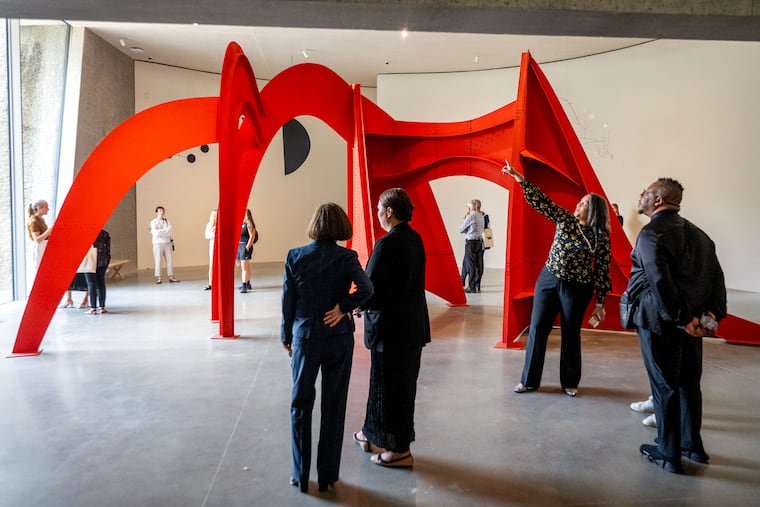
Given the diversity and relative proximity of art in the downstairs galleries, it’s a challenge to focus on one artwork at a time. But that’s not a bad thing. The ground floor is a perfect place to “compare and contrast.”
Regardless of which of the various paintings, drawings, stabiles, and mobiles we’re looking at, it doesn’t take a genealogist to see family resemblances in nearby art, multiple echoes of Alexander Calder’s distinctive lines, curves, and shapes. To judge from the animated expressions on people around me, the scanning process can be eye-opening. In addition to a few benches, visitors find respite on padded window ledges or a cavity scooped out of a wall.

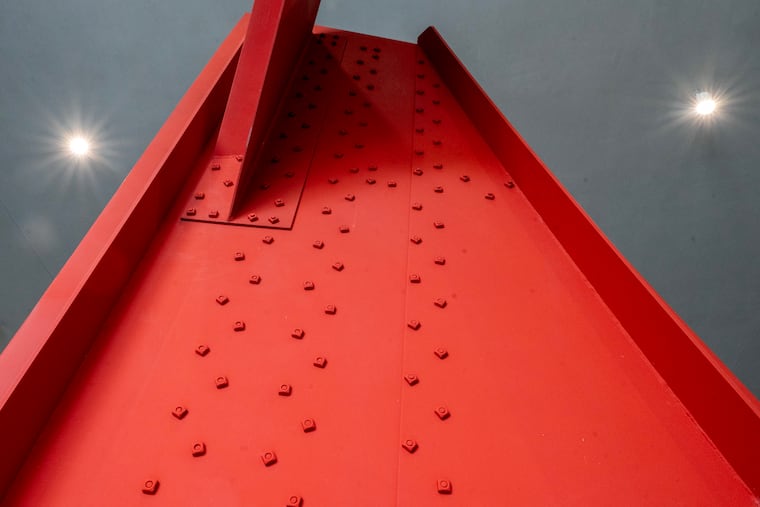
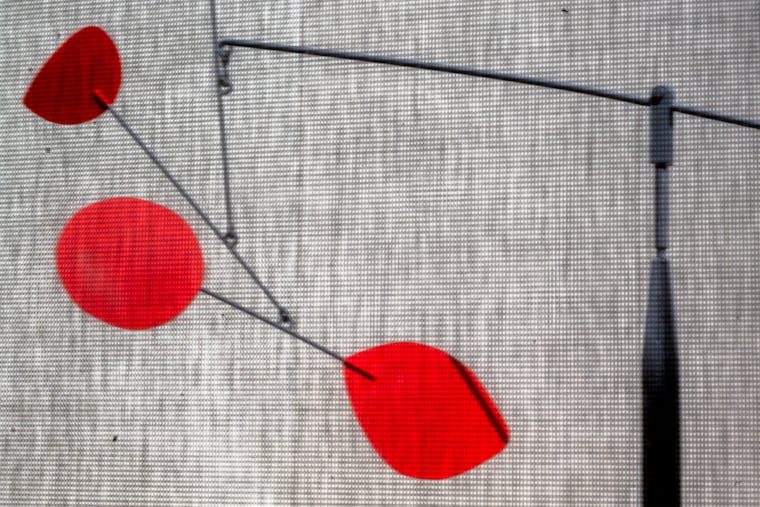
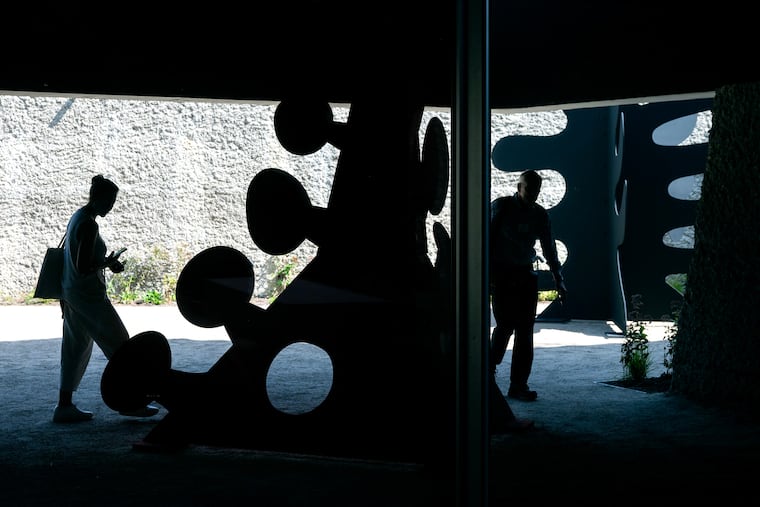
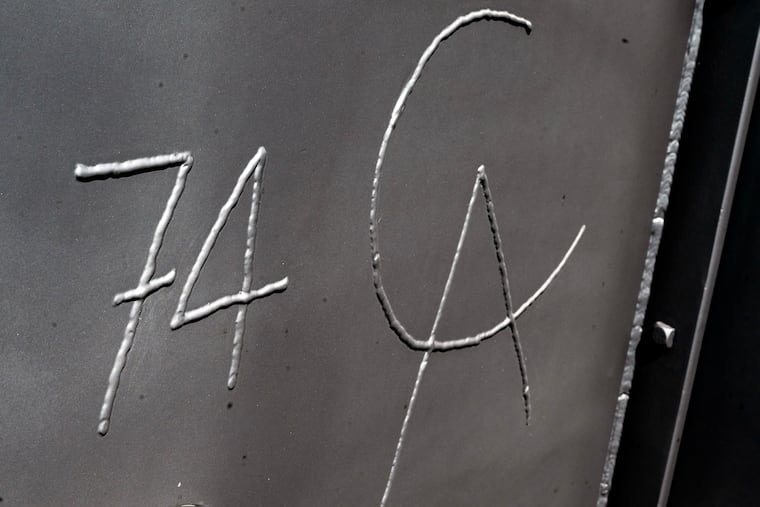
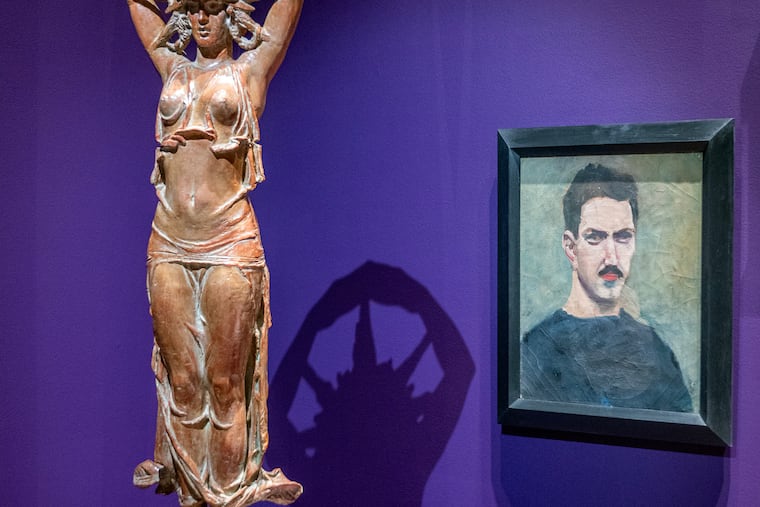
Alexander Calder may have inherited his forebears’ DNA, but not their interest in symbolic content. Grandfather Alexander Milne Calder’s colossal Billy Penn atop City Hall purposely faces toward Penn Treaty Park. Father Alexander Stirling Calder’s outsize figurative sculpture for the Logan Square fountain personifies the Delaware, Schuylkill, and Wissahickon waterways.
The gulf separating the generations is clear in a small gallery of art that predates Calder’s signature modernism. There’s a small-scale version of granddad’s familiar William Penn, and a comical (to me) allegorical damsel on tippy-toes, by his dad. Two paintings are by Calder’s mom, Nanette Lederer Calder. The information, of course, is only available on their website. Imagine that! The scion of an eminent lineage of male sculptors was mothered by an artist.
Protected from trespass by a glass barrier, the sunken gallery is one of Calder Gardens’ memorable exhibition areas. Within its refuge, a hybrid sculpture that’s both stabile and mobile connects to the ground on three sturdy feet.
Buttressed by towering exterior walls, the gallery is open to the sky. Although we can’t enter this outdoor space, we do catch sight of the ground and sky above. This limited view, framed by the curved edge of the enclosure, calls to mind the art of James Turrell, whose related work can alter our perception and foster contemplation.
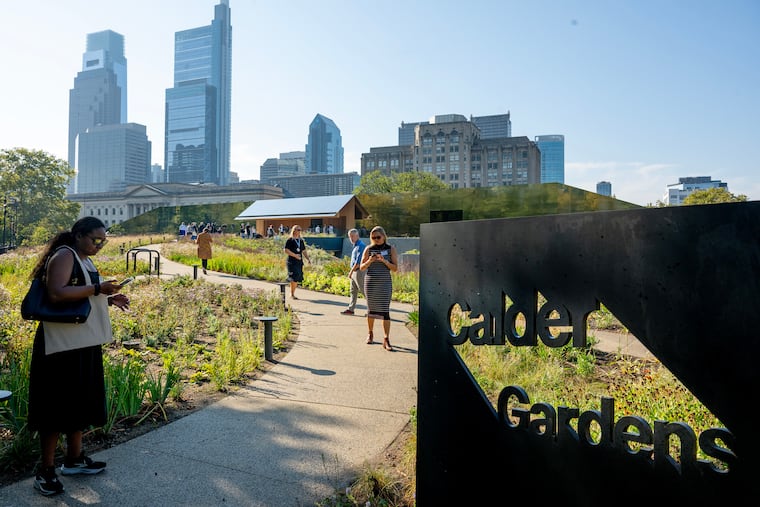
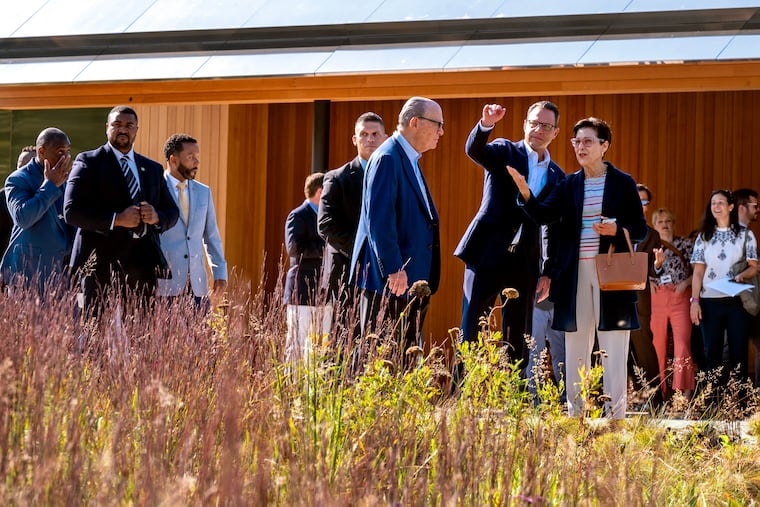
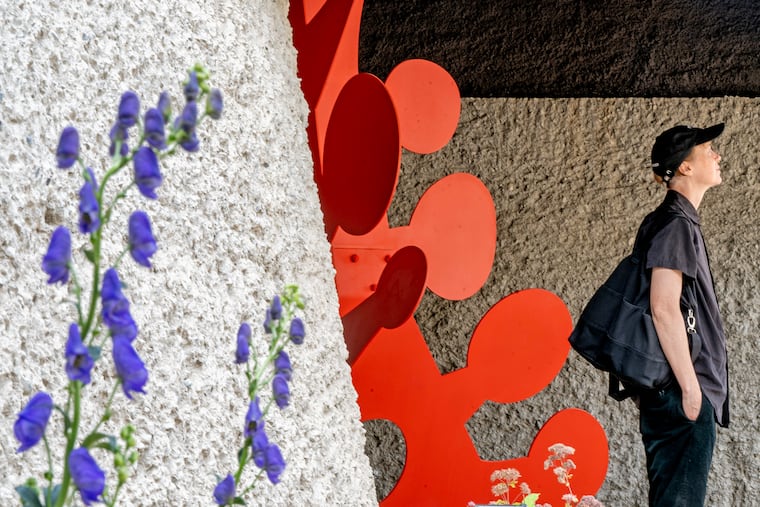
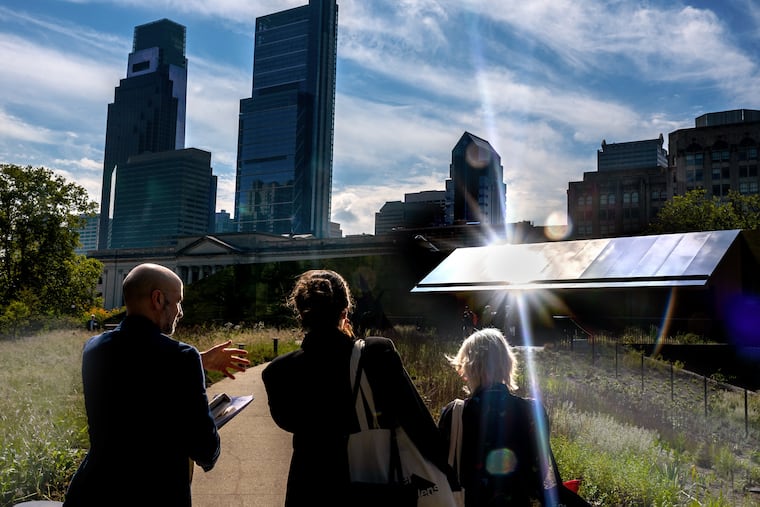
The art and architecture of Calder Gardens celebrate mutability, as does the surrounding landscape’s plantings. Conceived by the Dutch garden designer Piet Oudolf, it solicits nature as an inspiration for change.
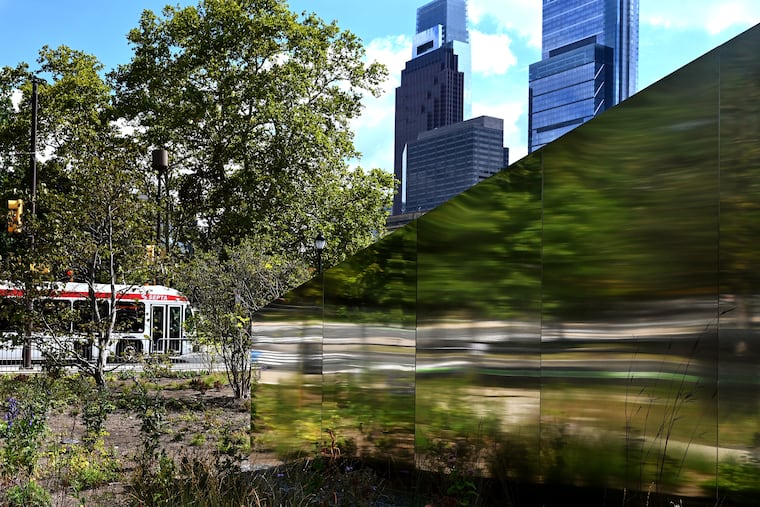
Should you be on the grounds in late afternoon, a brochure provides seasonally precise times when sunset light meets the building’s reflective facade. Sunlight and air are Calder’s treasured, unpredictable collaborators, as are we.
Calder Gardens is “open to interpretation,” heralds its social media posts.
Calder Gardens, 2100 Benjamin Franklin Parkway, Wednesday to Monday, 11 a.m. to 5 p.m. Tickets $5-$18, free for 12 and under, caldergardens.org