When looking at a sculpture in the Calder Gardens, there is ‘no wrong answer’
The brand new addition to Philadelphia’s Museum Row is, technically, not a museum at all.
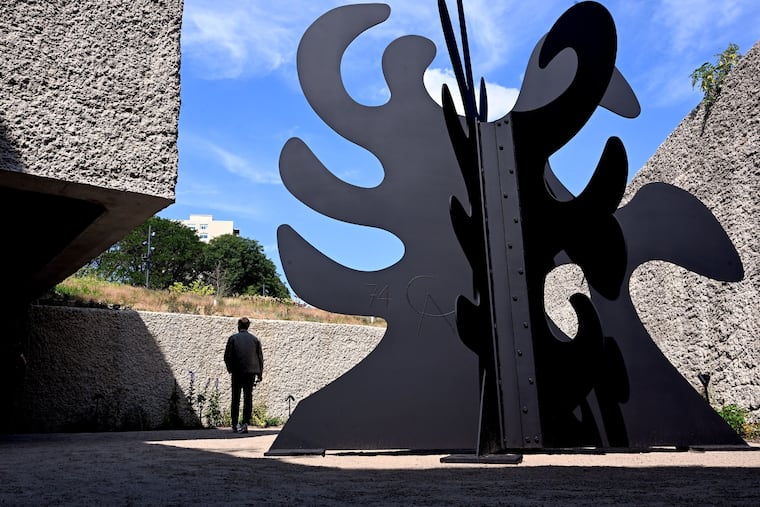
An oasis. A cultural destination. An urban sanctuary. A moveable stage. An experiment.
Calder Gardens, the brand new addition to Philadelphia’s Museum Row dedicated to groundbreaking American sculptor Alexander Calder, can go by many names, but “museum” isn’t one. Technically.
It’s a label that the Calder Gardens team believes doesn’t quite fit their vision for the arts institution. That view isn’t meant to be restrictive or prescriptive, but freeing. The Gardens welcome visitors to think beyond a traditional “museum,” with the slogan “open to interpretation.”
“Calder famously said in 1932 that his work has no meaning, but that doesn’t mean that it’s meaningless. It means that there’s no prescribed intention for how you would engage his work,” said Alexander S.C. Rower, the sculptor’s grandson and president of the Calder Foundation, which owns much of the artwork on display in the Gardens’ galleries.
“He’s saying there’s no meaning to go and search for, except whatever you might find within yourself. He’s really hoping that you’ll utilize his work — now in this beautiful space by [Swiss architect] Jacques Herzog — and have, maybe, a sacred connection to the self.
“Come out of the city, have your nervous system slow down and be present to what you might hear from yourself. There’s no right or wrong answer.”
The open-ended approach expands on Calder’s own innovative impact on abstract and surrealist art movements of the 20th century. The Philadelphia-born legend came from a family of artists who contributed major works to the city: his parents were painter Nanette Lederer Calder and sculptor Alexander Stirling Calder, creator of Logan Circle’s Swann Memorial Fountain. His grandfather was Alexander Milne Calder, who made the bronze of William Penn that towers above City Hall.
Biographical information isn’t a key element of exposition. Here, there are no wall labels introducing Calder’s life, family, and legacy, or listing the title and date of each artwork, because the space is less concerned with didactic museum practices; it’s more vibes-based.

- The Parkway’s luminous, magical spirit cave
- After two decades, Calder Gardens has finally arrived
- Take a virtual 360° tour of Calder Gardens
- When looking at a sculpture in the Calder Gardens, there is ‘no wrong answer’
- Calder Gardens architect on why it is a uniquely Philadelphia institution
- There are 37,000 individual plants at Calder Gardens. Here are five not to miss.
- The building may be done but the gardens are just getting to work at Calder Gardens
- 5 of our favorite sculptures at Calder Gardens and the stories behind them
- Calder Gardens’ programs will cultivate community and plant artistic seeds
Walking to the building is a brief, winding journey through nascent flower beds from Piet Oudolf, the Dutch garden expert behind New York’s High Line. The museum structure itself almost disappears underneath a wooden and metallic pavilion, beckoning you to look closer.
A welcome pamphlet encourages sensory awareness: “Take a moment. Look around. Did you walk by the grass that smells like burned popcorn at the entrance?”
Inside what Inquirer architecture critic Inga Saffron calls a “magical spirit cave,” the small galleries flow into one another without designated wings or imposing walls. Walk into the space and you are eye-level with a suspended, subtly swaying mobile (a Calder invention). Turn a corner and another sculpture will reveal itself.
Instead of rigid, separate spaces, there are pockets of surprises, with art tucked in. The Apse Gallery appears suddenly, holding a single hanging mobile surrounded by stark white walls. There are no arrows indicating exits and which direction to go next — and that’s by design.
The self-guided experience is directed by your individual curiosity, instead of a curatorial narrative or encyclopedic chronology explained through guides.
“We’re not presenting my grandfather’s work in a kind of storytelling way. In a museum, they would put together works that have a linear story … There’s no story being told in terms of how they’re organized — the space dictates how the works are organized,” said Rower. “There’s no curator here who’s telling you about Calder’s biography, where he was, what he felt, what he was thinking. It’s an attempt to make Calder Gardens really special by taking away outside influences, where you just come and you’re with his work.”
You can get up close, too. Walk under the commanding red steel structure (Jerusalem Stabile II) at the center of the Open Plan Gallery to see it from different angles as the incoming sunlight casts shifting shadows throughout the day.
The ephemeral is essential to Calder Gardens’ mission: The institution holds no permanent collection — another key distinction from conventional museums — as it provides a flexible, dynamic space to display holdings from the Calder Foundation, as well as pieces on loan from private collectors and other institutions. The 37 artworks on view now will change and move in the coming months, resulting in no two visits being quite the same.
For Rower, an ever-changing display aligns with his initial vision for the project that took years to develop and complete. He didn’t want a conventional memorial to his grandfather. Instead, he conceptualized a sanctuary for introspection, reflection, and mindfulness.
Senior director of programs Juana Berrío says the Gardens aren’t static or stale.
“It’s not just about Calder, it’s not just about the architecture, it’s not about just the gardens. It’s about interconnectedness of all of these elements,” she said. “It’s this living organism that is a living legacy, a living garden, a living building that changes all the time ... depending on the light, depending on the day, on our own mood, how we navigate it.”
Future programming will include informative lectures and film screenings as well as events like sound baths and collective singing performances. A forthcoming audio component won’t be a guided tour but commissioned works from poet Cecilia Vicuña and composer Raven Chacon created in response to the Gardens.
The underlying message? It’s Calder’s name on the sign, but you’re at the center.
“The Magic of Calder Gardens” is produced with support from Lisa D. Kabnick and John H. McFadden. Editorial content is created independently of the project’s donors.
To support The Inquirer’s High-Impact Journalism Fund, visit Inquirer.com/giving