A year on, what can the ‘No Arena in Chinatown’ protests still teach Philadelphians?
In time for America 250, artists have come together at the Asian Arts Initiative to document the anti-arena movement. “We want to highlight — we are a part of this country,” one of them said.
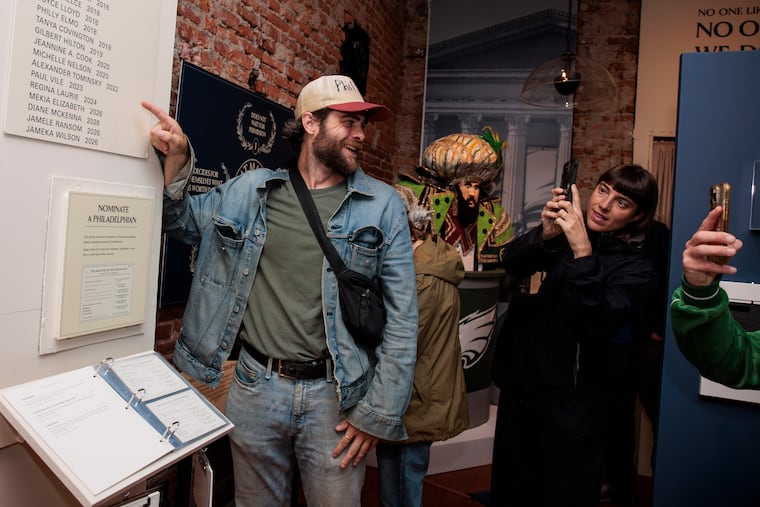
During the “No Arena in Chinatown” protests in 2024, Center City’s QT Vietnamese Sandwich wrapped its banh mis in protest fliers. More than a year since the Philadelphia 76ers abandoned plans of building the arena in the neighborhood, these fliers now find pride of place on the columns in the Asian Arts Initiative’s front room.
A massive collage of photographs from the protests covers a nearby wall. There’s even a mock-up of City Hall with a video screen that plays footage from anti-arena advocates speaking in front of Philadelphia’s City Council.
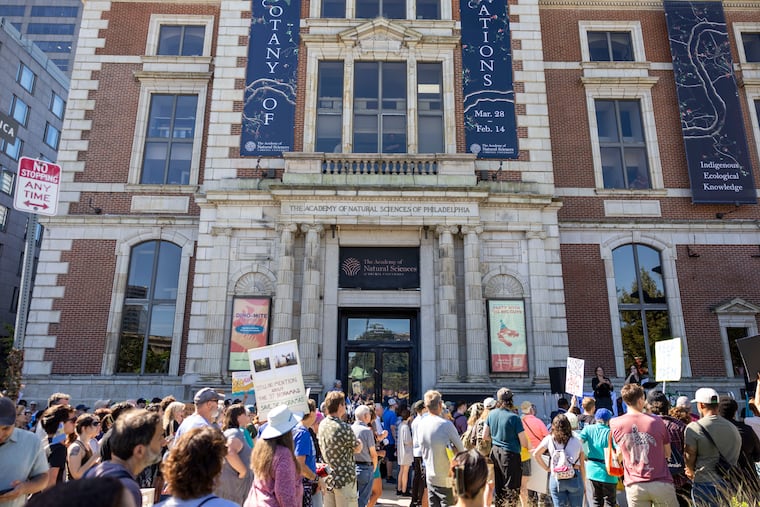
For months, protesters from all over Philadelphia gathered with signs and chants around City Hall and Center City. Now, the Asian Arts Initiative is providing a glimpse into what went into this fight and how demonstrators and activists won this battle, in its ongoing exhibition “No Arena: Making a Movement.”
“I think we were grappling with the question of what we’re going to do for the 250th anniversary of the United States, with the state of the country now,” said artist and writer David Kyu, the director of programs at the Asian Arts Initiative. “This had to be a community project.”
He was joined in this project by the director of Philadelphia Folklore Project, Mia Kang, Asian Americans United solidarity movement organizer Lauren Lowe, and community organizer for the Asian Pacific Islander Alliance Jenny Zhang.
“We want to highlight — we are a part of this country,” said Kyu, who was born in South Korea. “We have immigrated here, found opportunity, and we want to highlight this movement and a model of democracy we should be following.”
For these organizers, the idea of an arena destroying a large part of Chinatown was made worse by the fact that there’s already a basketball league in the neighborhood: the Philadelphia Suns, which forms a community and builds outreach.
And it wasn’t just them. Local restaurants also joined in on the fight. Restaurateur Ellen Yin, the founder of High Street Hospitality Group, held a fundraiser. South Philly Barbacoa’ Cristina Martinez, herself a champion of undocumented workers, put her weight behind the movement as well. “Uncle Sam,” the owner of Little Saigon, and Xu Lin, the owner of Bubblefish, provided space for organizers to meet.
The exhibition is divided into five sections that encompasses the trajectory of the fight to save Chinatown from the massive arena project — one that many residents claim would have destabilized this important neighborhood and community.
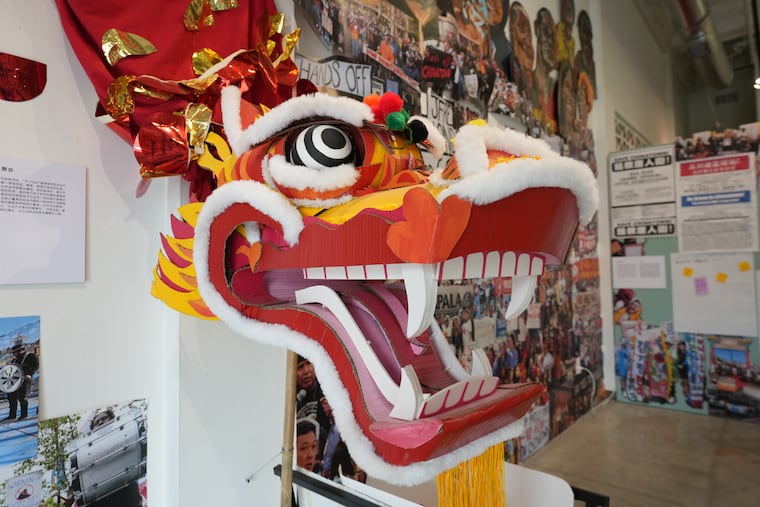
“Joy/Gathering” features a massive papier-mâché dragon and videos of people finding joy at protests. Next is “Participation,” which centers that massive photo collage. “Movement Culture” is a wall that features archival documents — including an Inquirer article from decades ago — that point to previous threats to Chinatown’s very existence.
That’s followed by “Confrontation,” clearly expressed in the City Hall mock-up, and finally, there’s “Transformation.”
This wall feels particularly poignant and timely, as it’s meant as a call to action for future generations to learn effective ways to protest and organize. This includes posters that call for U.S. Immigration and Customs Enforcement to be taken out of neighborhoods throughout the city.
Lowe believes these two fights are intertwined. “The displacement of communities — now we see people being forcibly taken from their homes,” Lowe said. “The coalition was so multiracial and the understanding was that all of these struggles are tied together.”
The obvious joy of this all, expressed through the videos and pictures of smiling protesters and the handmade papier-mâché art centered around this community effort, is what makes the exhibition well worth your time.
“The joy and fun was a reprieve,” Lowe said. As Zhang pointed out, this movement created a unified front that was beautiful to behold. “Part of the victory of the no arena fight was bringing people together from across the city. We actually got to know our neighbors,” she said, adding that Philadelphia’s Chinatown protests went on to inspire fights to save Chinatowns under threat in cities like Seattle, Chicago, and New York.
At the end of the day, this hard-fought struggle to save a historic and vital neighborhood — full of unimpeachably great restaurants, small businesses, and homes — was a success. The exhibit helps visitors relive that fight and find inspiration in getting involved within their communities.
“No Arena: Making a Movement” runs through July 11 at Asian Arts Initiative, 1219 Vine St., asianartsinitiative.org