Atlantic City Electric’s mascot for years wore blackface and a bellhop suit. The company has found a way to address its racist past.
Elec was a staple in advertisements from 1927 to 1952. The electricity provider wants more people to talk about him.
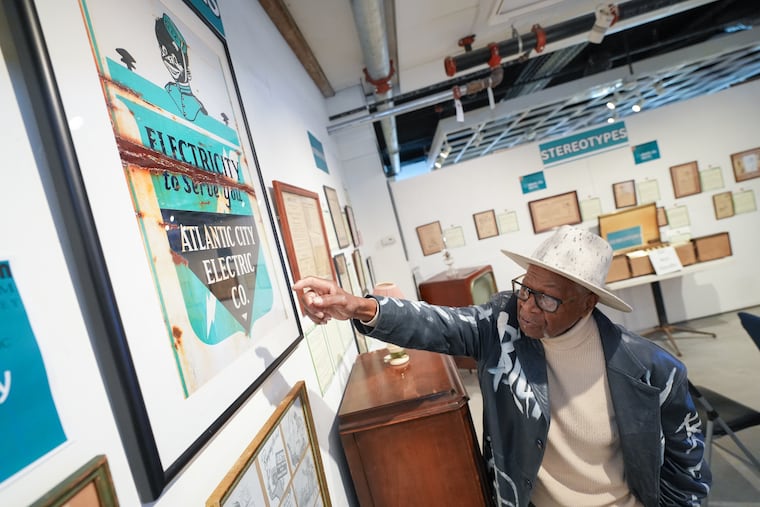
ATLANTIC CITY — He was called Elec, a caricature in a bellhop suit, drawn with a blackface and other exaggerated minstrel-like features.
And from 1927 to 1952, Elec was ready to serve, as depicted in numerous advertisements for Atlantic City Electric, even when it meant hanging three Axis dictators on electrical wire.
The advertisements, collected by a retired chemist from Margate, Larry Frankel, are at the heart of a new exhibit: “Stereotypes — How African Americans Have Been Depicted in Advertising” on display through May 26 at the African American Heritage Museum of Southern Jersey’s Atlantic City location at 2200 Fairmount Ave.
The Atlantic City Electric advertisements featuring the caricature bellhop were a local revelation, said Ralph Hunter, the museum’s founder and president, and a tireless exhibitor of Atlantic City and South Jersey’s Black history and culture.
The exhibit is underwritten by Atlantic City Electric itself, and features a range of corporate advertising with racial caricatures and Black stereotypes; from Aunt Jemima to Darkie Tooth Paste, Cream of Wheat, Uncle Ben’s Rice, and Gold Dust Washing Powder, featuring the Gold Dust Twins. It features a display of artifacts donated by the estate of Stanley Abrams, a Philadelphia surgeon.
“The most important thing we did here, we didn’t blindside Atlantic City Electric,” Hunter told a preview gathering that included numerous Atlantic City Electric employees last month. “We called them before we hung the first piece on the wall. Atlantic City Electric responded in such a way that was really fantastic. They said, ‘Yes, we’ll work with you, and we’ll sponsor the exhibit.’”
By the 1950s, the company left Elec behind, in favor of a generic light bulb mascot, Ready Kilowatt. The company now counts Black men and women among its top leadership. Its parent company, Exelon, has a Black CEO.
In a statement that is exhibited along with the advertisements, Atlantic City Electric notes, “We recognize these portrayals can be painful to see. Acknowledging them openly is an important step in understanding how deeply such stereotypes were embedded in everyday life and how far we still must go to ensure equality and respect for all.”
Bert Lopez, public affairs manager at Atlantic City Electric, said the company felt it was important not to look away from its past.
“We could see that at Atlantic City Electric and Exelon, we have learned from the past,” he said. “It’s an opportunity to really open the dialogue about the past, and what we could do to move forward.
“I’ve been with company for 48 years,” he added, “so I’ve seen glimpses of this in the past. It’s driven by slavery and Jim Crow, where they thought of African Americans as servants basically. And you saw a lot of that in the advertisements of the day. ”
Frankel had purchased a collection of old local newspapers from Atlantic City, Pleasantville, and Ventnor at first to look at old movie ads. But the Atlantic City Electric’s Easter advertising featuring Elec stood out.
“You know it was big, it was bold and unmistakable, and you wonder, what is this?” After finding dozens of different ads, he contacted Hunter.
“When he called me and we went down and saw what he had, I went crazy,” Hunter said. “How do we tie this together? How do we involve all these different people and be able to tell the story. The beautiful part about the story [is] from Atlantic City Electric: a Black kid who was the face of Elec to the CEO of Atlantic City Electric, a Black man.”
The ad that most caught Hunter’s favorite features Elec in a patriotic light, literally hanging the axis of Evil.
“That portrays a Black man with three electric wires, a positive, negative, and neutral wire, hanging over a telegraph poles, three wires hanging down, hanging three dictators,” he said. “Now what the hell does that have to do with electricity? ... The art says that I’m a Black man, I can hang dictators. That’s what I get. But you and I know that’s not true.”
The ads are all individually drawn, but only one is signed. Frankel has not been able to figure out who the artist was.
Nelson Johnson, the former judge who wrote the celebrated book Boardwalk Empire, which was made into the HBO series, and The Northside, a history of Atlantic City’s Black community, said the depictions represented the views of the day.
“In these ads, they knew their subscribers for electricity were white, and they knew that those white customers viewed Black people as servants,” said Johnson, who also attended the preview showing. “This character was quite appropriate in the minds of Atlantic City Electric at the time.”
Views of a woman’s role in domestic life in some of the ads also reflect stereotypes of the day and the novelty of electric appliances. One promises the homemaker “freedom from drudgery,” courtesy of “a good electric range.”
“The Woman Pays,” several ads are headlined. “Electric cookery tastes better.”
“Domestic tragedies have their beginnings in small things not the least of which is tasteless or poorly prepared food,” the ad warns. “No man can neglect an electrically cooked meal.”
Shayla Salter, Atlantic City Electric’s external affairs manager for 14 years, said viewing the exhibit “confirms what you hear, but makes it tangible.”
“I wouldn’t work for this company if I didn’t feel we were really setting the pace, representing the people of the community,” she added.