Founding Father Ben Franklin also founded America’s first volunteer fire department
After a fire nearly destroyed a colonial community along the Delaware River, Ben Franklin organized the first volunteer fire company in 1736. Its warehouse was in Old City.
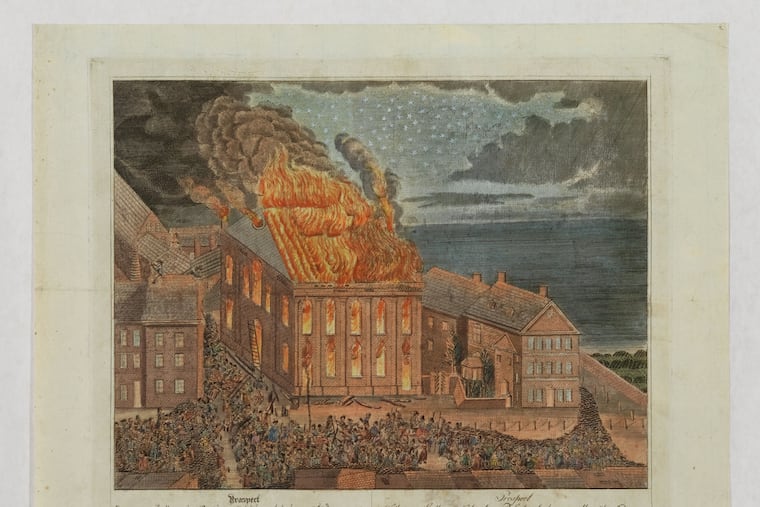
Colonial Philadelphia — a community of wooden dwellings and businesses along the Delaware River back in the 1700s — was under constant threat of burning to the ground. Fires could and did start from the haphazard fling of a cigarette, or burning the soot out of chimneys, or sometimes the accidental drop of a lantern.
By 1730, the city had just one fire engine — a steam-powered box car — and dozens of buckets for carrying water to extinguish flames. When a fire that year on Fishbourne Wharf nearly destroyed the city, causing 5,000 pounds in property damage, Ben Franklin took notice.
The incident prompted him to advocate for fire prevention in his newspaper, The Pennsylvania Gazette, coining the still-used fire safety mantra, “An ounce of prevention is worth a pound of cure.”
On Dec. 7, 1736, Franklin and 24 other prominent Philadelphians established the Union Fire Company.
The formation of the Union Fire Company will be remembered Saturday at the Firstival to be held at Fireman’s Hall Museum. Firstivals are the Philadelphia Historic District’s weekly day parties celebrating historic events that happened in Philadelphia before anywhere else in America, and often the world. They are part of a yearlong celebration of America’s 250th birthday.
The Union Fire Company, also called the Bucket Brigade, was modeled after mutual aid firefighting organizations in Boston. In its early years, the company only helped its members put out fires in their homes or properties.
In 1742, the members voted to help any Philadelphian whose home or property was ablaze. The fact that they helped all Philadelphians, not just members, made the company America’s first volunteer fire department.
Within the decade, Philadelphia had eight volunteer fire companies.
These early volunteer fire companies were elite organizations that capped their memberships at about 30, explained Carol Smith, curator and archivist at Fireman’s Hall Museum. Members provided their own equipment: buckets for carrying water to put out fires and bags to salvage items from being destroyed. Companies had several meetings a year and members were fined for absence or tardiness.
As the home of the country’s first volunteer firefighting outfit, Philadelphia was progressive when it came to fighting fires — they were among the first companies in the country to experiment with innovative hoses. The city also was unique in establishing ways to support Philadelphia residents impacted by fire.
In 1752, Franklin started the nation’s first property insurance company, the Philadelphia Contributionship for the Insurance of Houses from Loss by Fire, still operating today.
Philadelphia’s early network of volunteer firefighters stopped major fires, like the 1794 burning of Zion Lutheran Church, and prevented extensive fire damage to the city.
“A lot of it was because of the advances in firefighting technology like updated hoses,” Smith said. “Our volunteer fire departments were very proactive.”
The Union Fire Company housed its equipment on Old City’s Grindstone Alley and was active through the early 1800s, disbanding in 1843. Its remaining members joined the Vigilant Engine Company, that, in 1871 became Engine 8, one of the city’s first municipal fire stations.
It remains open.
This week’s Firstival is Saturday, Jan. 17, 11 a.m. — 1 p.m., Fireman’s Hall Museum, 147 N. Second St. The Inquirer will highlight a “first” from Philadelphia Historic District’s 52 Weeks of Firsts program every week.