The South Philly author who hopes a billboard on I-95 N will make people rethink fatness and AI slop
Emma Copley Eisenberg used a $3,000 settlement from an AI lawsuit to rent a billboard for six weeks. Not just to advertise her new book, "Fat Swim."
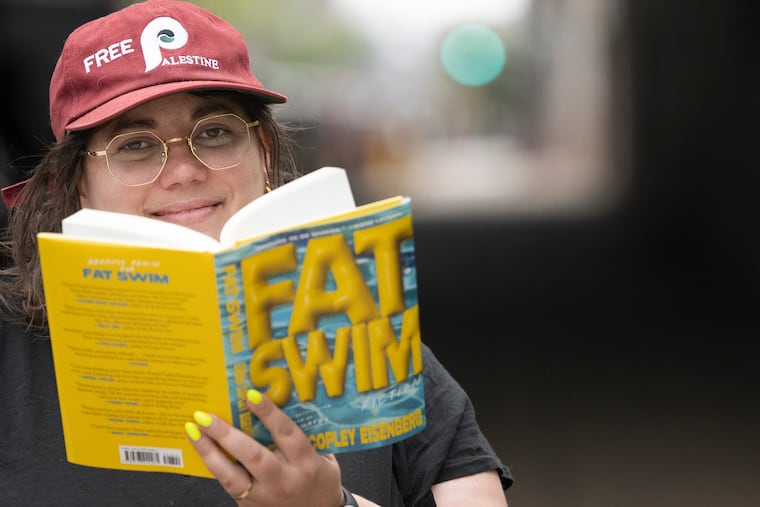
Author Emma Copley Eisenberg; her mom, Claire Copley; and her partner, Art Phung, let out a gleeful exhale on a recent Monday morning as billboard installers sent a swath of oceanic blue heavy-duty vinyl fluttering down a sky-high placard rooted at Northern Liberties’ Front Street and Fairmount Avenue.
As the workers tightly wrapped the vinyl around the billboard’s base, the image of a fat, naked woman came into focus. Her skin spilled over a fully exposed bottom in thick rolls, a piece of fabric loosely draped over her protruding belly.
“Your gut is a terrible thing to lose” is printed across the billboard in bold caps. In the lower right hand corner is Eisenberg’s website: FatSwim.com, named for her third book of the same name, due toward the end of April. It is a collection of short stories centering Philadelphia-area fat people, many of whom are queer.
“We just so rarely see images of fat people in public,” said Eisenberg, whose fiction and nonfiction pieces aggressively challenge the notion that big people are unhappy in their skin and view their girth as temporary.
Eisenberg prefers to use the term fat. “Plus-size,” “curvy,” and “overweight,” she says are euphemisms that imply being large is inherently bad.
The Your Fat Body Is Just Fine message needs to be amplified particularly in today’s world, Eisenberg said, where GLP-1 usage is widespread throughout contemporary pop culture, their advertisements infiltrating daily mundane tasks from watching television to scrolling.
“There is wisdom in the body,” Eisenberg said. “There are emotional and spiritual consequences when we view our whole selves as disgusting. We live in a world where people are always telling us to trust our gut. But there is so much pressure to lose it.”
On the strength of fat liberation alone, the 12-foot-by-28-foot matte billboard — 44 feet above the ground situated next to I-95 North just before the Girard Avenue exit — sends a powerful message.
But that’s only half it.
Last September, Eisenberg was one of 500,000 authors awarded $3,000 in a landmark settlement against Anthropic, an AI research company. A judge ruled that the San Francisco-based tech company illegally downloaded and stored millions of copyrighted books to train its large language models.
Eisenberg’s 2020 nonfiction work The Third Rainbow Girl: The Long Life of a Double Murder in Appalachia was one of those books. The $1.5 billion settlement was the largest payout ever in U.S. copyright cases.
“It felt like such a violation,” Eisenberg said. “Our original art was being stolen and recycled to create slop.”
From that settlement, Eisenberg paid Lamar Advertising $1,500 to rent the billboard for six weeks, until May 25. Fat Swim is Eisenberg’s giant middle finger to AI, algorithms, and any technology that controls how artists get their work into the world. She’s hoping that potential readers will find her website by happenstance, not a newsfeed that may — or may not — have targeted them.
“Essentially, algorithms are controlled by multinational corporations that are profiting off our data,” Eisenberg said. “I want to interrupt that and, as a human, put important ideas in front of other humans who might not otherwise find them.”
A billboard, she thought, is an analog broadcast that is the exact opposite of a newsfeed.
Eisenberg points to artists like Joseph Kosuth who, in the early 1970s, erected billboards throughout Europe and the Americas that blurred the line between public art and advertising. She was also inspired by feminist artists Jenny Holzer and Felix Gonzalez-Torres, whose texts and photographs, respectively, shouted messages of equality to passersby in the 1980s and 1990s in major American cities.
But, Eisenberg said, fellow South Philadelphian Zoe Strauss is her greatest influence. In 2012, the street photographer’s work appeared on 54 billboards and was the subject of a Philadelphia Museum of Art exhibit.
Authors, even those like Eisenberg who snag book deals at major publishing houses, are largely responsible for book sales and marketing. Fat Swim is set for release April 28, by Hogarth, an imprint of Penguin Random House. A March Publisher’s Weekly article reported that in 2025, more than 4 million book titles were published. Bold marketing ideas like billboards can potentially cut through the cyber noise and reach the reader directly.
According to Lamar Advertising, which is based in Baton Rouge, La., Eisenberg’s billboard is seen by 450,000 people a week, or 1.8 million people a month.
“The landscape for books in 2026 is very challenging because publishers believe that volume is key to sales,” Eisenberg said. “This is one small way I hope my book can be discovered.”
Eisenberg, a 2025 Pew Fellow, licensed the billboard photograph from Downington artist Devon Dadoly. The two met at Philadelphia’s Fat Con last year and Eisenberg said she fell in love with Dadoly’s sensual depiction of fat people, right down to their “delicious folds.”
“What she’s doing is incredibly radical,” Dadoly said. “As someone who is a fat person and who proudly identifies that way, I want to be seen. I don’t hate my body. I’m not a means to an end. I’m not some ‘before’ image.”
The short story “Fat Swim,” from which the book takes its title, is about a chubby pre-adolescent girl who is trying to come to terms with her size and who experiences complex feelings watching a Fat Positive Pool Party in West Philly.
Phung, Eisenberg’s partner, who is a graphic designer, edited the picture to make it look like an ocean. The wavy water graphics give the photo the mysterious vibe of a fashion magazine.
“We went with water because ‘Fat Swim’ is a story about water, and there are many stories in the book that have a water theme,” Phung said. “We really wanted to show the joy of what it’s like existing in all kinds of bodies.”
When Fat Swim drops, Eisenberg will have a book party and go on a small book tour that includes an April 30 appearance at the Ethical Society on Rittenhouse Square, sponsored by the Head and the Hand bookstore.
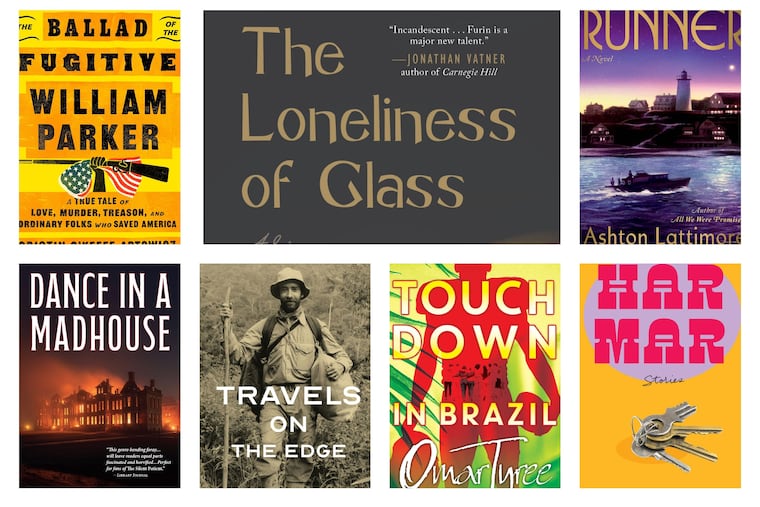
» READ MORE: 10 books with strong Philly ties for your spring reading list
And while the roughly 2 million people who will happen upon Fat Swim through the billboard might boost sales, no one knows for sure.
“This is an experiment,” she said. “It’s not tailored to anyone. It’s just there. People who never thought about the idea of fat liberation or cared to see an image of a fat body in public will see this. That gives me hope at a time when the algorithm just makes me depressed.”