An art gallery pops up in a Jefferson Einstein Hospital corridor
Reimagined JET covers, on loan from the African American Museum of Art, are making staff, visitors, and patients stop in their tracks.
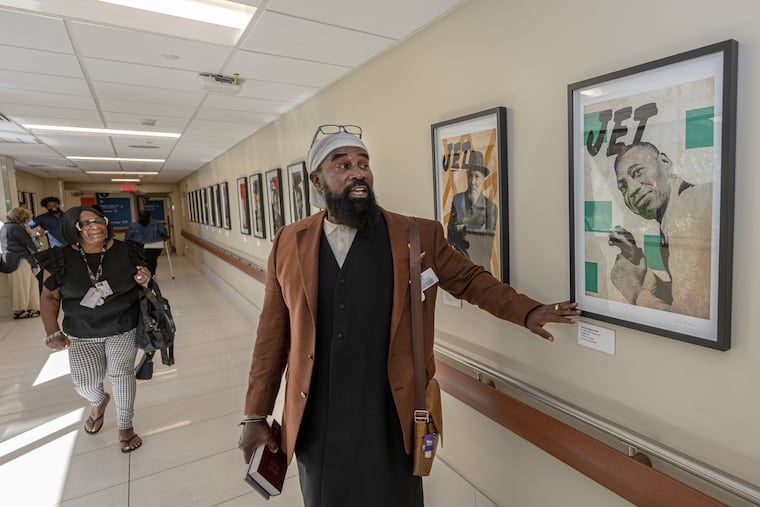
In Jefferson Einstein Philadelphia Hospital’s gleaming community corridor, passersby stop, stare, and smile at the framed black-and-white images of Philadelphia-born entertainers Jazzy Jeff and Marian Anderson; civil rights leaders Cecil B. Moore and Octavius Catto; and 19th-century artists Horace Pippin and Henry Ossawa Tanner.
Rare images of the icons — Anderson in a flapper dress and pearls, Billie Holiday without her gardenia, and Patti LaBelle with her 1980s “New Attitude” hair — are pause-worthy by themselves, but the word JET inscribed on the top left-hand corner of each of the images is what stops visitors, patients, and staff in their tracks.
“These are just so wonderful,” hospital chaplain Robert Harcum said Monday afternoon. Every stroll through the $2.9 million renovated corridor reminds him of a time not too long ago when John H. Johnson’s glossy news magazine was ubiquitous in Black spaces.
“JET was on every coffee table and in every barbershop,” Harcum said. “Look, there is [artist] Horace Pippin and [boxer] Joe Frasier. These are my memories. This is just wonderful."
Earlier this year, 24 reimagined JET magazine covers designed by North Philadelphia graphic artist Shaheed Rucker were the focus of the African American Museum in Philadelphia’s “(re)Covering the Iconic” exhibition. Today, those covers line the walls of Jefferson Einstein’s community corridor where they will be on display through February.
The traveling exhibit is the latest iteration of a six-year partnership between hospital and the museum.
“I wanted a community corridor that was engaging and told stories of people who looked like those who visited, worked, and were treated in our hospital,” explained Dixie James, president of Jefferson Health’s central region.
“(re)Covering the Iconic” is the seventh collaboration between AAMP and Jefferson Einstein. Past exhibits include “100 Black Leaders to Know in Philadelphia” and selections from AAMP’s Jack T. Franklin’s photography collection.
AAMP’s presence on Jefferson Einstein’s walls has led to a new curiosity about AAMP, said Djay Duckett, the museum’s vice president of curatorial services. And the collaboration is showing Jefferson Einstein’s community that fine art can include artifacts and images from everyday Black life.
This message is especially important when Black history and the Black experience is under attack by conservatives who argue the struggle that defines the American experience is “un-American.” JET and Ebony reported news about Black communities that mainstream publications ignored.
“I mean this is JET magazine,” said Dell Porter, who works in Jefferson Einstein’s patient registration department as she gleefully trotted through the wing. “That’s Tammi Terrell and look at Teddy Pendergrass and Patti LaBelle. This is just something!”
Johnson started JET magazine in 1951 as a newsy companion to its lifestyle glossy, Ebony. In its early days, JET’s mid-century modern covers featured newsmakers, activists, and celebrities framed by bold shapes and colors. JET was written in a brushstroke font popular at the time. Johnson Publishing Company stopped producing the mini-mag weekly in 2014, but it’s available online.
In 2018, artist Shaheed Rucker began placing black-and-white photos of contemporary celebrities like Solange Knowles and Lauryn Hill against original JET covers. He placed his art in Black-owned restaurants and sold them at events throughout Atlanta. He became JET’s creative director in the early 2020s.
In 2024, AAMP curator Michael K. Wilson asked Rucker to curate an exhibition of reimagined JET covers featuring mostly-Philadephia celebs for the museum. Playwright August Wilson and civil rights activist Bayard Rustin were thrown in the mix, too; they are from Pittsburgh and West Chester, respectively.
At Jefferson Einstein, Rucker also curated a companion show, “Breakfast of Our Champions,” featuring reimagined Wheaties boxes with Negro League Baseball players. Philadelphia Stars catcher Bill “Ready” Cash and Pittsburgh Pirates right fielder Roberto Clemente are among the athletes on the cereal boxes.
“It was cool to learn about Philadelphia’s rich cultural history and the variety of artists, athletes, and activists who call our city home,” said Rucker, 39.
AAMP and Jefferson Einstein’s art collab is part of a larger trend of private and public institutions paring with museums to zhuzh up hallways, entrances, and high-traffic spaces. Hyatt Centric Philadelphia has a dedicated space featuring artists of color, women, Latinos, and the LGBTQI community.
“It’s a great way to keep the space fresh, celebrate the history and culture of our community and give guests a fresh perspective,” said Elizabeth Fricke, director of sales and marketing at Hyatt Centric Philadelphia.
Traveling exhibitions are a long-term business strategy for museums.
Germantown’s Colored Girls Museum will launch a mobile museum this month at Harlem’s Children’s Art Carnival “The First Time Ever I Saw Your Face,” a portrait series celebrating Black girlhood.
“When artwork leaves its space, it establishes new relationships with new audiences,” said Vashti DuBois, the founder and executive director of the Colored Girls Museum.
“Those audiences are able to relate to the work from where they are.”
Rucker would like to see “re(Covering) the Iconic” and “Breakfast of Our Champions” in museums throughout the state, including the Philadelphia Museum of Art and the August Wilson Center in Pittsburgh. The more places his exhibits go, the more young people will learn about JET magazine, the reason he started reimagining covers in the first place.
“JET and Ebony was one of the only news sources for Black people,” Rucker said. “The keys to today’s struggle are nestled in these pages. If we understand the past, we can apply these lessons to today.”