Philadelphia Ballet’s ‘The Merry Widow’ is a rom-com, period piece, and visual feast. It’s the Jane Austen of ballet.
Set in the Belle Époque era in Paris, it is all lush dances, glittering dresses, tiaras, and impossibly lavish feathered scarves
If you’re looking to find an artistic escape with your night out, Philadelphia Ballet’s new (to them) The Merry Widow is a good match.
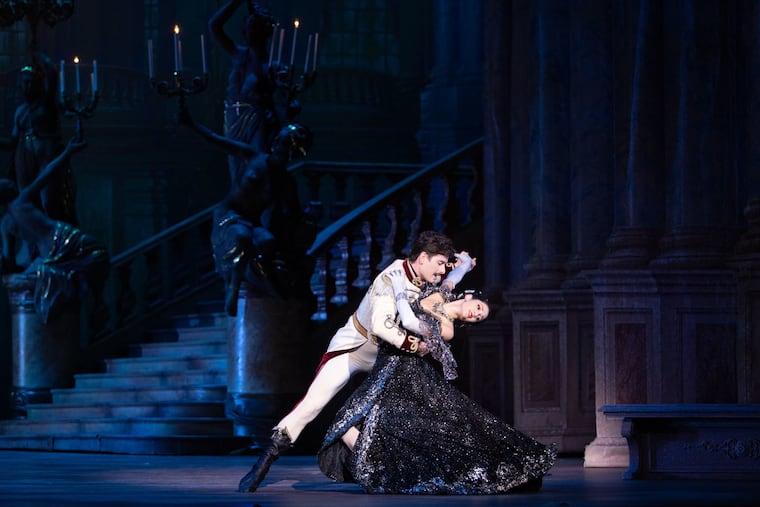
Set in the Belle Époque era in Paris, it is all glittering dresses, tiaras, stunning ballrooms, and beautiful gardens. The main characters change costumes several times. The movement mixes in waltzes and folk dances (from a fictional country), along with pointe work and partnering.
A romantic comedy, period piece, and visual feast, it is sort of the Jane Austen of ballet.
While it’s called The Merry Widow, there are two strong principal couples. On Thursday night’s premiere at the Academy of Music, Mayara Pineiro was Hanna, a rich widow, and Sterling Baca was Danilo, an aristocrat who broke it off with the young Hanna years ago when she was a poor peasant. The leaders of their fictional country, Pontevedro, would like them to marry to keep their homeland afloat.
The second couple is Valencienne, danced on Thursday by Yuka Iseda, and Camille, performed by Ashton Roxander. The third wheel in the relationship is Valencienne’s much older husband, Baron Zeta, a character role performed by rehearsal director Charles Askegard.
Iseda was the best surprise of the night. Her reactions and comedic timing were on point and helped move the narrative along.
» READ MORE: Philadelphia Ballet’s 2026-27 season brings the fireworks for America’s 250th birthday
The partnering from both couples was top-notch, and the dancing as a whole was rich and lush.
The sets and costumes, by Roberta Guidi di Bagno, are reason enough to see The Merry Widow. Occasionally the costume changes make identifying the characters confusing, but all is forgiven when Pineiro enters in a white gown and an impossibly lavish feathered scarf.
Ronald Hynd adapted The Merry Widow in 1975 for the Australian Ballet from the operetta and the Franz Lehár score was arranged for the ballet by John Lanchbery.
The original Danilo for the Australian Ballet, John Meehan, was a répétiteur for the Philadelphia Ballet, along with Steven Woodgate. So the dancers learned the choreography from an original source.
» READ MORE: There’s a bit of Philly everywhere, even in Milan’s La Scala
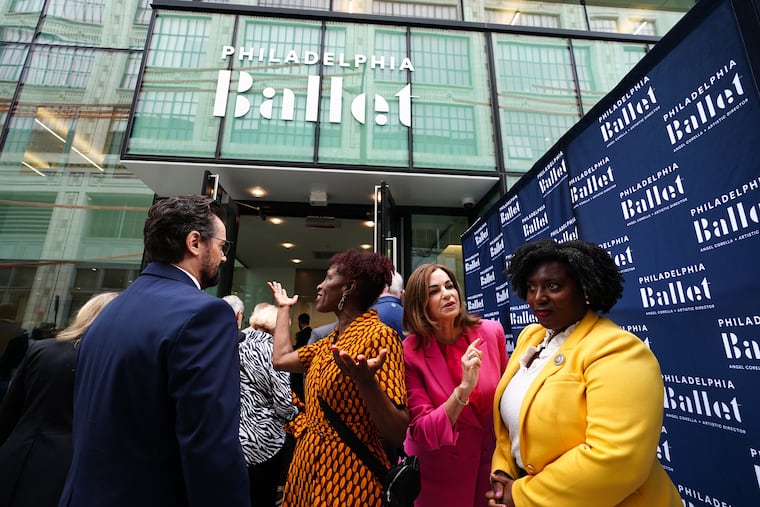
Artistic director Angel Corella said last week that he had wanted the company to perform The Merry Widow since he came to the company in 2014.
“It’s one of my favorite ballets. It’s so much fun,” Corella said. “Great dancing, beautiful music, beautiful story.”
The group dances add a lot of depth to the ballet — and more stunning costumes. From the ballroom scenes to the folk dances of fictional Pontevedro, a cancan scene, and men performing in tails, the stage nearly vibrates with color and sparkle. The ballet has many dancers to cast, from the advanced levels of the school through the professional ranks, so these large scenes are impressive.
For a fairly recent ballet, there is some Orientalism in the folk dance scenes. But since it is set in a made-up place, any passing likeness to Turkey or the Middle East is easier to take.
Philadelphia Ballet in “The Merry Widow.” Through March 15. Academy of Music. $29-$274.40. 215-893-1999 or ensembleartsphilly.org