Thanks to a million-dollar grant, Mother Bethel A.M.E. may soon have air-conditioning in its sanctuary and other much-needed repairs
The historic site was one of five chosen by African American Cultural Heritage Action Fund's Black Churches Project.
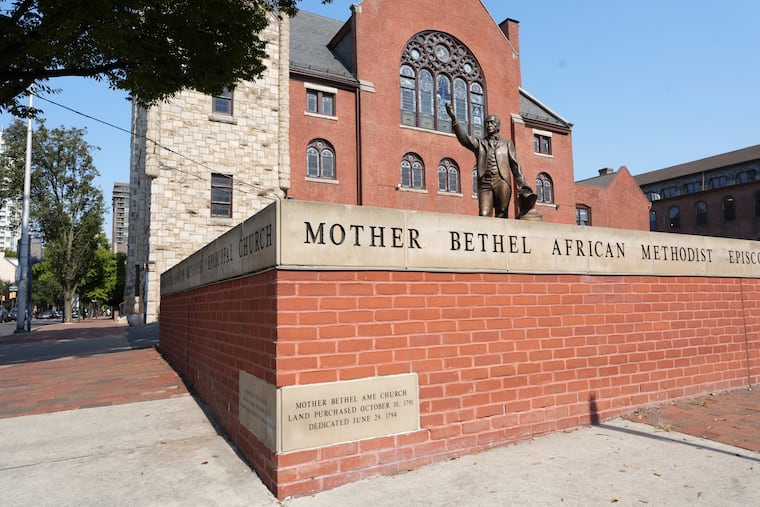
Within the Mother Bethel African Methodist Episcopal Church’s 162-year-old brick walls is a venerable American history collection. It includes A.M.E. church founder Richard Allen’s Bible, the pulpit from which he preached, pews from its first building, and a bust of Allen, first displayed at the 1876 World’s Fair.
Keeping the lights on, the centuries-old stained glass windows translucent, and the organ pipes tuned isn’t cheap. Then there’s maintaining a presence in the community and conserving the church’s aged artifacts. .
In late January, Mother Bethel was one of five historic African American churches to receive a $1 million grant from the African American Cultural Heritage Action Fund to do just that. When the Rev. Carolyn C. Cavaness learned the news, she was as relieved as she was elated.
With Philadelphia’s Semiquincentennial around the corner, the money was right on time.
“This is a major transformational opportunity for us to chart a pathway forward,” Cavaness said. “We have critical building needs like the brick pointing needed to repair the masonry, rebuilding parts of the foundation, and improving our accessibility. There are 40 steps to get to the second floor and we don’t have an elevator.”
The African American Cultural Heritage Action Fund, a division of the National Trust for Historic Preservation, was launched in 2017 to grant money to sites where important moments in Black history central to America’s story.
Within the African American Cultural Heritage Action Fund is the Preserving Black Churches Project, funded through a $60 million investment from the Lilly Endowment.
Black churches have served as political and educational cornerstones in the Black community for more than a century, built by communities of formally enslaved and free Black people. Today, many of the sites are civic spaces that need a financial boost to continue to thrive, Brent Liggs, executive director of the Cultural Heritage Action Fund, said in a news release.
First African Baptist Church in Beaufort, S.C. — one of the first schools to educate Black people during Reconstruction — is among the $1 million awardees.
The other churches are: Chicago’s Roberts Temple Church of God in Christ, where lynching victim Emmett Till’s open casket funeral was held; Second Baptist Church Los Angeles, a West Coast civil rights hub where the Rev. Dr. Martin Luther King Jr. once preached; and Brown Chapel A.M.E. in Selma, headquarters for the 1965 Voting Rights Act Movement.
“These churches represent multifaceted legacies spanning cultural moments in American history and culture,” Liggs said.
In 1791, a few years after the formerly enslaved Richard Allen and Absalom Jones were told they had to sit in Old City’s St. George’s Methodist Church’s segregated balcony, Allen bought land at Sixth and Lombard Streets. The block of land became home to America’s and the world’s first African Methodist Episcopal congregation.
Mother Bethel’s first building, a repurposed blacksmith shop, was dedicated in 1794. The current, and fourth building, was completed in 1890. Mother Bethel sits on the oldest parcel of land in the country continuously owned by African Americans. It presently has a congregation of 800.
The church has been at the center of Philadelphia’s Black community for two centuries. The first meeting of the Colored Convention — today’s NAACP — was held there in 1830.
“We have records in our church that serve as court proceedings,” Cavaness said. “Because of the level of fear people of African descent had with authorities at the time, they settled their disputes and disagreements internally and did not rely on the law and order of the era.”
W. E. B. Du Bois lectured at Mother Bethel, referring to the church as “the best of the great laboring classes.” It was designated a historic shrine by the U.S. Department of the Interior in 1965 and a national historic landmark in 1974.
Cultural Heritage Fund grant recipients receive money and the opportunity to work with building conservationists and tech experts to plan and prioritize the work needed.
Among Cavaness’ top priorities is installing air-conditioning in the sanctuary and tuning all the pipes in the church’s great organ. The organ was completely refurbished in 1976, the year of the bicentennial.
“A lot is required to keep these structures up and running,” Cavaness said. “It’s tough to balance ministry, serve the people, and preserve history all at the same time. This grant will give us a sustainability plan for the future and allow us to dream.”