Alexander Hamilton believed in Philadelphia’s prosperity and insisted the Federal Bank be headquartered in the city
The city is home to America's first national bank, which was established in 1791. But the Federal Reserve story remained unwritten for more than 100 years.
The Revolutionary War ended in 1783, but when the 1790s rolled in, America was in an economic spiral. Citizens were broke. Businesses were going under. The government had little money.
So the first United States Treasurer Alexander Hamilton came up with a plan to create a national bank to serve as the primary fiscal agent for the federal government. It would issue paper money, pay America’s bills, provide loans to private citizens, and collect taxes so the country could fund itself.
“Hamilton had been studying the British banking system for decades,” said Lynn Nash, a park ranger at Philadelphia’s First National Bank that is managed by the U.S. National Park Service. “He did a deep dive and decided America needed a similar system to build more fiscal authority.”
On Feb. 8, 1791, Congress passed a law establishing America’s first federally backed bank, which was located inside Philadelphia’s Carpenter’s Hall.
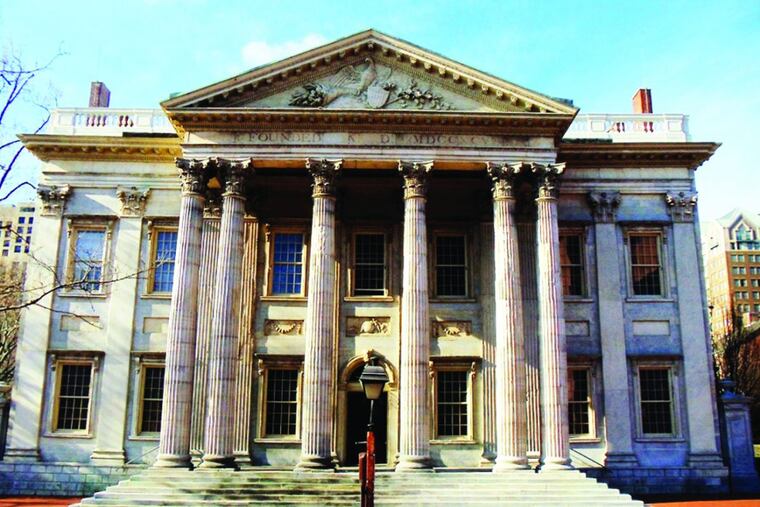
The city will celebrate America’s First National Bank Saturday, July 4, at the First Bank of the United States, 120 S. 3rd St., where it moved in 1797. The Independence Day fete is part of the Philadelphia Historic District’s 52 Weeks of Firsts program.
In honor of the Semiquincentennial, the National Park Service will reopen the First Bank to the public on July 1, following a multiyear $43 million rehabilitation. The gleaming Greek Revival-style building will feature exhibits centering on the history of American banking.
America’s first commercial bank, the Bank of North America, was charted by the Continental Congress in 1781 to provide loans to colonists and fund the Revolutionary War. And some lawmakers, especially Thomas Jefferson, thought that was sufficient and that the Federal Bank overstepped the Constitution.
While lawmakers settled into their capital digs in Washington, D.C., in 1800, Hamilton argued that the Federal Bank should be kept in Philadelphia through the end of its charter.
“He writes a letter to George Washington telling him how the bank needs to be housed in a large commercial seat,” Nash said. ”And that he knows Philadelphia will remain prosperous."
The First Bank of the United States’ charter ended in 1811. Hamilton had died by then and President James Madison did not renew the charter. The next year, the building was purchased by Stephen Girard, who opened a private bank in the space.
“But the War of 1812 was hard on the economy again,” Nash said. On April 10, 1816, Madison signed legislation establishing the Second Bank of the United States at 420 Chestnut St., Nash said.
(Today that building is the Second Bank of the United States Portrait Gallery.)
Its charter expired in 1832; Andrew Jackson was president, and he, too, opposed the idea of a federal bank. The charter was not renewed and America didn’t have a federal banking system for 77 years.
In 1907, New York financier J.P. Morgan and a consortium of bankers stopped the American banking system from collapsing by extending a line of credit to banking institutions. Without a federal banking system, the government could not bail these institutions out, so government officials began discussing the establishment of yet another national bank.
Finally, President Woodrow Wilson signed the Federal Reserve Act in 1913, setting up the federal banking system we know today.
The Federal Reserve is headquartered in D.C., but there are 12 branches across the country; Philadelphia is home to one of them.
Today, the Federal Reserve acts as a fiscal agent for the U.S. Treasury, which issues paper money, collects taxes, and pays America’s bills. It does not offer private loans to businesses or individuals.
Like the national banks, the Federal Reserve also began with a 20-year-charter. But in 1927, Congress passed the McFadden Act, granting the Federal Reserve Bank perpetual succession.
“The government finally agreed that a federal banking system was something America needed,” Nash said. “It just took them more than 100 years to agree.”
America’s First National Bank Firstival will be celebrated on Saturday, July 4, from 11 a.m. to 1 p.m., the First Bank of the United States, 120 S. Third St.
The Inquirer is highlighting a “first” from the Philadelphia Historic District’s 52 Weeks of Firsts program each week. A “52 Weeks of Firsts” podcast, produced by All That’s Good Productions, drops every Tuesday.