Opera Philadelphia’s ‘Sleepers Awake’ is the ‘Turandot’ opera with a prescription for Ambien
The retelling of the "Sleeping Beauty" legend that hasn’t quite found its legs but still has a lot for audiences to immediately latch on to.
With the ambitious hybrid nature of the new Gregory Spears choral opera Sleepers Awake, has Opera Philadelphia opened a promising new door amid the endless possibilities of music theater? Or is the piece a one-of-a-kind curiosity?
Either way, Wednesday’s premiere revealed a retelling of the Sleeping Beauty legend that hasn’t quite found its legs but still has a lot for audiences to immediately latch on to. The feast of sounds coming off the Academy of Music stage was plenty reason to hear this 90-minute, intermissionless piece.
How often is an orchestra dominated by harps positioned antiphonally in box seats on each side of the stage? How often is sleep conveyed by colorful smears of sound achieved by microtonal glissandos? And that otherworldly, piccolo-like sound at the beginning? Those were dog whistles. And that carried me through passages where the opera’s dream-dominated world felt distant — emotionally, and intellectually.
The Sleeping Beauty story — a princess and her community cursed to sleep for a century until awakened by a prince — has some surprises for our times. Fairy tales come down to us in fragments that are reassembled in every generation. The libretto compiled by the composer based on the writings of Robert Walser (1878—1956) has a plainspoken edge (somewhat like the Anne Sexton’s irreverent fairy tale collection Transformations), so that the awakening isn’t the happiest experience.
The populace is tired of everyday responsibilities, tired of doing the right thing and just plain tired. The parallels with Puccini’s Turandot (also a fairy tale opera) are inescapable with its morally exhausted society and imperious princess who doesn’t just dismiss her suitors but executes them.
In Sleepers Awake, the cultural promise of a Prince Charming is an impractical illusion. The princess, named Thorn Rose, isn’t swept away by The Stranger but comes to be moved by his heartfelt sincerity. And the rest of the community ultimately seems to long for the illusions of the sleep world, even knowing that they’re illusions.
It’s the Turandot opera with a prescription for Ambien — the question is how and why they want to take it. At least that’s what I got from the piece.
Speaking of Turandot: Spears’ music shares many of Puccini’s attractive qualities but is very much its own thing with a color palette whose grandeur doesn’t come from imposing washes of sound, but layers of activity that are out to carry the stories macro and micro narratives.
Harps give a sense of a bard-like figure telling a centuries-old saga. Some moments are spare and simple. Minimalism is an intermittent presence, its repetitive rhythms used to suggest racing pulse and time-sensitive urgency. Spears employs his range of techniques as demanded by the libretto, but not to prove himself as some sort of modernist. Music director Corrado Rovaris made sure all elements were integrated in ways that told you that they all belong together.
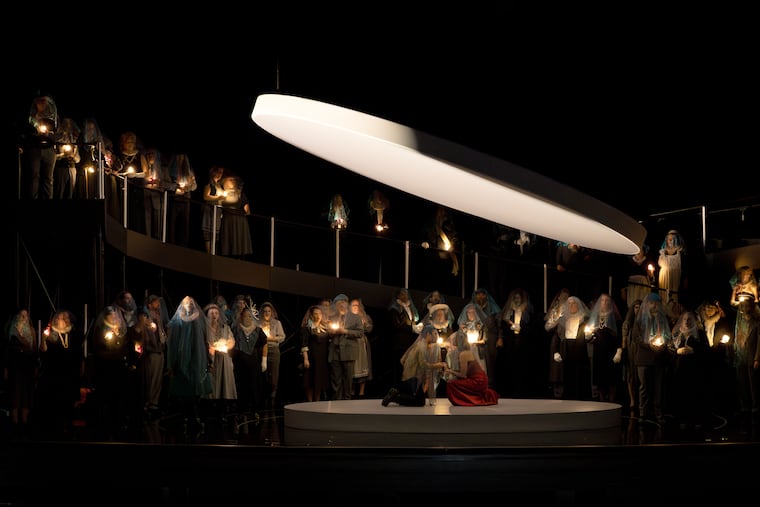
Stage director Jenny Koons and designer Jason Ardizzone West couldn’t have served the piece better: The circular set had the population in a semicircle surrounding the centralized action (not unlike the great Andrei Serban production of Turandot at London’s Royal Opera House). Lighting shifts from twilight to blindingly bright moments of revelation (thanks to Yuki Link) also assured that there were no sleepy moments — while giving the narrative well-defined sign posts.
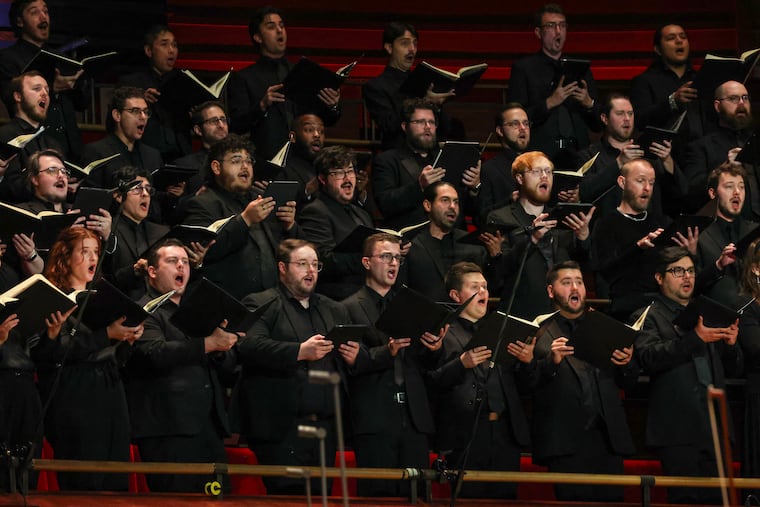
The choral story-telling element demanded a kind of precision that’s tough for a 60-member chorus in a large theater — even for a group as fine as the Opera Philadelphia Chorus. The welcome subtitle screen can only go so far in projecting the sense of the words — a cognitive element that is aided by the singers living with the piece longer than most opera-company rehearsal periods allow.
The solo singing — Susanne Burgess as Thorn Rose and Brian Major as the Court Poet — was more able-bodied than charismatic, though Jonghyun Park as The Stranger delivered a much-needed emotional underpinning to the stage full of conflicted characters, plus excellent high notes.
Some revision might be in order for the piece. Lyrics could be tweaked for sense and singability. In the percussion section, use of the slap stick — frequently employed for reasons that weren’t clear at all — can be cut in half. And maybe the opera needs to be longer. There’s always more to the story, especially in the unlimited fantasy that is allowed by fairy tales.
Repeat performances are April 24 and 26 at the Academy of Music. 215-732-8400 or www.operaphila.org.