A South Philly teen broke into the Barnes Foundation 73 years ago. It led to a lifelong artistic career.
The 89-year-old painter Peter Paone, considered a father figure to Philly artists, has two museum shows this season.
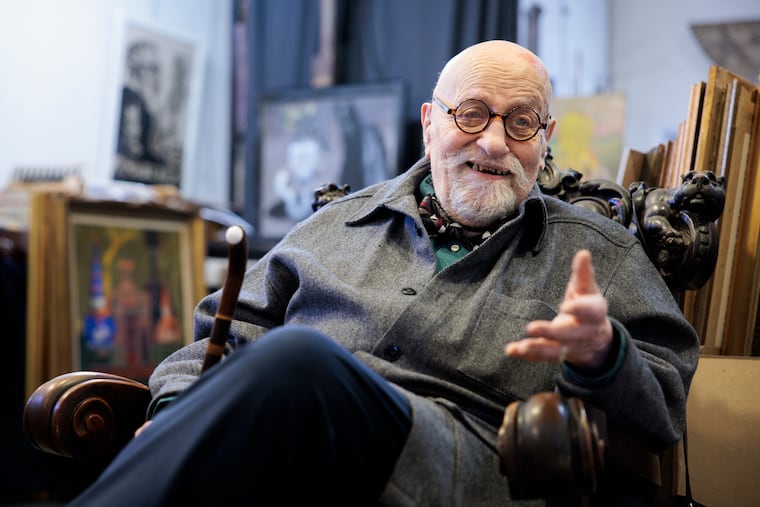
Painter Peter Paone might have never experienced his seven-decade-long illustrious art career if he hadn’t tried breaking into the Barnes Foundation in the spring of 1952.
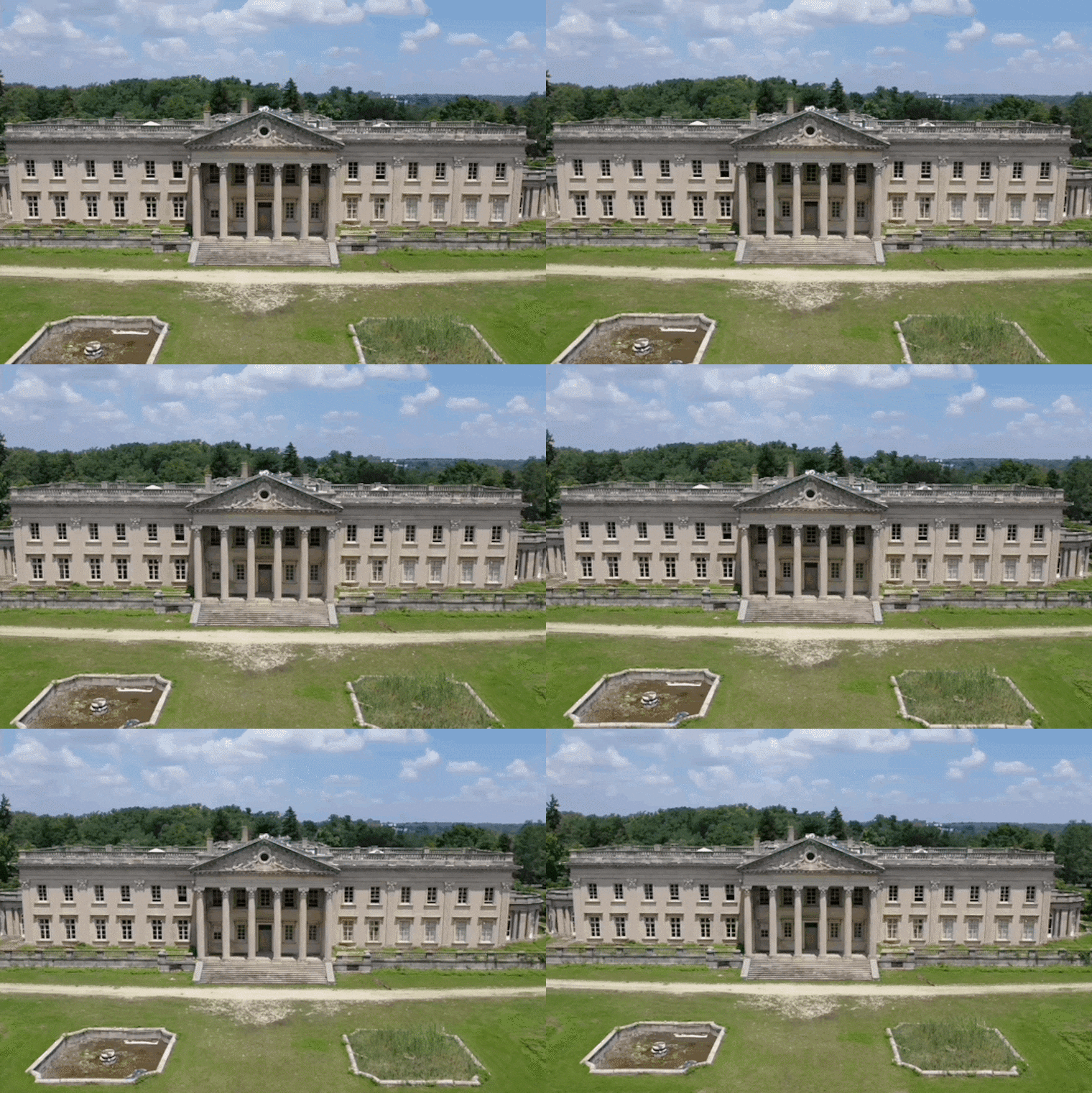
At 15, he traveled three hours from his home at Seventh and Dickinson Streets in South Philly out to Merion, taking several buses and getting lost along the way. The venerable institution was not yet a public museum, and in the wake of founder Albert Barnes’ death a year earlier, access remained severely restricted by invitation only.
When Paone, unaware of those rules, arrived at the gate, he found it locked.
“I was angry, so I did what 15-year-old kids from South Philadelphia do. I climbed over the gate — which was about 12 feet high,” said Paone, 89, who lives in West Mount Airy.
He landed on the other side, walked up to the stately building, and knocked. Arts educator Violette de Mazia, Barnes’ longtime assistant, opened the door, stunned and alarmed to see the teen in front of her.
“She said, ‘Go away. You can’t do that. Who are you? How did you get here?’” Paone recalled. “She was very taken aback and she wasn’t gonna let me in.”
Undeterred, Paone asked for a glass of water and de Mazia, somewhat begrudgingly, let him in while she fetched it. She returned to see the budding art student entranced by the impressionist works on the walls, so she relented and gave him a tour.
It was an unforgettable day that paved the way for Paone to take classes with de Mazia, setting him on a path that catapulted him into the art world.
For decades, Paone has served as an educator and mentor, becoming a father figure to Philadelphia artists while creating his own distinct body of work.
Now on the cusp of 90, he is in the midst of a career renaissance with two museum shows this season — and no signs of slowing down.
‘Promising talent’
Paone has been making art for as long as he can remember. The middle son of Italian immigrants who moved to South Philadelphia, he spent long hours playing in the streets and listening to the stories of hardworking families like his. They lived in a two-story rowhouse not far from a community center called Reed House, where he found his first art teacher at around age 8.
“My parents were supportive in the sense that they didn’t object, and I think mainly because they didn’t know what an artist’s life was like. There was no financial support and there was no discussion about it,” Paone said. “My father did what he could to help me build an easel and build storage racks because I had a little room in the basement.”
Fleisher Art Memorial was another haven for the curious kid in the neighborhood where he regularly attended art classes each week. Years later, when he was a teen, his name appeared in The Inquirer for the first time, in a short blurb about the school’s 1954 exhibit of young Philadelphia artists: “Explorative in their subject-matter, full of linear vitality and bold color this exhibition is refreshingly alive, though these are young students still groping for technical enrichment. … In [these works] we feel the contagion of promising talent in search of itself.”
He earned special permission to attend John Bartram High School, renowned for its creative arts program, and went on to study arts education at the Philadelphia Museum School of Art (later called University of the Arts) with a scholarship from the board of education that covered four years of tuition.
Like many artists, Paone spent some years in New York, but he never left Philly for too long. He taught at the Pratt Institute and worked with two galleries for about 12 years, with a brief stint in Europe funded by a Guggenheim Foundation grant that opened opportunities for him to exhibit in London, Vienna, and Hamburg.
He was always thinking about Philadelphia.
“In New York, you know, you’re good for a season, then you’re done, just like vegetables — you start to smell and you get out,” Paone said.
He returned home in the late ’70s, taking a teaching position at the Pennsylvania Academy of the Fine Arts in 1978, where he soon established the academy’s first printmaking department. While he built a stellar reputation as an educator and mentor for generations of emerging artists, Paone did not have a major solo museum show in his hometown until about 35 years later, in 2013, at Woodmere Art Museum in Chestnut Hill, where he shared never-before-seen drawings and paintings in “Wild Flowers.”
“I don’t think I could have had the career that I had outside of Philadelphia, I think, because of the art schools, because of the life I had in Philadelphia, and the collectors, and the Philadelphia Art Museum,” he said.
A studio of wonder
For the last 50 years, Paone has lived in a quiet, wooded area on the edge of Wissahickon Valley Park with his wife, Alma Alabilikian. Surrounded by nature, the former carriage house home is both inviting and mysterious, like something out of a fairy tale.
Inside, it’s a delightfully busy studio on the first floor (the couple lives right above). There are wonders in every corner, from a windowsill covered with tchotchkes to towering shelves laden with tomes on art history. His collection of roughly 6,000 books, amassed over his lifetime, has been willed to the Philadelphia Art Museum.
Then there are the canvases, packed in by the hundreds — all different sizes, all distinct frames, with clowns, dolls, and creatures amid scenes that puzzle and enchant.
Lately, Paone has been fixated on still life paintings — grumpy cats alongside decadent multitiered cakes, for instance — and portraits of what he calls snowpeople, with mouse ears and bird faces.
His subjects change, but a phantasmagoric splendor prevails throughout, evoking an uncanny, occasionally morbid vision.
It’s no surprise that for years Halloween has provided ample inspiration. One of his buzziest shows in recent years was “Reality Reassembled: The Halloween Paintings of Peter Paone,” which was at the Brandywine Museum of Art in 2019, about a decade after he retired from teaching at the Pennsylvania Academy of the Fine Arts.
Paone likes to say his main subject is “the human condition.” There are no models here — his surrealist-inspired paintings come from his whimsical imagination.
He spends about seven hours a day in the sunny, crowded space surrounded by dozens of brushes, cans, and paints he makes himself.
“Everything comes from memory. Everything comes from my own skills. I don’t go out painting. I don’t set up still lifes. I don’t hire models,” said the artist, who wears round, thick-framed glasses and has a penchant for bow ties. “It all comes from my lifestyle and what I did and what I remember from childhood to now.”
A spotlight long overdue
Today, Paone’s work is on view in two concurrent shows at the Woodmere (“Snowpeople,” through Feb. 15, 2026) and Doylestown’s Michener Art Museum (“Not So Still Life,” through March 15, 2026). For Michener chief curator Laura Igoe, it’s thrilling to present new works from a Philadelphia icon.
“He’s thinking a lot about division in society today, which it’s hard not to think about in our current political moment,” Igoe said. “Dolls and clowns will be arranged within the still life, but they won’t be engaged with each other — they’ll kind of be looking away from each other. He sees that as reflective of how we can’t always talk to each other in America today.”
Woodmere CEO William Valerio finds new treasures every time he visits Paone’s studio, and he’s consistently impressed by the painter’s relentless evolution. That was just one reason he ensured Paone’s portrait Peacock would have “pride of place” at the museum’s newly unveiled Maguire Hall.
“Peter is full of surprises and ideas. His creative imagination just gets richer and deeper, and he hasn’t stopped making art … nothing seems to slow him down,” Valerio said.
For Paone, this recognition is an affirmation of his refusal to capitulate to the commercial expectations of the previous decades.
“On one side, I’m surprised. On the other side, it’s about time. I’ve had a long and very active career on so many levels. … So back then, when nobody wondered what I was doing, I was ahead of my time, and now I’m in my time,” he said.
“One of the things that came out of being a child in South Philadelphia is that under no circumstances do you compromise in those days, you didn’t talk to the police. [It was] that kind of mentality. So I didn’t succumb to being a pop artist so I could be more known … I just kept going. That’s the secret of anybody’s success, is, no matter what, just keep going.”