Philadelphia’s ‘great masterpieces’ find a new home in Woodmere Museum’s Frances M. Maguire Hall
The Woodmere Art Museum repurposed a former convent to house its permanent collection. Frances M. Maguire Hall opens Nov. 1.
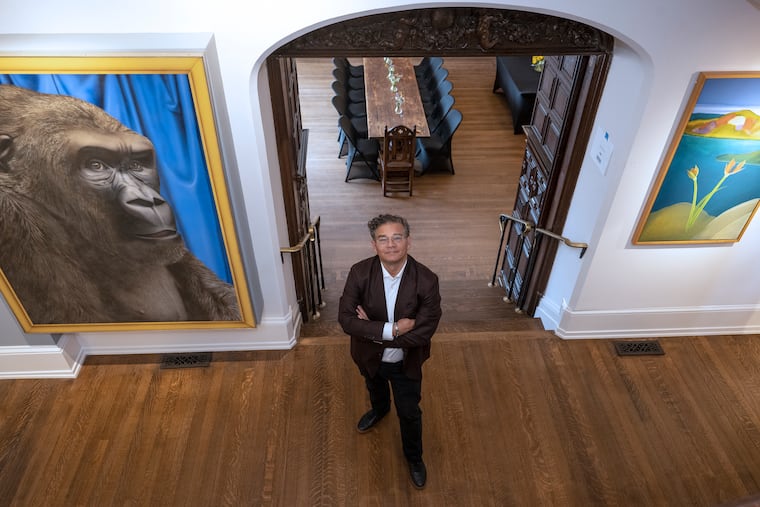
Woodmere Art Museum director and CEO William R. Valerio never thought he’d be standing in a former second-floor bedroom turned into a cozy, copper-hued art gallery, admiring Violet Oakley’s famous series of paintings: Building the House of Wisdom.
Yet, there he was.
Two weeks before the new Frances M. Maguire Hall for Art and Education opens on Nov. 1, Valerio was brimming with excitement.
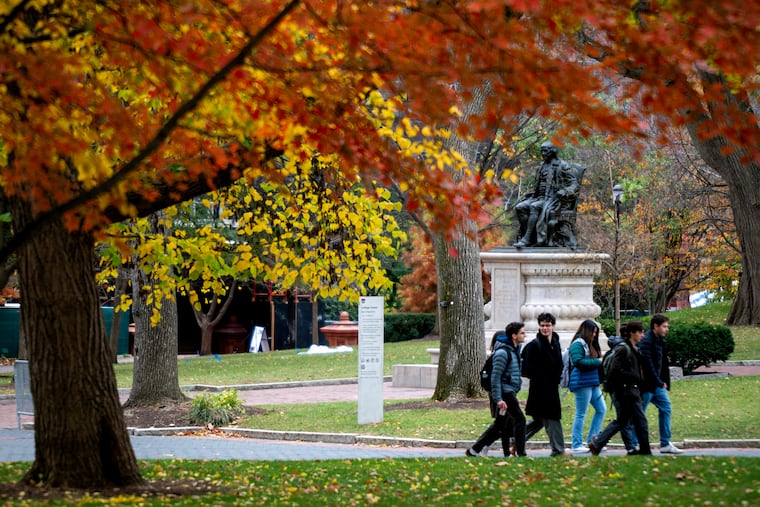
The Victorian mansion and former convent is the new home to the 112-year-old Chestnut Hill museum’s permanent collection, the most definitive group of paintings, sculptures, and prints by Philadelphia artists in the region — if not the world.
“I’ve been at the museum for 15 years and I’ve always wanted to build a space to show House of Wisdom the way Oakley intended it to be shown,” Valerio said. “But I never could have imagined this.”
This is a four-story, 17,000-square-foot, gleaming house museum.
The Violet Oakley Gallery is particularly noteworthy. The 375-square-foot space is a recreation of early 20th-century banker Charlton Yarnall’s music room, where Oakley’s vibrant murals were nestled in the Rittenhouse Square mansion’s vaulted ceilings.
At Maguire Hall, Oakley’s allegorical interpretations of wisdom in the arts and sciences are fixed in lunettes positioned at eye level, allowing museumgoers to sit in a meditative gaze under a glowing replica of Italian designer Nicola d’Ascenzo’s stained glass dome.
Oakley’s House of Wisdom has been on and off view at Woodmere since 1962, when the museum’s then director — and Oakley’s life partner — Edith Emerson brought the 12-piece series to the museum. Yarnall’s mansion was being converted to an office building, and Emerson feared her late partner’s seminal work would be carelessly discarded.
“The House of Wisdom is among the roughly 11,000 pieces of art we’ve acquired over the decades that now have a place to shine like never before,“ Valerio said.
‘Philadelphia’s great masterpieces’
Charles Knox Smith opened the Woodmere Museum — what is now the museum’s Charles Knox Smith Hall — in 1913. It holds Woodmere’s vast 18th- and 19th-century collections, including Smith’s beloved Philadelphia landscapes, and is open Wednesday to Sunday.
A few houses down and across the street, Maguire Hall’s 14 galleries hold paintings, sculptures, illustrations, photographs, and mixed media murals centering 20th-century Philadelphia artists.
“The idea is to show off Philadelphia’s great masterpieces,” Valerio said.
He and his four-person curatorial team spent months mounting golden frames on the monochromatic walls, so closely together they nearly touched. It gives Maguire Hall the intimate vibe of a 19th-century home.
Every major 20th-century art movement is represented, but the curation is a nod to 21st-century diversity.
African American realist Ellen Powell Tiberino’s striking nude Repose shares gallery space with Martha Mayer Erlebacher’s stunning life-size portrait The Path. Both are only a few feet away from a work by George Biddle — of the illustrious Philadelphia family that traces its roots to the 17th century — the thoughtful Evocation of the Past.
Black Pennsylvania Academy of the Fine Arts scholar Charles Jay’s meticulous floral still life paintings from the early 1980s line Maguire Hall’s grand staircase. It leads to the second-floor galleries, where lauded 1920s impressionist Walter Elmer Schofield’s bucolic renderings of snowy Wissahickon trails coolly hang.
An entire gallery is dedicated to female artists, featuring portraits by Oakley and Emerson. They are in conversation with an arresting sculpture by Syd Carpenter, Frank as the Sun King, an homage to Carpenter’s brother, who served in Desert Storm and came home to Philadelphia as a quadriplegic. Carpenter curated the Colored Girls Museum’s Livingroom Garden in 2024.
“These diverse backgrounds and social experiences reshape and expand the canon of 20th-century art through a Philadelphia lens,” Valerio said.
A major gift
Maguire Hall was built in 1854 as a country estate for the family of William Henry Trotter, an importer of steel, copper, and tin. In the 1890s, the house was renovated by sugar merchant Alfred C. Harrison.
The Sisters of St. Joseph bought the stately home from developers in the 1920s to serve as the Norwood-Fontbonne Academy dorm. The nuns lived there until 2021, when Woodmere purchased it for $2.5 million.
“It gave us the opportunity to take items out of storage and show the beauty of Woodmere to the world,” Valerio said.
James J. Maguire Sr. built a string of small insurance companies into a national conglomerate in the mid- to late 20th century. In 2008, he completed a $5 billion merger with a Japanese firm and, with his wife, Frances, became one of the region’s largest philanthropic donors.
An artist and patron of the arts, Frances Maguire died in 2020. Three years later, the Frances M. Maguire Art Museum was opened at the former home of the Barnes by St. Joseph’s University, which had received a $50 million donation from the Maguire Foundation in 2017.
Frances Maguire also spent a lot of time at Woodmere, taking classes and serving on the board of trustees. In her honor, the Maguire Foundation gave the museum $10 million. Valerio raised an additional $18 million from donors, state, and federal funding. The $28 million was used to renovate the mansion and start an endowment.
A portrait of Frances Maguire by Kassem Amoudi hangs in the foyer.
“In creating the Frances M. Maguire Hall and supporting Woodmere, we are assuring that her legacy is shared with current and future generations,” said Megan Maguire Nicoletti, one of the Maguires’ nine children and CEO of the Maguire Foundation.
All the details
Krieger Architects worked with New York-based Baird Architects to turn the ramshackle convent into a modern museum, complete with wheelchair-accessible ramps and a shiny glass elevator overlooking the art trail connecting Maguire Hall to Charles Knox Smith Hall.
Mammoth sculptures by 1959 Penn graduate Robinson Fredenthal are visible from the elevator as well as chokeberry, bayberry, and pawpaw trees, planted in Woodmere’s perennial Outdoor Wonder garden in honor of the Lenape Indians. Maguire Hall boasts a brand-new porch dotted with bright Adirondack chairs that once belonged to the University of the Arts.
In the mansion’s dining room, breakfast room, and central staircase are exquisite woodcarvings from 20th-century master and Belgium immigrant Edward Maene.
“He went all out and carved fantastical medallions with images of fish that turned into birds and humans that turned into lions,” Valerio said of Maene’s work.
There is the MacDonald Family Children’s Art Studio, where little ones can try their hands at finger painting, watercolors, and perhaps a bit of jewelry making. Right across from it is a jewelry vault, where an ankle-length Henri David coat sparkles with jewels from local Victorian-era jewelry houses: Bailey, Banks & Biddle and Caldwell.
Tyler School of Art and Architecture graduate Theophilus Annor fashioned hand mannequins for the baubles. (Annor also carved Adinkra symbols into John Rais’ decorative wrought iron)
Housing history
The second-floor illustrative arts rooms feature wartime drawings from 1940s issues of the Saturday Evening Post and framed TV Guide images of Kojak’s Telly Savalas and Columbo’s Peter Falk. (TV Guide was owned by former Inquirer and Daily News publisher Walter Annenberg.)
“This part of our history is often forgotten,” Valerio said. “But it was important to artists who lived here and made a living in what was then a big media city.”
But the bottom floor is the star. Housed here are Maguire’s most evocative pieces, like an abstract collage by Danny Simmons — brother of hip-hop luminaries Russell and Joseph “Run” Simmons — titled Hocus Pocus, which interrogates magic in the Black community. Ashley Flynn’s gripping mural depicting drug abuse in Kensington and gay artist and collage maker Stuart Netsky’s Have Your Cake and Eat it Too, which puts a naughty twist on Victorian-era prudishness, radiate under the Boyd Theatre’s chandelier.
With this work, Valerio hopes Maguire Hall plays a role in shaping a more inclusive future in Philadelphia — and around the world — through the arts.
“We do what no other museum does in exploring the art and culture of this city in depth,” Valerio said. “And we welcome everyone to take part in the conversation."
Woodmere’s Frances M. Maguire Hall for Art and Education, 9001 Germantown Ave., opens to the public on Nov. 1 and 2. Charles Knox Smith Hall is located at 9201 Germantown Ave. Both are open Wednesday to Sunday, 10 a.m. to 5 p.m. Tickets are $10. ($15 after Nov. 1) Free on Sundays. www.woodmereartmuseum.org
The article was updated to reflect the new name of the children’s art studio at Woodmere Museum, and the last name of Maguire Foundation’s CEO.