Philadelphia Ballet’s two new ballets are ghastly and nightmarish, but in a good way
Two very theatrical pieces, one ripped from the (19th century) headlines, another a psychological nightmare, celebrate the spooky season.
Lately, ballet can be a lot of the same thing. Nutcracker, Giselle, Swan Lake, the same hot choreographers of the moment.
And then there is the “Evening of Horror,” which Philadelphia Ballet opened Thursday night at the Academy of Music.
The ballet presented two theatrical pieces, one ripped from 19th-century headlines, another the world premiere of a psychological nightmare. It also highlighted the talents of some up-and-coming dancers as well as the principals.
The pieces worked well together. Both had a similar structure of lush group dances and edgy storylines.
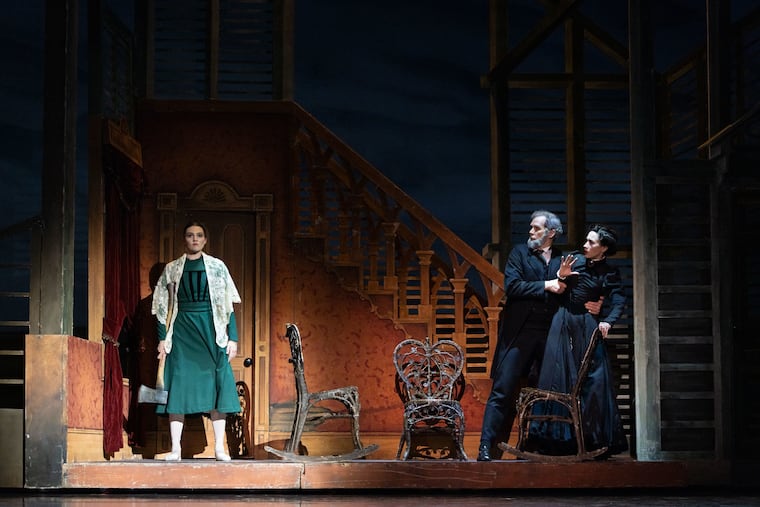
Agnes de Mille’s Fall River Legend, a company premiere, opened the program. It is based on the true story of Lizzie Borden, with some poetic liberty taken to depict the end of Borden’s tale. In 1892, Borden was accused of brutally murdering her father and stepmother in Fall River, Mass.
Sydney Dolan, who plays Borden, has grown up a lot since she joined what was then Pennsylvania Ballet II as a 15-year-old in 2016. Now, she is an exceptional actor as well as a dancer. Her seething at the hands of her oppressive stepmother and useless father, sizzled. The parents (Gabriela Mesa and Charles Askegard) felt it, too, and recoiled the first time Dolan (whose character is simply called The Accused) wielded an ax — to chop some wood.
» READ MORE: The Philadelphia Ballet is letting the ghosts out on stage this spooky season
Lucia Erickson (a soloist) as the child version of The Accused was also excellent, often mirroring Dolan both in dance and emotion. Her costume made her look appropriately young.
Set to the music of Morton Gould (with whom de Mille worked closely when creating the ballet in 1948), Fall River Legend is highly cinematic. The sets and lighting set the mood well, and de Mille’s background (she was from Hollywood and Broadway’s de Mille family) also helped.
Resident choreographer Juliano Nunes got his inspiration of Valley of Death from the classic Giselle, which starts as a love story and winds up in a nightmare. Set to music by Sergei Rachmaninoff and Ralph Vaughan Williams, the world premiere ballet has notes of Sleeping Beauty, too.
One of the three main characters is an uninvited guest who creates havoc at a wealthy couple’s ball.
That uninvited guest was danced by Thays Golz (a first soloist), who brought lots of fierce power and fury into the role. We never quite find out what she has against the host couple (the powerful Zecheng Liang and flowy, refined Jacqueline Callahan, a soloist), but she may have objected to their ostentatious wealth and masked ball. She attacks Liang, dumping him into another kind of ball, with creatures of the night.
» READ MORE: The best Philadelphia dance shows coming to Philadelphia this fall (and winter)
From there, the classical steps take a more contemporary feel. Liang’s dancing involves a lot of writhing, contracting, trying to recover from his near-death experience.
Soon the corps de ballet returns, but this time they are gender-fluid creatures of the night who paw and pull so much that it was somewhat surprising to see Liang still capable of partnering Callahan when she returned to rescue him.
It was fun to see Philadelphia Ballet do something a little different and to celebrate another holiday.
Neither ballet feels like we need to see them every season, but it would be great to have an occasional horror program on the schedule, perhaps with other options as well.
“Philadelphia Ballet: Evening of Horror,” Oct. 17, 7:30 p.m.; Oct. 18, 7:30 p.m.; Oct. 19, 2 p.m. Academy of Music. $20-$271, 215-893-1999 or ensembleartsphilly.org