Philadelphia Ballet’s artistic director didn’t want to rework ‘Romeo and Juliet.’ The company’s resident choreographer has done just that.
Both artistic director Angel Corella and choreographer Juliano Nunes thought that the Kenneth MacMillan version was perfect. But they wanted a version that would be the company's own.
Since he came to Philadelphia Ballet in 2016, artistic director Angel Corella has presented new versions of many full-length ballets. Among the ballets he re-choreographed were Don Quixote, Le Corsaire, and Swan Lake.
But there is one he did not want to change: Romeo and Juliet.
He thought Kenneth MacMillan’s choreography was the ideal version.
On Thursday night, though, Philadelphia Ballet is presenting the world premiere of resident choreographer Juliano Nunes’ Romeo and Juliet at the Academy of Music.
It wasn’t Nunes’ idea. It was Corella’s.
“I still think that Macmillan is pretty much perfection,” Corella said. “But I wanted to create something that would be ours, that would be our signature.”
To make it the company’s own, Nunes decided not to watch other versions of the ballet. He had performed in the MacMillan ballet, but he didn’t look further.
“I find the best-ever version of Romeo and Juliet, it is MacMillan’s," Nunes said. “It’s a masterpiece. It’s sensitive, it’s just pure.”
Instead, he revisited Shakespeare’s play, reading it once through and then leaving that alone, too. The story was already so familiar.
But he listened to the Sergei Prokofiev score every day.
“I think the story lives within the score,” said Nunes, who is from Brazil. “Music is a wild and free space for it to be inspired by.”
Then he and his partner both in life and creative ventures — fashion, costume, and set designer Youssef Hotait — mapped out all the scenes and planned the costumes. (The budget for the costumes and sets was $400,000.)
This is Nunes’ first full-length work.
» READ MORE: 5 dance shows we are excited for this spring
His goal was to create a ballet that matched today’s time. It would be on pointe, classical, and remain true to the story and score. But it would reflect his style that is layered through his training in many styles of dance.
He wanted the audience to be immersed in the story.
“Sometimes when you see something and it feels like two different bodies in conflict, or there is no communication, then [as an audience member], you go ‘I think I have to do laundry.’ I start like, wanting to check my phone.
“My goals were rhythm, expression, raw, pain, silliness, conflict, connection, royalty, arrogance, naivety, being deeply in love, being blinded by love, being dumb enough to be loving in that direction, like the layers of what the story portrays.”
He wanted to keep it real, he wanted strong emotions, and he wanted to keep it moving.
Nunes opted for a two-act ballet rather than three, with the first act ending with Romeo and Juliet’s wedding. Then the tragedy takes hold.
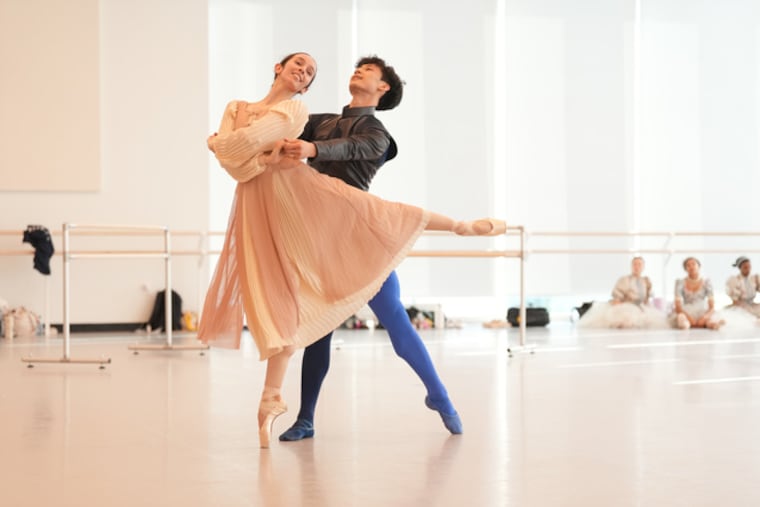
Philadelphia Ballet principal dancers Zecheng Liang (from China) and Thays Golz (from Brazil) are the real-life married couple who will dance the roles of Romeo and Juliet at Thursday’s world premiere.
Both of them have danced the MacMillan version when the company performed it in 2018. Liang was a Romeo in one of the casts. He has also performed three other versions, including the time when, as a very young dancer, he had a small part as the first to die early in the ballet.
Both have also danced several of Nunes’ ballets in Philadelphia.
“The movement feels very free,” Golz said, “and it’s almost like you have no control over movement at all, which is kind of a scary thing to feel. As a classical ballet dancer, you’re always so much in control of your position and how you look. With Juliano, he doesn’t want any of that. He wants to see that your vulnerability, not just physically, but emotionally.
» READ MORE: Philadelphia Ballet’s 2026-27 season brings the fireworks for America’s 250th birthday
“It’s like the classical technique is not as important for him, but he uses it as a base, and he wants it to come from the inside out.”
There has to be a lot of trust and communication in the partnering, Liang said, and it’s helpful that they know each other so well and can also work things out more at home.
“He really used each note of the music, and sometimes [when they rehearsed with the] piano, down to each finger. And I’m like, ‘How many notes are in this whole production?’”
But it works, Liang said. “It really floats the body.”
“It’s not like putting the body in the music,” Golz said. “It’s like the music is making you create that reality.”
Nunes shows them how it should look. In one rehearsal, he stepped in and partnered Golz as Romeo and then later partnered Liang as Juliet, Golz said.
For Nunes, everything needed to feel real. The company brought in specialists to oversee the sword-fighting scenes: Joshua Kachnycz to work on technique and weapon safety and Oliver Donahue on the fight choreography.
Nunes wanted the dancers “to mix the speed and the anger and also being in the moment and not trying to make like a dance fight. It is a real fight.
“I wanted to feel uncomfortable,” he said. “More like a horror movie where you want to look away. It’s about death that happens in a way that’s very aggressive.”
» READ MORE: A first look at Philadelphia Ballet’s impressive new home on North Broad Street
By the end of a week of rehearsal, Golz and Liang need something else to focus their energies on.
After the company’s recent run-through before the Guggenheim Works and Process series in New York, “we were emotionally drained,” Liang said.
“Then we went to puppy yoga on Saturday, because we needed something that was pure happiness and sunshine. That’s how we recovered.”
Philadelphia Ballet in “Romeo and Juliet.” Thursday through May 10. Academy of Music. $29-$290.80. 215-893-1999 or ensembleartsphilly.org