The Philadelphia Orchestra’s chief artistic administrator is leaving after 18 years
Jeremy Rothman has been named president and CEO of the Seattle Symphony. “My job is to be behind the scenes,” said Rothman, who grew up in Abington.
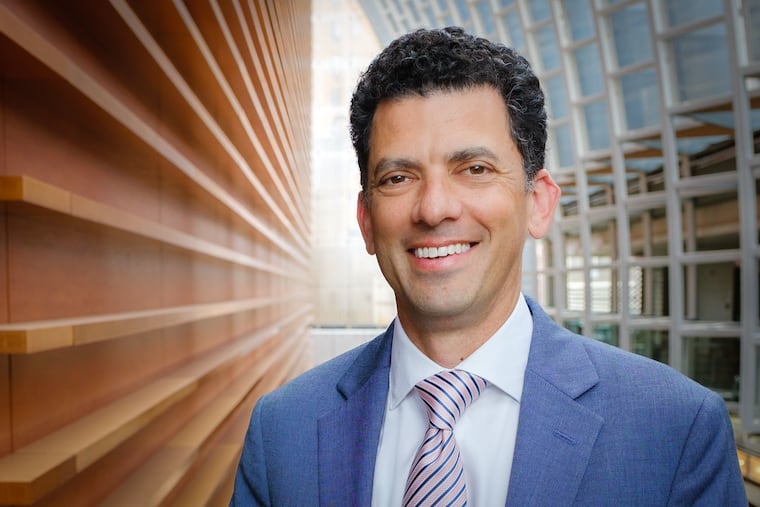
At most orchestras, the artistic authority figure — the person whose face is in brochures and on the sides of buses — is the music director. But deciding what gets performed and who performs it is actually a collaborative process, and one that flows through the artistic administrator, a little-known figure who holds enormous sway.
At the Philadelphia Orchestra, for 18 years, that person has been Jeremy Rothman, and now he’s moving on. Come Sept. 1, Rothman will be president and CEO of the Seattle Symphony and Benaroya Hall, that orchestra announced Wednesday.
Rothman, 49, who found his time here “incredibly stimulating and challenging,” said it had been his ambition to run an orchestra from his earliest days training in the profession.
“It’s been my life’s work and my life’s passion to build really strong performing arts ecosystems and orchestras, and connect orchestras to the community and raise money for them,” said Rothman, “and I saw this as a great opportunity for me personally to take on that work and lead a 21st-century American orchestra in a city that is very forward-thinking, very innovative, and has a strong arts and culture scene.”
The Philadelphia Orchestra and Ensemble Arts won’t seek to immediately replace him.
Programming for next season is set, and “his departure creates a natural moment for us to evaluate the future needs around artistic leadership within the organization, and we will be doing this over the next few months,” said POEA president Ryan Fleur in a statement.
Rothman “helped shape one of the most dynamic and respected artistic eras in our institution’s history,” Fleur said, and his “influence can be seen across nearly every facet of our artistic growth during his tenure.”
It was at his suggestion that the Philadelphia Orchestra played its very first notes by Florence Price — a movement from one of her symphonies.
After the 2019 performance, music and artistic director Yannick Nézet-Séguin told Rothman he liked the music so much he wanted the orchestra to program more of Price’s works. It did, and the ensemble quickly became one of the overlooked composer’s most ardent advocates.
Within a few years, Price’s music had won the Philadelphians their first-ever Grammy for best orchestra performance — and Nézet-Séguin’s first in any category — for a recording of her First and Third symphonies.
Rothman began at the orchestra as vice president for artistic planning in 2008, and with the 2021 merger of the orchestra and its landlord, the Kimmel Center, his job expanded.
Currently chief artistic officer and executive producer of the combined Philadelphia Orchestra and Ensemble Arts, Rothman oversees all of the offerings presented by the organization from Broadway to its Spotlight Series of recitalists.
His fingerprints are everywhere, even if they’re not immediately visible.
“My job is to be behind the scenes,” said Rothman, who grew up in Abington and came back to Philadelphia after working his way up to vice president of artistic administration at the Baltimore Symphony Orchestra.
“If I wanted to be on stage performing, I would have chosen that course, but my passion has been connecting artists to audiences, understanding what artists want to say, what their aspirations and strengths are, what audiences are interested in and what they may not know that they’re interested in. If people are really enjoying the performances and the orchestra sounds great and the artists are comfortable on stage, then I’ve done my job well.”
Not that he’s totally escaped notice. Rothman says he’s occasionally taken cues from listeners — as was the case in Amy Beach’s Gaelic Symphony.
“Every couple of months somebody would mention it to me, and I mentioned it to Yannick at one point, and he was like, ‘Yeah, we should put it on the season.’”
Among the artists with whom he has begun or built relationships are soprano Angel Blue, conductor Fabio Luisi, pianist Yunchan Lim, violinist and conductor Nikolaj Szeps-Znaider, violinist María Dueñas, composer and conductor Joe Hisaishi, and pianist Aaron Diehl.
Asked about his most artistically meaningful experiences, Rothman gave an “it’s-a-long list” answer: much-acclaimed productions of Wagner’s Tristan und Isolde and the Bernstein Mass; concerts with John Williams; the orchestra’s appearance for Pope Francis’s visit to Philadelphia in 2015 for an audience estimated at a million.
He cites the orchestra’s relationship with composer and trumpeter Hannibal Lokumbe and the way “he was really immersed in the city of Philadelphia, performing at Mother Bethel A.M.E. Church, taking musicians to Holmesburg prison.”
The bigger sweep of Rothman’s time in Philadelphia saw the orchestra evolve through a bankruptcy, a music director search, the pandemic, the #MeToo and George Floyd eras, and now this as-yet inconclusive era of social and political turmoil.
He says he’s proud of the orchestra’s diversification of its repertoire, the increase in commissions and BIPOC and women composers on programs, and engaging conductors and soloists of broader backgrounds.
It was part of an arc, Rothman says, that culminated in the rededication of Marian Anderson Hall.
And then there’s this:
“Ultimately it’s also the musicians of the orchestra. Getting to hear that ensemble play every single day, whether in rehearsal or concert, is something that always lifted my spirit and always motivated me to do the absolute best for the art and best for the ensemble.”